


Inhibition of hepatitis B virus by a novel L-nucleoside, beta-L-D4A and related analogues
- PMID: 12918134
- PMCID: PMC4611557
- DOI: 10.3748/wjg.v9.i8.1840
Inhibition of hepatitis B virus by a novel L-nucleoside, beta-L-D4A and related analogues
Abstract
Aim: To explore the inhibition of beta-L-D4A on hepatitis B virus (HBV) in 2.2.15 cells derived from HepG2 cells transfected with HBV genome.
Methods: 2.2.15 cells were plated at a density of 5X10⁴ per well in 12-well tissue culture plates, and treated with various concentrations of beta-L-D4A for 6 days. In the end, 5 microl of medium was used for the estimation of HBsAg and HBeAg, the other medium was processed to obtain virions by a polyethylene glycol precipitation method. At the same time, intracellular DNA was also extracted and digested with HindIII. Both DNAs were subjected to Southern blot, hybridized with a (32)P-labeled HBV probe and autoradiographed. Intensity of the autoradiographic bands was quantitated by densitometric scans of computer and ED(50) was calculated. Then Hybond-N membrane was washed and rehybridized with a (32)P-labeled mtDNA-specific probe, and effect of beta-L-D4A on mitochondrial DNA was studied. 2.2.15 cells were also seeded in 24-well tissue culture plates, and cytotoxicity with different concentrations was examined by MTT method. ID(50) was calculated. Structure-activity relationships between D2A and D4A were also studied as above.
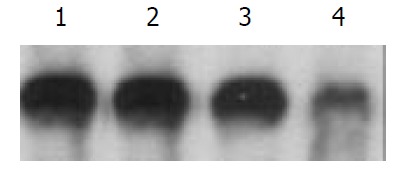
Results: Autoradiographic bands were similar between supernatant and intracellular HBV DNA. Episomal HBV DNA was inhibited in a dose-dependent manner. ED(50) was 0.2 microM. HBsAg or HBeAg was not apparently decreased, and inhibition of mitochondrial DNA was not obvious. The experiment of cytotoxicity gained ID(50) at 200 microM.
Conclusion: beta-L-D4A possesses potent inhibitory effects on the replication of HBV in vitro with little cytotoxicity and mitochondrial toxicity, TI value is 1000. It is expected to be developed as a new clinically anti-HBV drug.
Figures



References
-
- Bridges EG, Cheng YC. Use of novel beta-L(-)-nucleoside analogues for treatment and prevention of chronic hepatitis B virus infection and hepatocellular carcinoma. Prog Liver Dis. 1995;13:231–245. - PubMed
-
- Freiman JS, McCaughan GW. Current limitations to nucleoside analogue therapy for chronic hepatitis B virus infection in the liver transplant and non-transplant settings. J Gastroenterol Hepatol. 2000;15:227–229. - PubMed
-
- Zoulim F. Therapy of chronic hepatitis B virus infection: inhibition of the viral polymerase and other antiviral strategies. Antiviral Res. 1999;44:1–30. - PubMed
Publication types
MeSH terms
Substances
LinkOut - more resources
Full Text Sources
