In vitro and ex vivo effects of a selective nociceptin/orphanin FQ (N/OFQ) peptide receptor antagonist, CompB, on specific binding of [3H]N/OFQ and [35S]GTPgammaS in rat brain and spinal cord
- PMID: 12922933
- PMCID: PMC1573970
- DOI: 10.1038/sj.bjp.0705371
In vitro and ex vivo effects of a selective nociceptin/orphanin FQ (N/OFQ) peptide receptor antagonist, CompB, on specific binding of [3H]N/OFQ and [35S]GTPgammaS in rat brain and spinal cord
Abstract
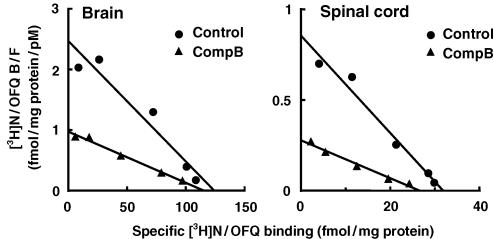
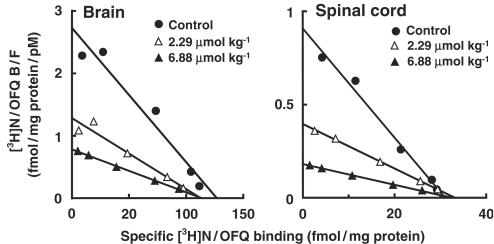
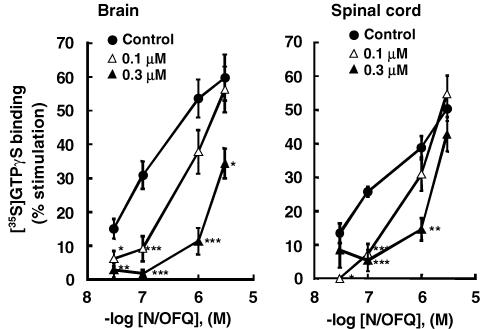
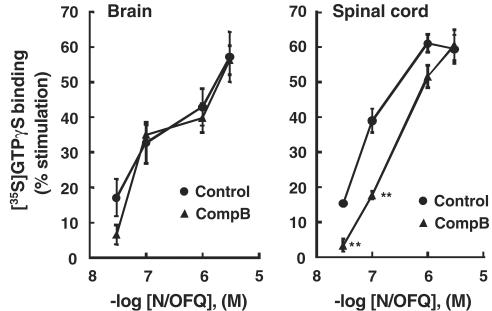
1. A novel selective nociceptin/orphanin FQ (N/OFQ) peptide receptor antagonist, 1-[(3R,4R)-1-cyclooctylmethyl]-3-hydroxymethyl-4-piperidyl)-3-ethyl-1,3-dihydro-2H-benzimidazol-2-one (CompB), inhibited specific binding of [(3)H]N/OFQ to crude membranes from the rat brain and spinal cord in a concentration-dependent manner and their K(i) values were 7.11 and 4.02 nM, respectively. Rosenthal analysis indicated that there was a significant increase in the K(d) value for [(3)H]N/OFQ binding in the brain and spinal cord in the presence of CompB (10 nM). 2. There was a dose-dependent increase in K(d) values for [(3)H]N/OFQ binding in the brain and spinal cord following i.v. injection of CompB at relatively low doses (0.69-6.88 micro mol kg(-1)), compared with the control values. In the spinal cord, enhancement with each dose was constantly greater and the duration of enhancement (6.88 micro mol kg(-1)) was significantly longer. 3. The degree of increase in K(d) values for [(3)H]N/OFQ binding after i.v. injection of CompB (6.88 micro mol kg(-1)) was significantly larger in the lumbar region of the spinal cord compared to other regions. 4. CompB (0.1, 0.3 micro M) shifted the concentration-effect curves of N/OFQ-stimulated [(35)S]GTPgammaS binding in the brain and spinal cord to the right. 5. The i.v. injection of CompB (6.88 micro mol kg(-1)) significantly suppressed the N/OFQ-stimulated [(35)S]GTPgammaS binding in the rat spinal cord and shifted the concentration-effect curve to the right, while it produced little inhibitory effect in the brain. The present study has shown that CompB may exhibit pharmacological effects through a predominant blockade of N/OFQ peptide receptors in the spinal cord under in vivo conditions.
Figures
References
-
- ADAPA I.D., TOLL L. Relationship between binding affinity and functional activity of nociceptin/orphanin FQ. Neuropeptides. 1997;31:403–408. - PubMed
-
- BEAUCHAMP H.T., CHANG R.S.L., SIGEL P.K.S., GIBSON R.E. In vivo receptor occupancy of the angiotensin II receptor by nonpeptide antagonists: Relationship to in vitro affinities and in vivo pharmacologic potency. J. Pharmacol. Exp. Ther. 1995;272:612–618. - PubMed
-
- BENYHE S., MONORY K., FARKAS J., TOTH G., GUERRINI R., SALVADORI S., OROSZ G., WOLLEMANN M., BORSODI A. Nociceptin binding sites in frog (Rana esculenta) brain membranes. Biochem. Biophys. Res. Commun. 1999;260:592–596. - PubMed
-
- BUNZOW J.R., SAEZ C., MORTRUD M., BOUVIER C., WILLIAMS J.T., LOW M., GRANDY DK. Molecular cloning and tissue distribution of a putative member of the rat opioid receptor gene family that is not a mu, delta or kappa opioid receptor type. FEBS Lett. 1994;347:284–288. - PubMed
MeSH terms
Substances
LinkOut - more resources
Full Text Sources