


Action potential changes associated with a slowed inactivation of cardiac voltage-gated sodium channels by KB130015
- PMID: 12922934
- PMCID: PMC1573977
- DOI: 10.1038/sj.bjp.0705379
Action potential changes associated with a slowed inactivation of cardiac voltage-gated sodium channels by KB130015
Abstract
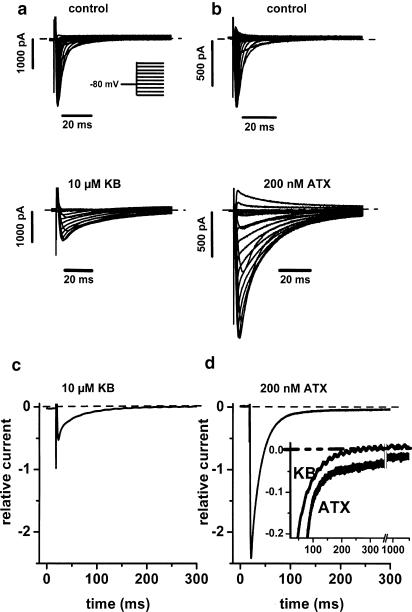
1. We have studied the acute cardiac electrophysiological effects of KB130015 (KB), a drug structurally related to amiodarone. Membrane currents and action potentials were measured at room temperature or at 37 degrees C during whole-cell patch-clamp recording in ventricular myocytes. Action potentials were also measured at 37 degrees C in multicellular ventricular preparations. 2. The effects of KB were compared with those of anemone toxin II (ATX-II). Both KB and ATX-II slowed the inactivation of the voltage-gated Na(+) current (I(Na)). While KB shifted the steady-state voltage-dependent inactivation to more negative potentials, ATX-II shifted it to more positive potentials. In addition, while inactivation proceeded to completion with KB, a noninactivating current was induced by ATX-II. 3. KB had no effect on I(K1) but decreased I(Ca-L) The drug also did not change I(to) in mouse myocytes. 4. The action potential duration (APD) in pig myocytes or multicellular preparations was not prolonged but often shortened by KB, while marked APD prolongation was obtained with ATX-II. Short APDs in mouse were markedly prolonged by KB, which frequently induced early afterdepolarizations. 5. A computer simulation confirmed that long action potentials with high plateau are relatively less sensitive to a mere slowing of I(Na) inactivation, not associated with a persisting, noninactivating current. In contrast, simulated short action potentials with marked phase-1 repolarization were markedly modified by slowing I(Na) inactivation. 6 It is suggested that a prolongation of short action potentials by drugs or mutations that only slow I(Na) inactivation does not necessarily imply identical changes in other species or in different myocardial regions.
Figures


References
-
- AMOS G.J., RAVENS U. The inotropic agents DPI 201-106 and BDF 9148 differentially affect potassium currents of guinea-pig ventricular myocytes. Naunyn Schmiedebergs Arch. Pharmacol. 1994;350:426–433. - PubMed
-
- BALSER J.R. The cardiac sodium channel: gating function and molecular pharmacology. J. Mol. Cell. Cardiol. 2001;33:599–613. - PubMed
-
- BENNETT P.B. Long QT syndrome: biophysical and pharmacologic mechanisms in LQT3. J. Cardiovasc. Electrophysiol. 2000;11:819–822. - PubMed
-
- BEZZINA C.R., ROOK M.B., WILDE A.A. Cardiac sodium channel and inherited arrhythmia syndromes. Cardiovasc. Res. 2001;49:257–271. - PubMed
-
- BOUTJDIR M., RESTIVO M., WEI Y., STERGIOPOULOS K., EL-SHERIF N. Early afterdepolarization formation in cardiac myocytes: analysis of phase plane patterns, action potential, and membrane currents. J. Cardiovasc. Electrophysiol. 1994;5:609–620. - PubMed
Publication types
MeSH terms
Substances
LinkOut - more resources
Full Text Sources
Other Literature Sources
