


Composition, acquisition, and distribution of the Vi exopolysaccharide-encoding Salmonella enterica pathogenicity island SPI-7
- PMID: 12923078
- PMCID: PMC180996
- DOI: 10.1128/JB.185.17.5055-5065.2003
Composition, acquisition, and distribution of the Vi exopolysaccharide-encoding Salmonella enterica pathogenicity island SPI-7
Abstract
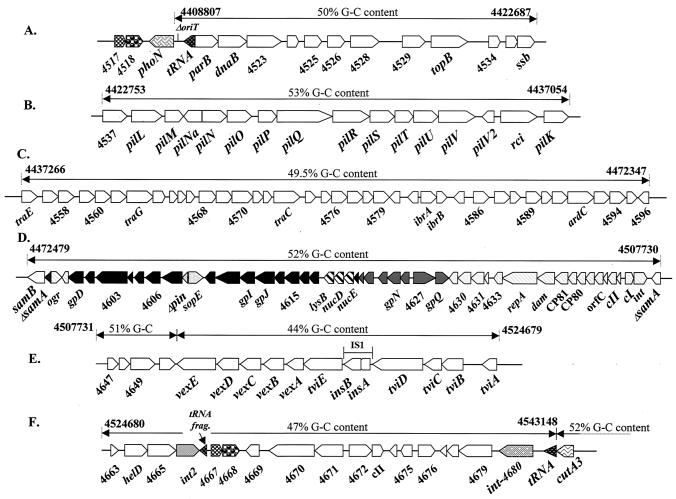
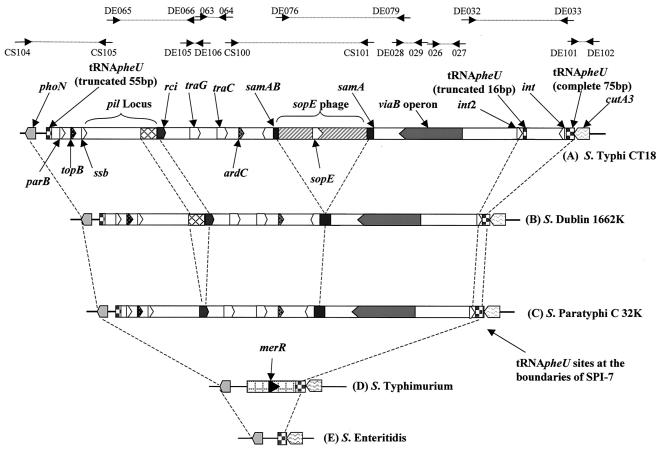
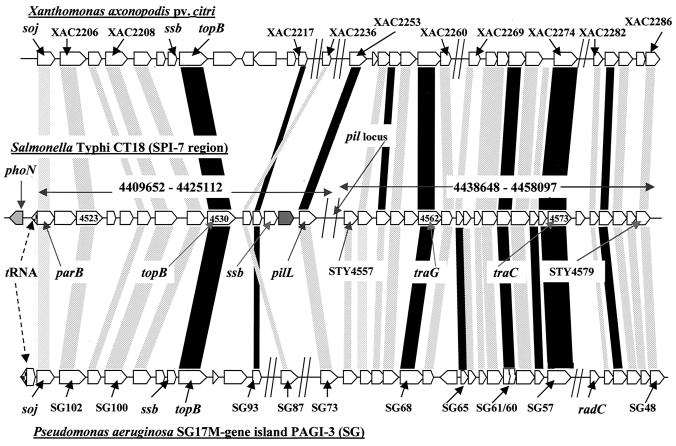
Vi capsular polysaccharide production is encoded by the viaB locus, which has a limited distribution in Salmonella enterica serovars. In S. enterica serovar Typhi, viaB is encoded on a 134-kb pathogenicity island known as SPI-7 that is located between partially duplicated tRNA(pheU) sites. Functional and bioinformatic analysis suggests that SPI-7 has a mosaic structure and may have evolved as a consequence of several independent insertion events. Analysis of viaB-associated DNA in Vi-positive S. enterica serovar Paratyphi C and S. enterica serovar Dublin isolates revealed the presence of similar SPI-7 islands. In S. enterica serovars Paratyphi C and Dublin, the SopE bacteriophage and a 15-kb fragment adjacent to the intact tRNA(pheU) site were absent. In S. enterica serovar Paratyphi C only, a region encoding a type IV pilus involved in the adherence of S. enterica serovar Typhi to host cells was missing. The remainder of the SPI-7 islands investigated exhibited over 99% DNA sequence identity in the three serovars. Of 30 other Salmonella serovars examined, 24 contained no insertions at the equivalent tRNA(pheU) site, 2 had a 3.7-kb insertion, and 4 showed sequence variation at the tRNA(pheU)-phoN junction, which was not analyzed further. Sequence analysis of the SPI-7 region from S. enterica serovar Typhi strain CT18 revealed significant synteny with clusters of genes from a variety of saprophytic bacteria and phytobacteria, including Pseudomonas aeruginosa and Xanthomonas axonopodis pv. citri. This analysis suggested that SPI-7 may be a mobile element, such as a conjugative transposon or an integrated plasmid remnant.
Figures
References
-
- Altschul, S. F., W. Gish, W. Miller, E. W. Myers, and D. J. Lipman. 1990. Basic local alignment search tool. J. Mol. Biol. 215:403-410. - PubMed
-
- Arricau, N., D. Hermant, H. Waxin, C. Ecobichon, P. S. Duffey, and M. Y. Popoff. 1998. The RcsB-RcsC regulatory system of Salmonella typhi differentially modulates the expression of invasion proteins, flagellin and Vi antigen in response to osmolarity. Mol. Microbiol. 29:835-850. - PubMed
-
- Ausubel, F. B. R., R. E. Kingston, D. D. Moore, J. G. Seidman, J. A. Smith, and K. Struhl. 1987. Current protocols in molecular biology, p. 112-116. Wiley, New York, N.Y.
-
- Belogurov, A. A., E. P. Delver, O. V. Agafonova, N. G. Belogurova, L. Y. Lee, and C. I. Kado. 2000. Antirestriction protein Ard (type C) encoded by IncW plasmid pSa has a high similarity to the “protein transport” domain of TraC1 primase of promiscuous plasmid RP4. J. Mol. Biol. 296:969-977. - PubMed
Publication types
MeSH terms
Substances
Associated data
- Actions
Grants and funding
LinkOut - more resources
Full Text Sources
Molecular Biology Databases
