. 2003 Sep;9(9):1073-83.
doi: 10.1261/rna.5880403.

Mitochondrial RNase P RNAs in ascomycete fungi: lineage-specific variations in RNA secondary structure

Affiliations

Mitochondrial RNase P RNAs in ascomycete fungi: lineage-specific variations in RNA secondary structure

Elias R Seif et al. RNA. 2003 Sep.

Abstract

The RNA subunit of mitochondrial RNase P (mtP-RNA) is encoded by a mitochondrial gene (rnpB) in several ascomycete fungi and in the protists Reclinomonas americana and Nephroselmis olivacea. By searching for universally conserved structural elements, we have identified previously unknown rnpB genes in the mitochondrial DNAs (mtDNAs) of two fission yeasts, Schizosaccharomyces pombe and Schizosaccharomyces octosporus; in the budding yeast Pichia canadensis; and in the archiascomycete Taphrina deformans. The expression of mtP-RNAs of the predicted size was experimentally confirmed in the two fission yeasts, and their precise 5' and 3' ends were determined by sequencing of cDNAs generated from circularized mtP-RNAs. Comparative RNA secondary structure modeling shows that in contrast to mtP-RNAs of the two protists R. americana and N. olivacea, those of ascomycete fungi all have highly reduced secondary structures. In certain budding yeasts, such as Saccharomycopsis fibuligera, we find only the two most conserved pairings, P1 and P4. A P18 pairing is conserved in Saccharomyces cerevisiae and its close relatives, whereas nearly half of the minimum bacterial consensus structure is retained in the RNAs of fission yeasts, Aspergillus nidulans and Taphrina deformans. The evolutionary implications of the reduction of mtP-RNA structures in ascomycetes will be discussed.


Figures
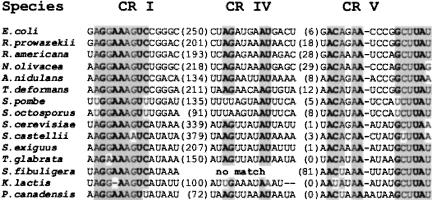
FIGURE 1.
FIGURE 1.
Alignment of the universally conserved regions (CRs) I, IV, and V. CRs of the universally conserved nucleotides are in bold, following the analysis by Chen and Pace 1997. Shaded nucleotides are conserved at >75%, in E. coli, R. prowazekii, and mitochondrial P-RNAs. The numbers between brackets indicate the number of nucleotides that separate the conserved regions.
FIGURE 2.
FIGURE 2.
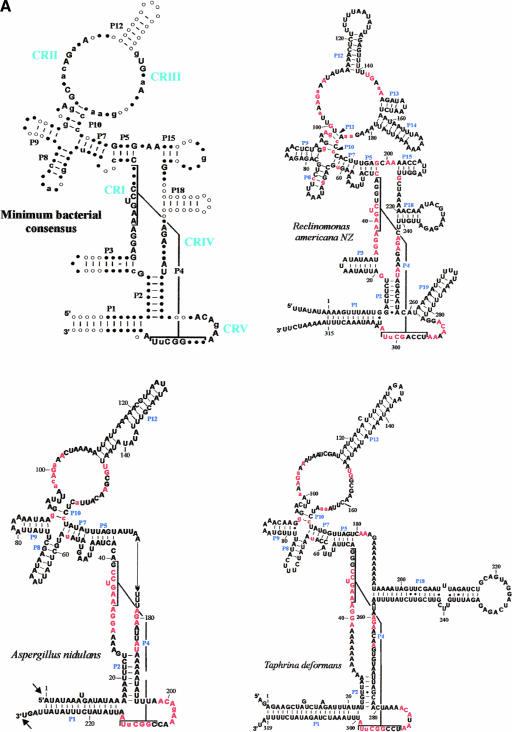
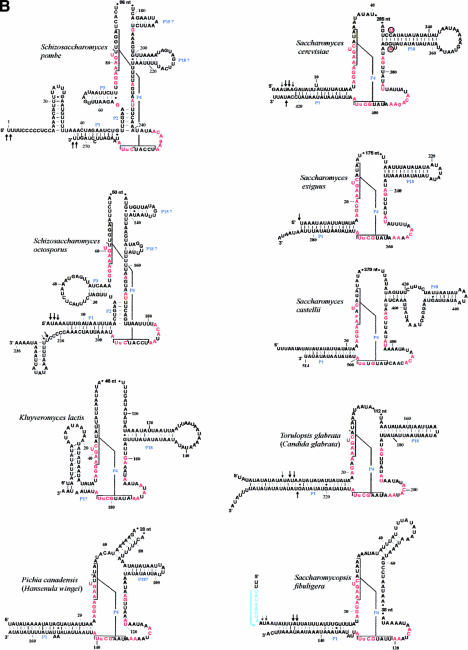
Minimum bacterial P-RNA consensus and mtP-RNA secondary structure models of R. americana and ascomycete fungi. (A) Positions in red are invariant in the minimum bacterial consensus; uppercase letters in the mtP-RNAs indicate 100%, lowercase letters at least 90%, conservation of the minimum bacterial consensus sequence. The conserved motifs CRI through CRV are indicated in blue. The arrows indicate experimentally determined RNA extremities; arrow thickness is proportional to the percentage of molecules ending at this position. (B) mtP-RNA secondary structures from nine additional ascomycetes. In the S. cerevisiae structure, nucleotides that co-vary with the Saccharomyces douglasii sequence are in red circled letters. A putative promoter in S. fibuligera is highlighted in blue. Asterisks next to nucleotides in the P4 of S. pombe, S. octosporus, C. glabrata, and P. canadensis indicate mispairs in these helices. Note that the Candida structure P1 helix can be further extended by 9 to 12 bp from its mature ends. It is possible that the noncanonical A–G pair adjacent to the RNA processing sites in this mtP-RNA serves as a signal for RNA maturation.
FIGURE 2.
FIGURE 2.
Minimum bacterial P-RNA consensus and mtP-RNA secondary structure models of R. americana and ascomycete fungi. (A) Positions in red are invariant in the minimum bacterial consensus; uppercase letters in the mtP-RNAs indicate 100%, lowercase letters at least 90%, conservation of the minimum bacterial consensus sequence. The conserved motifs CRI through CRV are indicated in blue. The arrows indicate experimentally determined RNA extremities; arrow thickness is proportional to the percentage of molecules ending at this position. (B) mtP-RNA secondary structures from nine additional ascomycetes. In the S. cerevisiae structure, nucleotides that co-vary with the Saccharomyces douglasii sequence are in red circled letters. A putative promoter in S. fibuligera is highlighted in blue. Asterisks next to nucleotides in the P4 of S. pombe, S. octosporus, C. glabrata, and P. canadensis indicate mispairs in these helices. Note that the Candida structure P1 helix can be further extended by 9 to 12 bp from its mature ends. It is possible that the noncanonical A–G pair adjacent to the RNA processing sites in this mtP-RNA serves as a signal for RNA maturation.
FIGURE 3.
FIGURE 3.
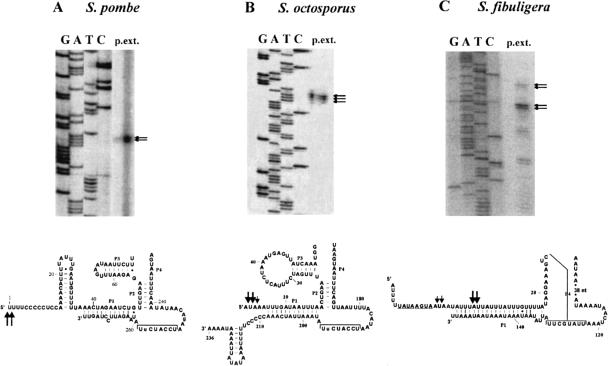
RNA mapping of S. pombe, S. octosporus, and S. fibuligera mtP-RNAs. (A) S. pombe primer extension experiment. The bottom part of the figure shows the partial, corresponding region of the mtP-RNA structure. The main bands are consistent with sequencing of RT-PCR product of in vitro circularized P-RNA. The thickness of the arrows is proportional to the proportion of RNA extremities of the RT-PCR experiment. (B) S. octosporus primer extension experiment. The main bands are consistent with sequencing of RT-PCR product of in vitro circularized P-RNA. The thickness of the arrows is proportional to the proportion of RNA extremities of the RT-PCR experiment. (C) Primer extension for S. fibuligera mtP-RNA. The weak upper signal matches the transcription initiation site at the potential promoter sequence (underlined). The strongest signal corresponds to the mature end of the mtP-RNA.

References

    1. Altman, S., Wesolowski, D., and Puranam, P.S. 1993. Nucleotide sequences of the RNA subunit of RNase P from several mammals. Genomics 18: 418–422. - PubMed
    1. Arends, S. and Schön, A. 1997. Partial purification and characterization of nuclear ribonuclease P from wheat. Eur. J. Biochem. 244: 635–645. - PubMed
    1. Baum, M., Cordier, A., and Schön, A. 1996. RNase P from a photosynthetic organelle contains an RNA homologous to the cyanobacterial counterpart. J. Mol. Biol. 257: 43–52. - PubMed
    1. Biswas, T.K. 1996. Expression of the mitochondrial RNase P RNA subunit-encoding gene from a variant promoter sequence in Saccharomyces cerevisiae. Gene 170: 23–30. - PubMed
    1. Brown, J.W. 1999. The Ribonuclease P Database. Nucleic Acids Res. 27: 314. - PMC - PubMed

Publication types

LinkOut - more resources