Novel "anti-reverse" cap analogs with superior translational properties
- PMID: 12923259
- PMCID: PMC1370475
- DOI: 10.1261/rna.5430403
Novel "anti-reverse" cap analogs with superior translational properties
Abstract
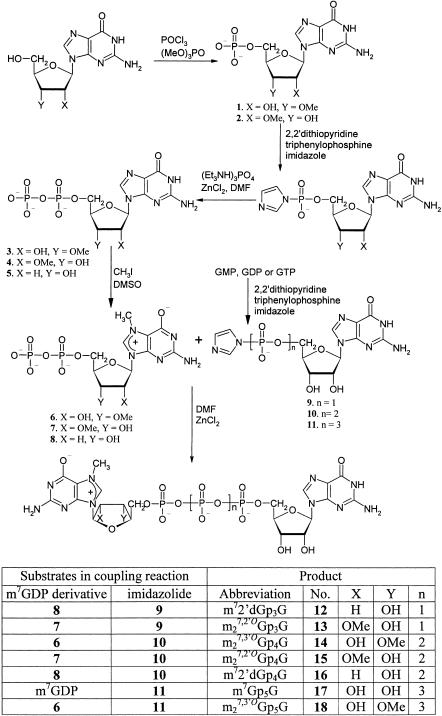
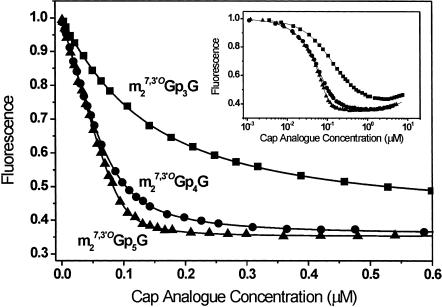
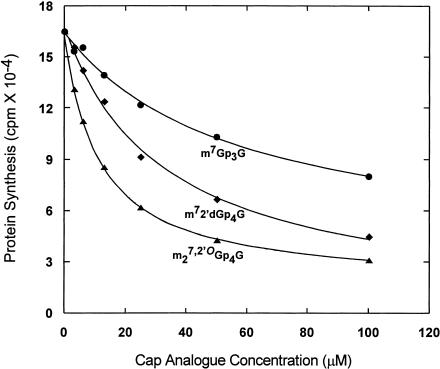
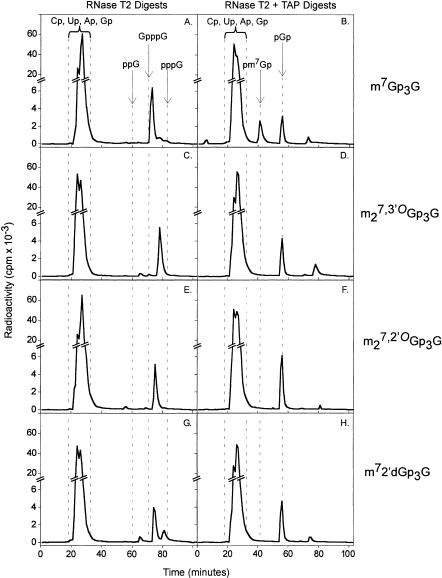
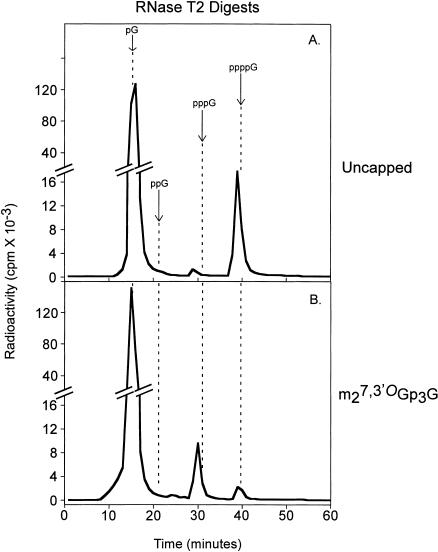
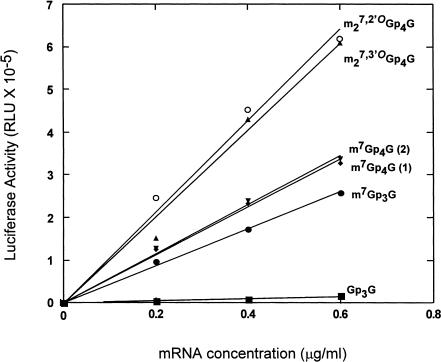
Synthetic analogs of the 5'-terminal caps of eukaryotic mRNAs and snRNAs are used in elucidating such physiological processes as mRNA translation, pre-mRNA splicing, intracellular transport of mRNA and snRNAs, and mRNA turnover. Particularly useful are RNAs capped with synthetic analogs, which are produced by in vitro transcription of a DNA template using a bacteriophage RNA polymerase in the presence of ribonucleoside triphosphates and a cap dinucleotide such as m(7)Gp(3)G. Unfortunately, because of the presence of a 3'-OH on both the m(7)Guo and Guo moieties, up to half of the mRNAs contain caps incorporated in the reverse orientation. Previously we designed and synthesized two "anti-reverse" cap analogs (ARCAs), m(7)3'dGp(3)G and m(2)(7,3'-)(O)Gp(3)G, that cannot be incorporated in the reverse orientation because of modifications at the C3' position of m(7)Guo. In the present study, we have synthesized seven new cap analogs modified in the C2' and C3' positions of m(7)Guo and in the number of phosphate residues, m(2)(7,2'-)(O)Gp(3)G, m(7)2'dGp(3)G, m(7)2'dGp(4)G, m(2)(7,2'-)(O)Gp(4)G, m(2)(7,3'-)(O)Gp(4)G, m(7)Gp(5)G, and m(2)(7,3'-)(O)Gp(5)G. These were analyzed for conformation in solution, binding affinity to eIF4E, inhibition of in vitro translation, degree of reverse capping during in vitro transcription, capping efficiency, and the ability to stimulate cap-dependent translation in vitro when incorporated into mRNA. The results indicate that modifications at C2', like those at C3', prevent reverse incorporation, that tetra- and pentaphosphate cap analogs bind eIF4E and inhibit translation more strongly than their triphosphate counterparts, and that tetraphosphate ARCAs promote cap-dependent translation more effectively than previous cap analogs.
Figures
References
-
- Adams, B.L., Morgan, M., Muthukrishnan, S., Hecht, S.M., and Shatkin, A.J. 1978. The effect of “cap” analogs on reovirus mRNA binding to wheat germ ribosomes. J. Biol. Chem. 253: 2589–2595. - PubMed
-
- Beelman, C.A., Stevens, A., Caponigro, G., LaGrandeur, T.E., Hatfield, L., Fortner, D.M., and Parker, R. 1998. An essential component of the decapping enzyme required for normal rates of mRNA turnover. Nature 382: 642–646. - PubMed
-
- Blaedel, W.J. and Meloche, V.W. 1963. Elementary quantitative analysis: Theory and practice, p. 640. Harper & Row, New York.
-
- Cai, A., Jankowska-Anyszka, M., Centers, A., Chlebicka, L., Stepinski, J., Stolarski, R., Darzynkiewicz, E., and Rhoads, R.E. 1999. Quantitative assessment of mRNA cap analogs as inhibitors of in vitro translation. Biochemistry 38: 8538–8547. - PubMed
-
- Calero, G., Wilson, K.F., Ly, T., Rios-Steiner, J.L., Clardy, J.C., and Cerione, R.A. 2002. Structural basis of m7GpppG binding to the nuclear cap-binding protein complex. Nat. Struct. Biol. 9: 912–917. - PubMed
Publication types
MeSH terms
Substances
Grants and funding
LinkOut - more resources
Full Text Sources
Other Literature Sources
Miscellaneous