


Review
doi: 10.1172/JCI19547.
Therapeutic potential of antisense oligonucleotides as modulators of alternative splicing
Affiliations
- PMID: 12925686
- PMCID: PMC171400
- DOI: 10.1172/JCI19547
Item in Clipboard
Review
Therapeutic potential of antisense oligonucleotides as modulators of alternative splicing
J Clin Invest.
2003 Aug.
Abstract
An estimated 60% of all human genes undergo alternative splicing, a highly regulated process that produces splice variants with different functions. Such variants have been linked to a variety of cancers, and genetic diseases such as thalassemia and cystic fibrosis. This Perspective describes a promising approach to RNA repair based on the use of antisense oligonucleotides to modulate alternative splicing and engender the production of therapeutic gene products.
Figures
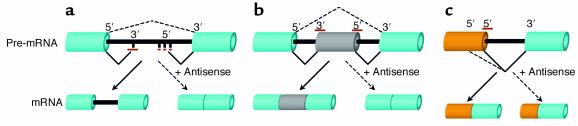
Modification of splicing by antisense oligonucleotides. Aberrant splicing in thalassemic β-globin pre-mRNA or in certain splice mutants in CFTR is prevented, and correct splicing is restored, by oligonucleotides (dark red bars) that block aberrant 5′ or 3′ cryptic splice sites (a). Similarly, oligonucleotides induce skipping of a normal exon (gray) (b) or force selection of an alternative 5′ splice site (c) by antisense oligonucleotides targeted to appropriate splice sites.
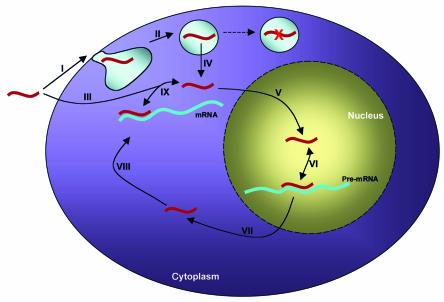
Site of action of antisense oligonucleotide. (I) From the extracellular space, an oligonucleotide or oligonucleotide/cationic lipid complex interacts with the cell surface, presumably through receptor-ligand binding. (II) The oligonucleotide then undergoes endocytosis and is thus sequestered from the rest of the cytoplasm. Alternatively (III) an oligonucleotide conjugated to cell-penetrating peptide fragments may enter the cell via a nonendocytotic mechanism. (IV) Escape from the endosome is facilitated by the cationic lipid. Oligonucleotides that do not escape are degraded in the lysosome (dashed arrow). (V) Once free in the cytoplasm, the oligonucleotide can passively diffuse into the nucleus, where (VI) hybridization to the pre-mRNA target can take place. (VII) Export from the nucleus is energy dependent and involves interactions of the oligonucleotide with nuclear export factors, such as the nuclear pore complex. (VIII) The biologically active oligonucleotide can then bind cytoplasmic mRNA. (IX) The oligonucleotide can also dissociate from the mRNA target and recycle.
References
-
- Crooke, S.T. 2001. Antisense drug technology: principles, strategies and applications. Marcel Dekker Inc. New York, New York, USA. 916 pp.
-
- Mercatante D, Sazani P, Kole R. Modification of alternative splicing pathways as a potential chemotherapy for cancer and other diseases. Curr. Cancer Drug Targets. 2001;1:211–230. - PubMed
-
- Schwartz, E., Benz, Jr., E.J., and Forget, B.G. 2000. Thalassemia syndromes. In Hemalotogy: basic principles and practice. 3rd edition. R. Hoffman, et al., editors. Churchill Livingstone. New York, New York, USA. 485–510.
-
- Suwanmanee T, et al. Restoration of human beta-globin gene expression in murine and human IVS2-654 thalassemic erythroid cells by free uptake of antisense oligonucleotides. Mol. Pharmacol. 2002;62:545–553. - PubMed
Publication types
MeSH terms
Substances
Grants and funding
LinkOut - more resources
Full Text Sources
Other Literature Sources
Research Materials
Miscellaneous
