


Conservation of the prion properties of Ure2p through evolution
- PMID: 12925776
- PMCID: PMC181580
- DOI: 10.1091/mbc.e03-01-0007
Conservation of the prion properties of Ure2p through evolution
Abstract
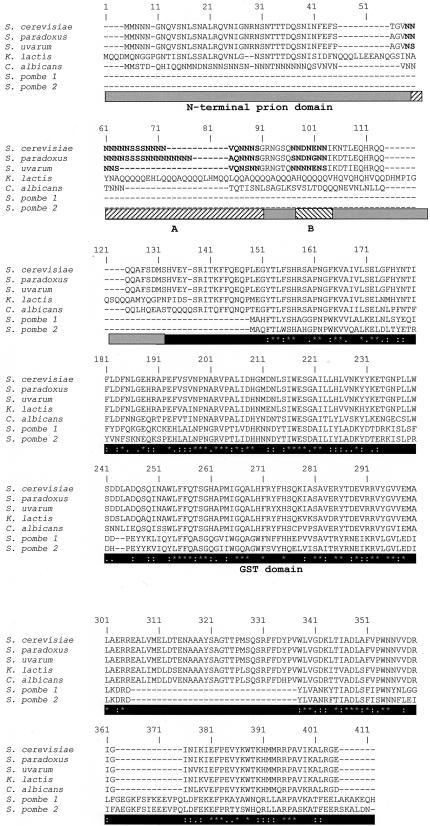
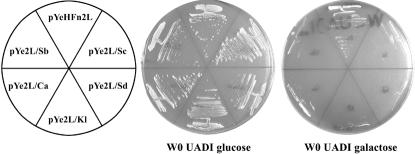
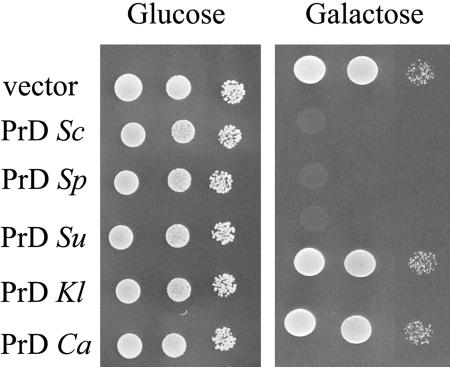
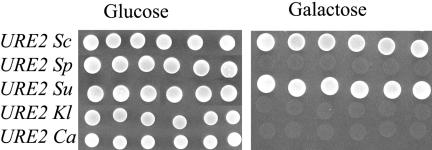
The yeast inheritable [URE3] element corresponds to a prion form of the nitrogen catabolism regulator Ure2p. We have isolated several orthologous URE2 genes in different yeast species: Saccharomyces paradoxus, S. uvarum, Kluyveromyces lactis, Candida albicans, and Schizosaccharomyces pombe. We show here by in silico analysis that the GST-like functional domain and the prion domain of the Ure2 proteins have diverged separately, the functional domain being more conserved through the evolution. The more extreme situation is found in the two S. pombe genes, in which the prion domain is absent. The functional analysis demonstrates that all the homologous genes except for the two S. pombe genes are able to complement the URE2 gene deletion in a S. cerevisiae strain. We show that in the two most closely related yeast species to S. cerevisiae, i.e., S. paradoxus and S. uvarum, the prion domains of the proteins have retained the capability to induce [URE3] in a S. cerevisiae strain. However, only the S. uvarum full-length Ure2p is able to behave as a prion. We also show that the prion inactivation mechanisms can be cross-transmitted between the S. cerevisiae and S. uvarum prions.
Figures
References
-
- Aigle, M., and Lacroute, F. (1975). Genetical aspects of [URE3], a non-mitochondrial, cytoplasmically inherited mutation in yeast. Mol. Gen. Genet. 136, 327–335. - PubMed
-
- Bousset, L., Belrhali, H., Janin, J., Melki, R., and Morera, S. (2001). Structure of the globular region of the prion protein Ure2 from the yeast Saccharomyces cerevisiae. Structure 9, 39–46. - PubMed
-
- Bucciantini, M. et al. (2002). Inherent toxicity of aggregates implies a common mechanism for protein misfolding diseases. Nature 416, 507–511. - PubMed
-
- Chernoff, Y.O., Lindquist, S.L., Ono, B., Inge, V.S., and Liebman, S.W. (1995). Role of the chaperone protein Hsp104 in propagation of the yeast prion-like factor [psi+]. Science 268, 880–884. - PubMed
Publication types
MeSH terms
Substances
LinkOut - more resources
Full Text Sources
Molecular Biology Databases
Research Materials
