


Mammographic density is related to stroma and stromal proteoglycan expression
- PMID: 12927043
- PMCID: PMC314426
- DOI: 10.1186/bcr622
Mammographic density is related to stroma and stromal proteoglycan expression
Abstract
Background: Mammographic density and certain histological changes in breast tissues are both risk factors for breast cancer. However, the relationship between these factors remains uncertain. Previous studies have focused on the histology of the epithelial changes, even though breast stroma is the major tissue compartment by volume. We have previously identified lumican and decorin as abundant small leucine-rich proteoglycans in breast stroma that show altered expression after breast tumorigenesis. In this study we have examined breast biopsies for a relationship between mammographic density and stromal alterations.
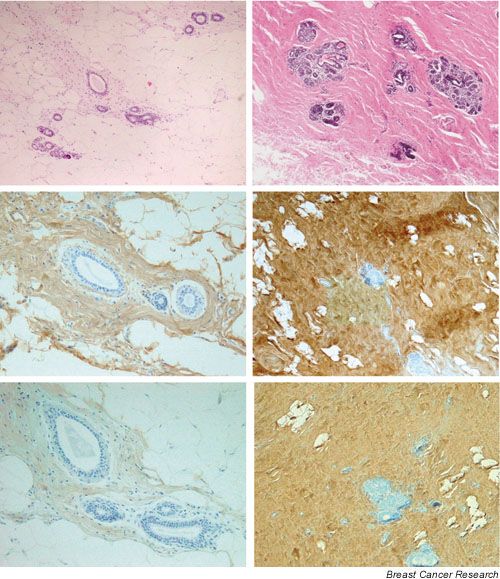
Methods: We reviewed mammograms from women aged 50-69 years who had enrolled in a provincial mammography screening program and had undergone an excision biopsy for an abnormality that was subsequently diagnosed as benign or pre-invasive breast disease. The overall mammographic density was classified into density categories. All biopsy tissue sections were reviewed and tissue blocks from excision margins distant from the diagnostic lesion were selected. Histological composition was assessed in sections stained with haematoxylin and eosin, and the expression of lumican and decorin was assessed by immunohistochemistry; both were quantified by semi-quantitative scoring.
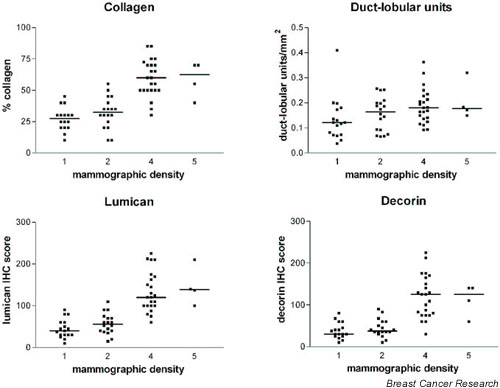
Results: Tissue sections corresponding to regions of high in comparison with low mammographic density showed no significant difference in the density of ductal and lobular units but showed significantly higher collagen density and extent of fibrosis. Similarly, the expression of lumican and decorin was significantly increased.
Conclusion: Alteration in stromal composition is correlated with increased mammographic density. Although epithelial changes define the eventual pathway for breast cancer development, mammographic density might correspond more directly to alterations in stromal composition.
Figures
Comment in
-
Can the stroma provide the clue to the cellular basis for mammographic density?Breast Cancer Res. 2003;5(5):225-7. doi: 10.1186/bcr642. Epub 2003 Jul 23. Breast Cancer Res. 2003. PMID: 12927028 Free PMC article. Review.
References
-
- Ernster VL, Barclay J. Increases in ductal carcinoma in situ (DCIS) of the breast in relation to mammography: a dilemma. J Natl Cancer Inst Monogr. 1997;22:151–156. - PubMed
-
- King MC, Wieand S, Hale K, Lee M, Walsh T, Owens K, Tait J, Ford L, Dunn BK, Costantino J, Wickerham L, Wolmark N, Fisher B. Tamoxifen and breast cancer incidence among women with inherited mutations in BRCA1 and BRCA2: National Surgical Adjuvant Breast and Bowel Project (NSABP-P1) Breast Cancer Prevention Trial. JAMA. 2001;286:2251–2256. doi: 10.1001/jama.286.18.2251. - DOI - PubMed
-
- Dupont WD, Page DL. Risk factors for breast cancer in women with proliferative breast disease. N Engl J Med. 1985;312:146–151. - PubMed
-
- Allred DC, Mohsin SK, Fuqua SA. Histological and biological evolution of human premalignant breast disease. Endocr Relat Cancer. 2001;8:47–61. - PubMed
-
- Boyd NF, Martin LJ, Stone J, Greenberg C, Minkin S, Yaffe MJ. Mammographic densities as a marker of human breast cancer risk and their use in chemoprevention. Curr Oncol Rep. 2001;3:314–321. - PubMed
Publication types
MeSH terms
Substances
LinkOut - more resources
Full Text Sources
Other Literature Sources
Medical
Miscellaneous
