


In vitro co-stimulation with anti-CD28 synergizes with IL-12 in the generation of T cell immune responses to leukaemic cells; a strategy for ex-vivo generation of CTL for immunotherapy
- PMID: 12930376
- PMCID: PMC1808782
- DOI: 10.1046/j.1365-2249.2003.02235.x
In vitro co-stimulation with anti-CD28 synergizes with IL-12 in the generation of T cell immune responses to leukaemic cells; a strategy for ex-vivo generation of CTL for immunotherapy
Abstract
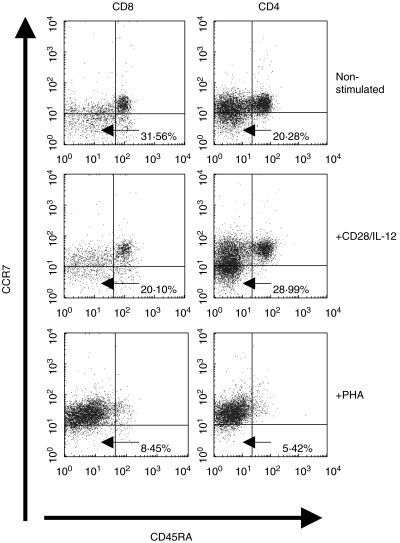
The existence of an immune based graft-versus-leukaemia (GvL) effect highlighted the prospect of managing relapsed leukaemias with T cell-based adoptive immunotherapy. Thus, various strategies have been explored for the in vitro expansion of acute myeloid leukaemia (AML)-specific T cells. In a popular approach, AML blasts have been genetically modified to express co-stimulatory molecules essential for effective T cell priming. One such tactic has been the modification of AML cells to express the B7/CD80 co-stimulatory molecule that binds to CD28 on T cells initiating events that culminate in enhanced cytokine production, proliferation and development of effector functions by T cells. The success of these strategies has been limited by difficulties in attaining sufficient transduction efficiencies and associated high levels of CD80 expression. We demonstrate that these problems can be circumvented by using anti-CD28 monoclonal antibody. Furthermore, we show that the synergistic relationship between CD80/CD28 pathway and interleukin 12 cytokine (IL-12), documented in the generation of cytotoxic T lymphocytes (CTL) for solid tumours, also applies to AML. CD28/IL-12 synergy facilitated the proliferation of allogeneic T cells in response to stimulation with primary AML blasts. The synergy also favoured generation of a Th1-type immune response, evidenced by gamma interferon (IFN-gamma) secretion and facilitated naive and memory T cell proliferation. Unlike some methods of in vitro T cell expansion, use of CD28/IL-12 synergy left T cells in the physiologically appropriate CD45RA-/CCR7- subsets known to be associated with immediate cytotoxic functions.
Figures
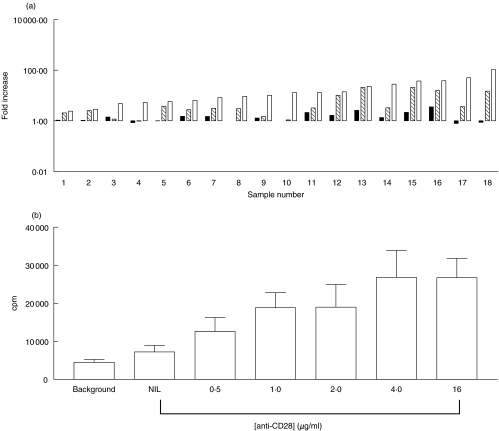
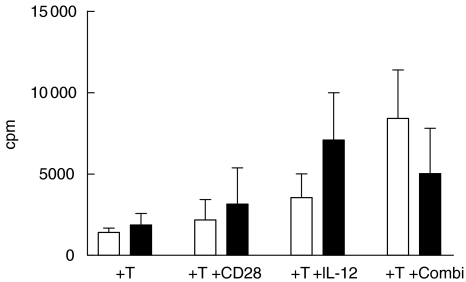
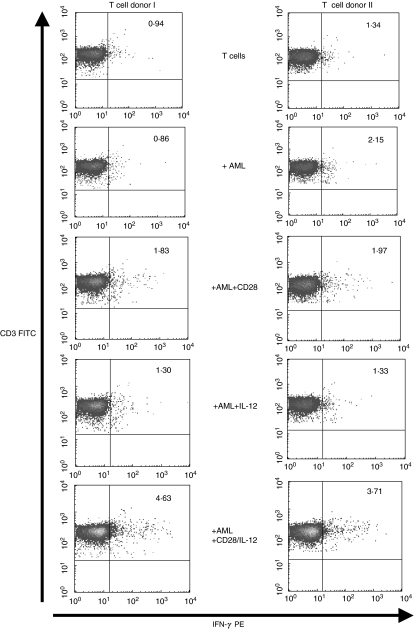
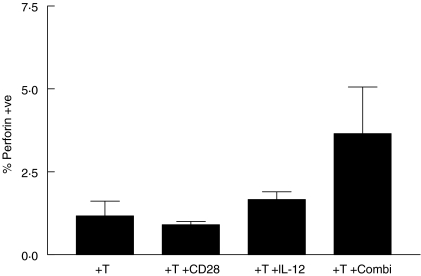
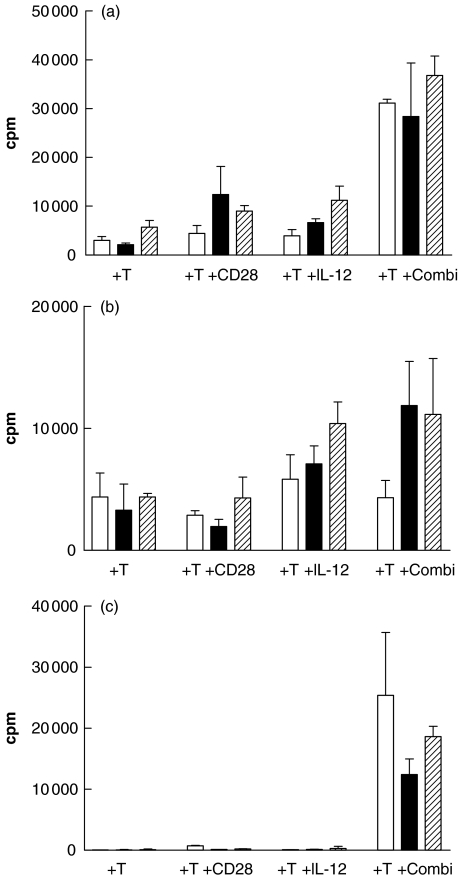
 , IL-12 cytokine (▪) or anti-CD28 in combination with IL-12 cytokine (□). Fold increase was calculated relative to the proliferation of T cells stimulated with AML blasts alone. (b) The effect of anti-CD28 on allogeneic T cell response to AML blasts plus IL-12.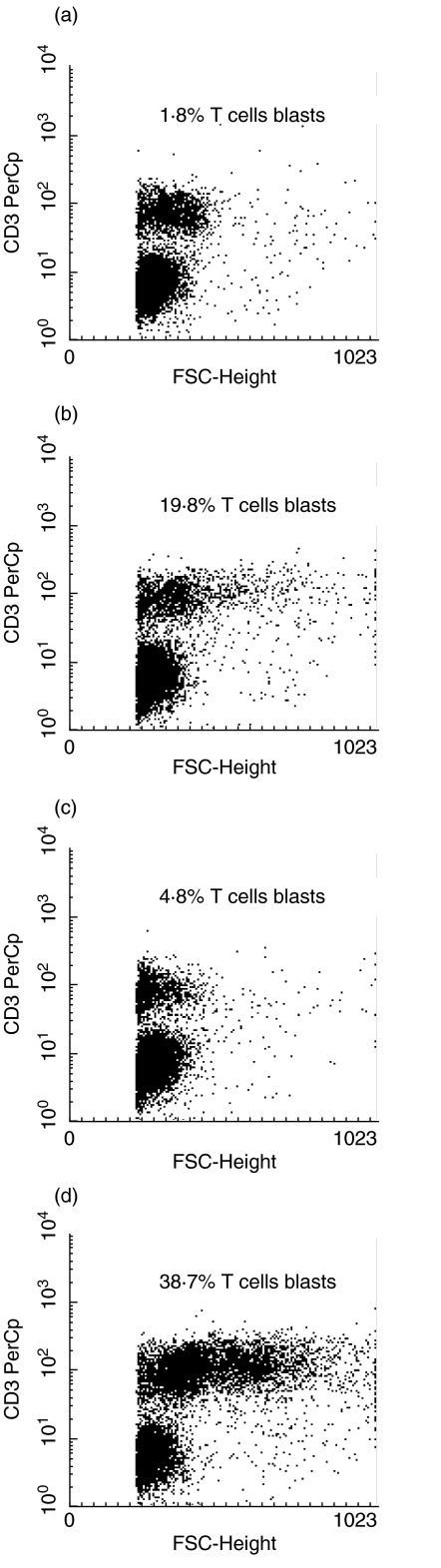
References
-
- Boyer MW, Vallera DA, Taylor PA, et al. The role of B7 co-stimulation by murine acute myeloid leukaemia in the generation and function of CD8+ T-cell line with potent in vivo graft-versus-leukaemia properties. Blood. 1997;89:3477–85. - PubMed
-
- Mutis T, Verdijk R, Schrama E, Esendam B, Brand A, Goulmy E. Feasibility of immunotherapy of relasped leukaemia with ex vivo – generated cytotoxic T lymphocytes specific for hematopoietic system-restricted minor histocompatibility antigens. Blood. 1999;93:2336–41. - PubMed
-
- Notter M, Willinger T, Erben U, Thiel E. Targeting of a B7-1 (CD80) immunoglobulin G fusion protein to acute myeloid leukemia blasts increases their co-stimulatory activity for autologous remission T cells. Blood. 2001;97:3138–45. - PubMed
-
- Lenschow DJ, Walunas TL, Bluestone JA. CD28/B7 system of T cell co-stimulation. Annu Rev Immunol. 1996;14:233. - PubMed
Publication types
MeSH terms
Substances
LinkOut - more resources
Full Text Sources
Other Literature Sources
