


Ionizing radiation delivered by specific antibody is therapeutic against a fungal infection
- PMID: 12930899
- PMCID: PMC196907
- DOI: 10.1073/pnas.1731272100
Ionizing radiation delivered by specific antibody is therapeutic against a fungal infection
Abstract
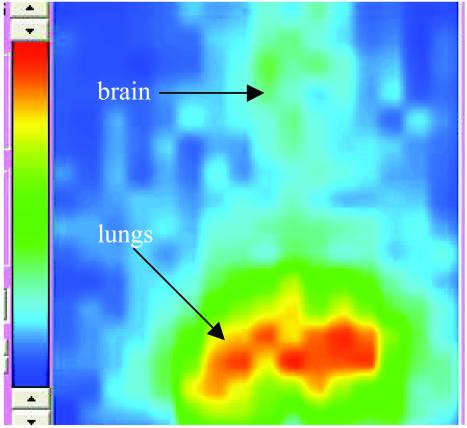
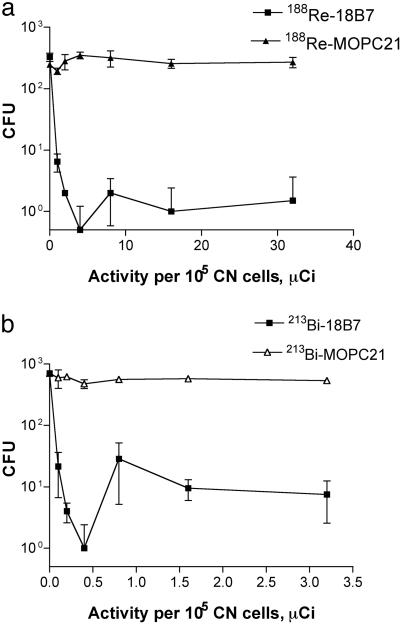
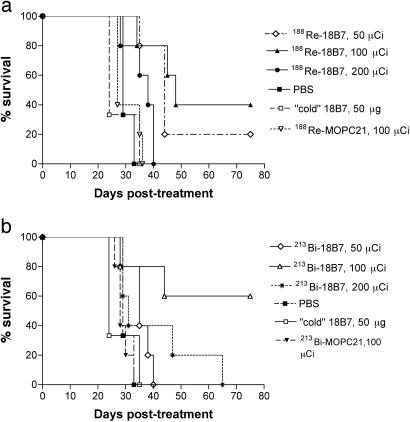
There is an urgent need for new antimicrobial therapies to combat drug resistance, new pathogens, and the relative inefficacy of current therapy in compromised hosts. Ionizing radiation can kill microorganisms quickly and efficiently, but this modality has not been exploited as a therapeutic antimicrobial strategy. We have developed methods to target ionizing radiation to a fungal cell by labeling a specific mAb with the therapeutic radioisotopes Rhenium-188 and Bismuth-213. Radiolabeled antibody killed cells of human pathogenic fungus Cryptococcus neoformans in vitro, thus converting an antibody with no inherent antifungal activity into a microbicidal molecule. Administration of radiolabeled antibody to mice with C. neoformans infection delivered 213Bi and 188Re to the sites of infection, reduced their organ fungal burden, and significantly prolonged their survival without apparent toxicity. This study establishes the principle that targeted radiation can be used for the therapy of an infectious disease, and suggests that it may have wide applicability as an antimicrobial strategy.
Figures
References
-
- Casarett, A. P. (1968). Radiation Biology (Prentice–Hall, Englewood Cliffs, NJ).
-
- Dembitzer, H. M., Buza, I. & Reiss, F. (1972) Mycopathol. Mycol. Appl. 47, 307–315. - PubMed
-
- Zack, M. B., Stottemier, K., Berg, G. & Kazemi, H. (1974) Chest 66, 240–243. - PubMed
-
- Dadachova, E. (1999) J. Labelled Comp. Radiopharm. 42, 287–292.
-
- Goldenberg, D. M., Sharkey, R. M., Udem, S., Vagg, R., Levine, G. M., Conte, P., Swayne, L. C., Hansen, H. J., Cunniff, D., Anton, J., et al. (1994) J. Nucl. Med. 35, 1028–1034. - PubMed
Publication types
MeSH terms
Substances
Grants and funding
LinkOut - more resources
Full Text Sources
Other Literature Sources
Medical
