Problems with sexual function in people attending London general practitioners: cross sectional study
- PMID: 12933729
- PMCID: PMC181260
- DOI: 10.1136/bmj.327.7412.423
Problems with sexual function in people attending London general practitioners: cross sectional study
Abstract
Objectives: To assess sexual behaviour, prevalence of ICD-10 diagnosed sexual dysfunction, associations between sexual and psychological problems, and help seeking for sexual problems in people attending general practice; to assess predictors of ICD-10 diagnosis of sexual dysfunction.
Design: Cross sectional study.
Setting: 13 general practices in London.
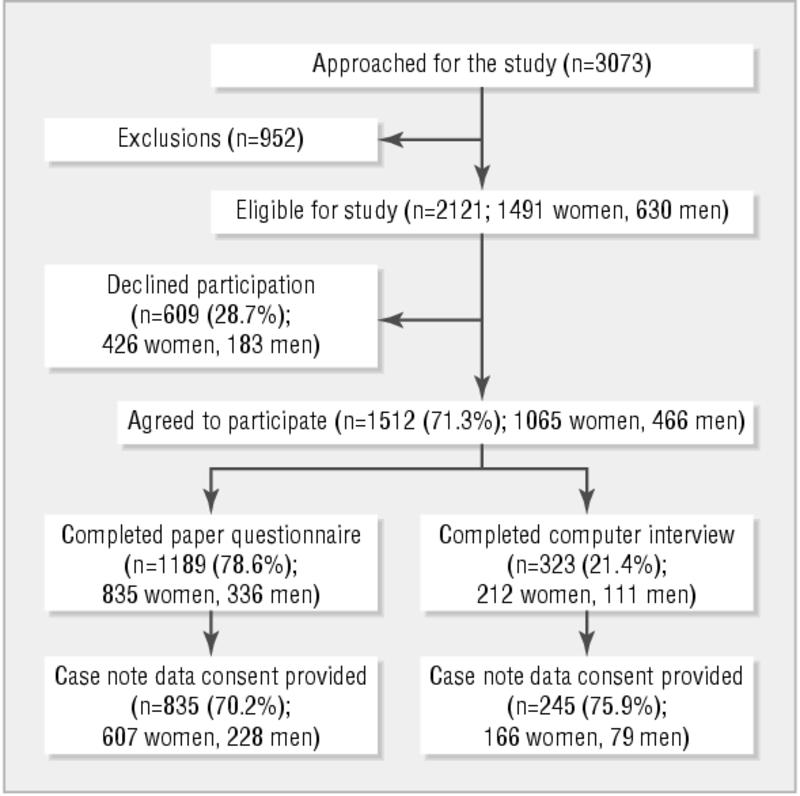
Participants: 1065 women and 447 men attending general practices.
Main outcome measure: Prevalence and predictors of ICD-10 diagnoses of sexual dysfunction.
Results: 97 (22%, 95% confidence interval 18% to 25%) men and 422 (40%, 37% to 43%) women received at least one ICD-10 diagnosis, but only 3-4% had an entry relating to sexual problems in their general practice notes. The most common problems were erectile failure and lack or loss of sexual desire in men and lack or loss of sexual desire and failure of orgasmic response in women. Increasing age and being unemployed predicted sexual problems in women, and bisexual orientation, being non-white, and being unemployed were demographic predictors in men. No practice note factors predicted sexual problems in women, but high consulting rate predicted problems in men. The main clinical predictors were poor physical function and dissatisfaction with current sex life in both sexes and higher psychological morbidity in women. When all factors were considered, increasing age (odds ratio 1.01, 1.00 to 1.02), physical subscale score on the SF-12 (0.98, 0.97 to 0.99), sexual dissatisfaction (1.9, 1.5 to 2.4), and scoring over a 3/4 threshold score on the general health questionnaire (1.5, 1.1 to 1.9) independently predicted an ICD-10 sexual dysfunction diagnosis in women. Being bisexual (4.1, 1.3 to 12.8) was the only independent predictor of an ICD-10 diagnosis in men.
Conclusions: Sexual difficulties are common in people attending general practitioners, and many people are prepared to talk about them with their doctors.
Comment in
-
What do symptoms mean?BMJ. 2003 Aug 23;327(7412):409-10. doi: 10.1136/bmj.327.7412.409. BMJ. 2003. PMID: 12933710 Free PMC article. No abstract available.
-
Problems with sexual function: comparison with other studies provides interesting findings.BMJ. 2003 Nov 8;327(7423):1109; author reply 1110. doi: 10.1136/bmj.327.7423.1109-b. BMJ. 2003. PMID: 14604945 Free PMC article. No abstract available.
-
Problems with sexual function: training in psychosexual medicine is available for doctors.BMJ. 2003 Nov 8;327(7423):1109-10; author reply 1110. doi: 10.1136/bmj.327.7423.1109-c. BMJ. 2003. PMID: 14604946 Free PMC article. No abstract available.
References
-
- Dunn KM, Crift PR, Hackett GI. Sexual problems: a study of the prevalence and need for health care in the general population. Fam Pract 1998:15: 519-24. - PubMed
-
- Reynolds CF, Frank E, Thase ME, Houck PR, Jennings JR, Howell JR, et al. Assessment of sexual function in depressed, impotent, and healthy men: factor analysis of a brief sexual function questionnaire for men. Psychiatry Res 1987;24: 231-50. - PubMed
-
- Daker-White G. Reliable and valid self-report outcome measures in sexual dysfunction: a systematic review. Arch Sex Behav 2002;31: 197-209. - PubMed
-
- Taylor JF, Rosen RC, Leiblum SR. Self report assessment of female sexual function. Arch Sex Behav 1994;23: 627-43. - PubMed
Publication types
MeSH terms
LinkOut - more resources
Full Text Sources
Medical