


Sexual cycle of Cryptococcus neoformans var. grubii and virulence of congenic a and alpha isolates
- PMID: 12933823
- PMCID: PMC187335
- DOI: 10.1128/IAI.71.9.4831-4841.2003
Sexual cycle of Cryptococcus neoformans var. grubii and virulence of congenic a and alpha isolates
Abstract
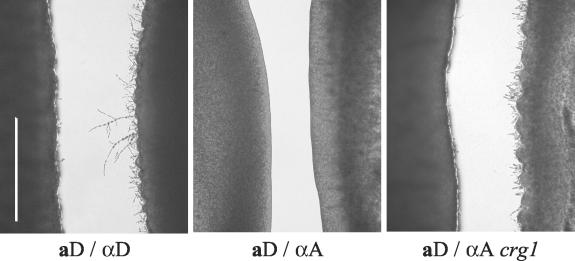
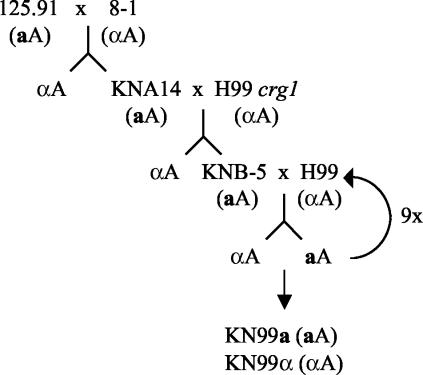
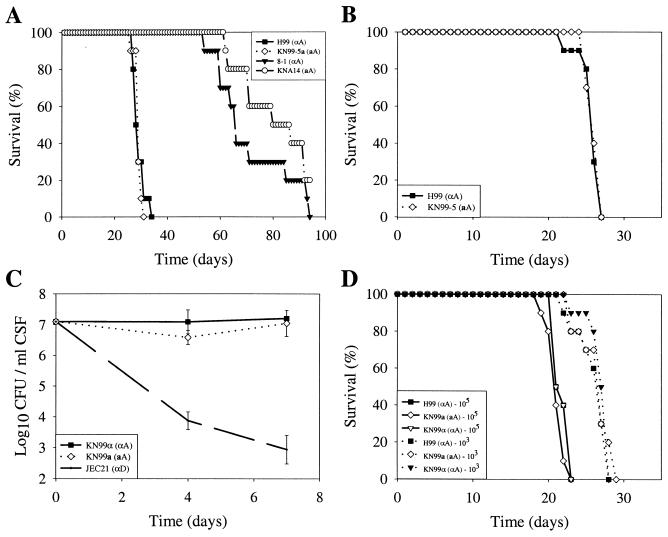
Cryptococcus neoformans is a human-pathogenic fungus that has evolved into three distinct varieties that infect most prominently the central nervous system. A sexual cycle involving haploid cells of a and alpha mating types has been reported for two varieties (C. neoformans var. neoformans, serotype D, and C. neoformans var. gattii, serotypes B and C), yet the vast majority of infections involve a distinct variety (C. neoformans var. grubii, serotype A) that has been thought to be clonal and restricted to the alpha mating type. We recently identified the first serotype A isolate of the a mating type which had been thought to be extinct (strain 125.91). Here we report that this unusual strain can mate with a subset of pathogenic serotype A strains to produce a filamentous dikaryon with fused clamp connections, basidia, and viable recombinant basidiospores. One meiotic segregant mated poorly with the serotype A reference strain H99 but robustly with a crg1 mutant that lacks a regulator of G protein signaling and is hyperresponsive to mating pheromone. This meiotic segregant was used to create congenic a and alpha mating type serotype A strains. Virulence tests with rabbit and murine models of cryptococcal meningitis showed that the serotype A congenic a and alpha mating type strains had equivalent virulence in animal models, in contrast to previous studies linking the alpha mating type to increased virulence in congenic serotype D strains. Our studies highlight a role for sexual recombination in the evolution of a human fungal pathogen and provide a robust genetic platform to establish the molecular determinants of virulence.
Figures

Comment in
-
Updated view of Cryptococcus neoformans mating type and virulence.Infect Immun. 2003 Sep;71(9):4829-30. doi: 10.1128/IAI.71.9.4829-4830.2003. Infect Immun. 2003. PMID: 12933822 Free PMC article. No abstract available.
References
-
- Anya, A. O. 1976. Physiological aspects of reproduction in nematodes. Adv. Parasitol. 14:267-351. - PubMed
-
- Barton, N. H., and B. Charlesworth. 1998. Why sex and recombination? Science 281:1986-1990. - PubMed
-
- Bell, G. 1982. The masterpiece of nature: the evolution and genetics of sexuality. University of California Press, Berkeley.
Publication types
MeSH terms
Substances
Associated data
- Actions
- Actions
- Actions
- Actions
Grants and funding
LinkOut - more resources
Full Text Sources
Other Literature Sources
