. 2003 Sep;71(9):5273-9.
doi: 10.1128/IAI.71.9.5273-5279.2003.

A monoclonal antibody directed against a Candida albicans cell wall mannoprotein exerts three anti-C. albicans activities

Affiliations

A monoclonal antibody directed against a Candida albicans cell wall mannoprotein exerts three anti-C. albicans activities

María D Moragues et al. Infect Immun. 2003 Sep.

Abstract

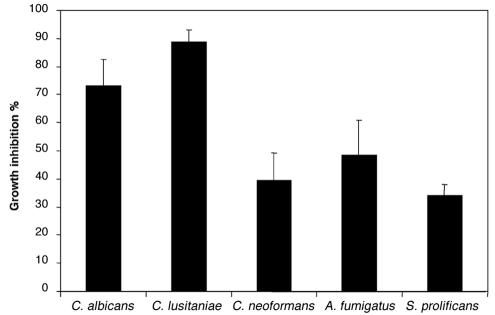
Antibodies are believed to play a role in the protection against Candida albicans infections by a number of mechanisms, including the inhibition of adhesion or germ tube formation, opsonization, neutralization of virulence-related enzymes, and direct candidacidal activity. Although some of these biological activities have been demonstrated individually in monoclonal antibodies (MAbs), it is not clear if all these anti-C. albicans activities can be displayed by a single antibody. In this report, we characterized a monoclonal antibody raised against the main target of salivary secretory immunoglobulin A in the cell wall of C. albicans, which exerts three anti-C. albicans activities: (i) inhibition of adherence to HEp-2 cells, (ii) inhibition of germination, and (iii) direct candidacidal activity. MAb C7 reacted with a proteinic epitope from a mannoprotein with a molecular mass of >200 kDa predominantly expressed on the C. albicans germ tube cell wall surface as well as with a number of antigens from Candida lusitaniae, Cryptococcus neoformans, Aspergillus fumigatus, and Scedosporium prolificans. MAb C7 caused a 31.1% inhibition in the adhesion of C. albicans to HEp-2 monolayers and a 55.3% inhibition in the adhesion of C. albicans to buccal epithelial cells, produced a 38.5% decrease in the filamentation of C. albicans, and exhibited a potent fungicidal effect against C. albicans, C. lusitaniae, Cryptococcus neoformans, A. fumigatus, and S. prolificans, showing reductions in fungal growth ranging from 34.2 to 88.7%. The fungicidal activity showed by MAb C7 seems to be related to that reported by antibodies mimicking the activity of a killer toxin produced by the yeast Pichia anomala, since one of these MAbs also reacted with the C. albicans mannoprotein with a molecular mass of >200 kDa. Results presented in this study support the concept of a family of microbicidal antibodies that could be useful in the treatment of a wide range of microbial infections when used alone or in combination with current antimicrobial agents.


Figures
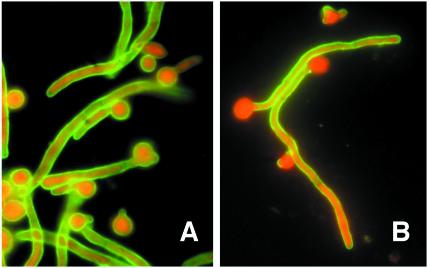
FIG. 1.
FIG. 1.
Immunofluorescence photographs of C. albicans blastoconidia and germ tubes oxidized with sodium meta-periodate and stained with MAbs C6 (A) and C7 (B). Magnification, ×1,000.
FIG. 2.
FIG. 2.
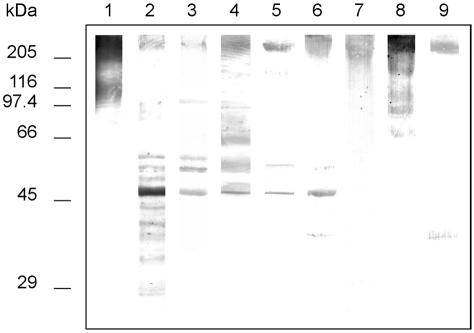
Western blots of 10% slab gels loaded with DTT extracts from C. albicans germ tubes stained with salivary secretory IgA (lane 1) and MAbs C6 (lane 2), C7 (lane 3), 28G11 (lane 4), 30C1 (lane 5), 30D1 (lane 6), 12D12 (lane 7), 28F7 (lane 8), and 29D1 (lane 9). Extracts in lanes 2 to 9 were oxidized with sodium meta-periodate. Molecular masses (in kDa) of standard proteins are listed to the left of the gel.
FIG. 3.
FIG. 3.
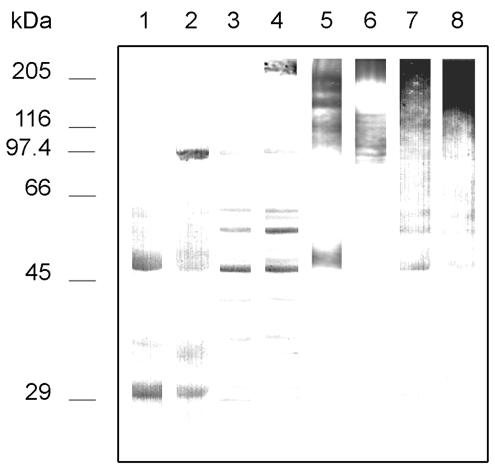
Western blots of 10% slab gels loaded with DTT extracts from C. albicans germ tubes grown in medium 199 at 37°C (lanes 2, 4, and 6), blastoconidia grown in medium 199 at 25°C (lanes 1, 3, and 5) or blastoconidia grown on Sabouraud agar at 25 (lane 7) and 37°C (lane 8) stained with MAb C7 (lanes 1 to 4 and 7 to 8) and concanavalin A (lanes 5 and 6). Extracts in lanes 3, 4, 7, and 8 were oxidized with sodium meta-periodate. Molecular masses (in kDa) of standard proteins are listed to the left of the gel.
FIG. 4.
FIG. 4.
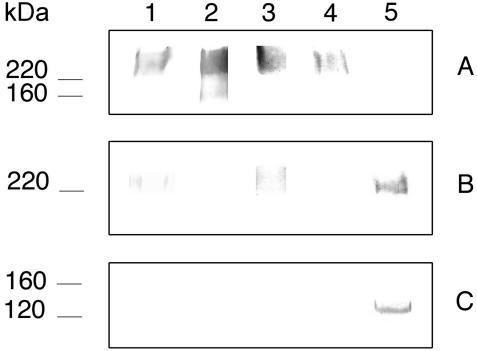
(A) Western blots of 10% slab gels loaded with an antigen of >200 kDa purified by electroelution from extracts of C. albicans germ tubes stained with salivary secretory IgA (lane 1), concanavalin A (lane 2), a polyclonal antibody against (1-6)-β-glucan (lane 3), and MAbs K10 (lane 4) and C7 (lane 5). (B and C) Reactivity of the antigen of >200 kDa after removal of carbohydrate groups by oxidation with sodium meta-periodate or with a deglycosylation kit, respectively. Molecular masses (in kDa) of standard proteins are listed to the left of the gel.
FIG. 5.
FIG. 5.
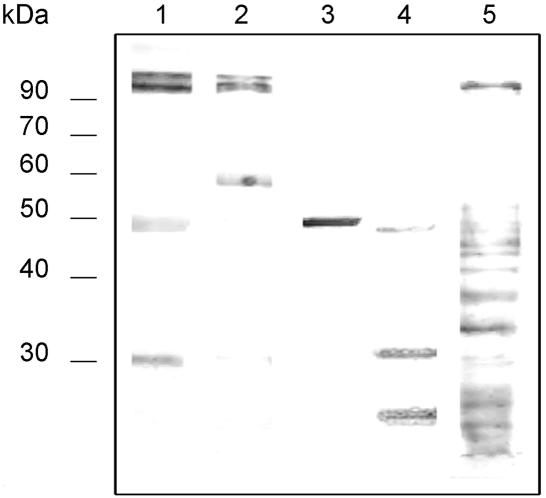
Western blots of 10% slab gels loaded with dithiothreitol extracts from C. albicans (lane 1), C. lusitaniae (lane 2), Cryptococcus neoformans (lane 3), A. fumigatus (lane 4), and S. prolificans (lane 5) stained with MAb C7. Molecular masses (in kDa) of standard proteins are listed to the left of the gel.
FIG. 6.
FIG. 6.
Fungicidal activity of MAb C7 against C. albicans, C. lusitaniae, Cryptococcus neoformans, A. fumigatus, and S. prolificans measured by the reduction in the number of CFU compared to the control with an irrelevant MAb. Values are means of triplicate determinations ± standard error of the mean.

References

    1. Barturen, B., J. Bikandi, R. San Millán, M. D. Moragues, P. Regúlez, G. Quindós, and J. Pontón. 1995. Variability in expression of antigens responsible for serotype specificity in Candida albicans. Microbiology 141:1535-1543. - PubMed
    1. Bendel, C. M., M. K. Hostetter, and M. McClellan. 1993. Distinct mechanisms of epithelial adhesion for Candida albicans and Candida tropicalis: identification of the participating ligands and development of inhibitory peptides. J. Clin. Investig. 92:1840-1849. - PMC - PubMed
    1. Bikandi, J., M. D. Moragues, G. Quindós, L. Polonelli, and J. Pontón. 2000. Influence of the environmental pH on the reactivity of Candida albicans with salivary secretory IgA. J. Dent. Res. 79:1439-1442. - PubMed
    1. Bromuro, C., R. La Valle, S. Sandini, F. Urbani, C. M. Ausiello, L. Morelli, C. Fè d'Ostiani, L. Romani, and A. Cassone. 1998. A 70-kDa recombinant heat shock protein of C. albicans is highly immunogenic and enhances systemic murine candidiasis. Infect. Immun. 66:2154-2162. - PMC - PubMed
    1. Casadevall, A. 1995. Antibody immunity and invasive fungal infections. Infect. Immun. 63:4211-4218. - PMC - PubMed

Publication types

LinkOut - more resources