


doi: 10.1128/IAI.71.9.5418-5421.2003.
Signaling via Toll-like receptor 5 can initiate inflammatory mediator production by murine osteoblasts
Affiliations
- PMID: 12933896
- PMCID: PMC187346
- DOI: 10.1128/IAI.71.9.5418-5421.2003
Item in Clipboard
Signaling via Toll-like receptor 5 can initiate inflammatory mediator production by murine osteoblasts
Infect Immun.
2003 Sep.
Abstract
Murine osteoblasts express Toll-like receptor 5 (TLR5), and this expression is upregulated following exposure to bacteria or to the TLR5 agonist, flagellin. Importantly, flagellin activates transcriptional regulators and elicits proinflammatory cytokine production, suggesting TLR5 functionality. TLR5 may represent an important mechanism underlying the recognition of bacterial pathogens by osteoblasts during bone infections.
Figures

Expression of mRNA encoding Toll-like receptor 5 (TLR5) in resting osteoblasts and cells exposed to bacterial species and the specific TLR5 ligand, flagellin. (A) Cells were unexposed (0) or exposed to Staphylococcus aureus, Salmonella, or P. aeruginosa at the indicated number of bacteria to osteoblasts. (B) Cells were unexposed (0) or exposed to purified flagellin (0.1, 1, 10, and 100 ng/ml). At 7 h, RNA was isolated and RT-PCR was performed for the presence of TLR5 mRNA. The migration of DNA fragments of known sizes is indicated on the right. These studies were performed three times with similar results.
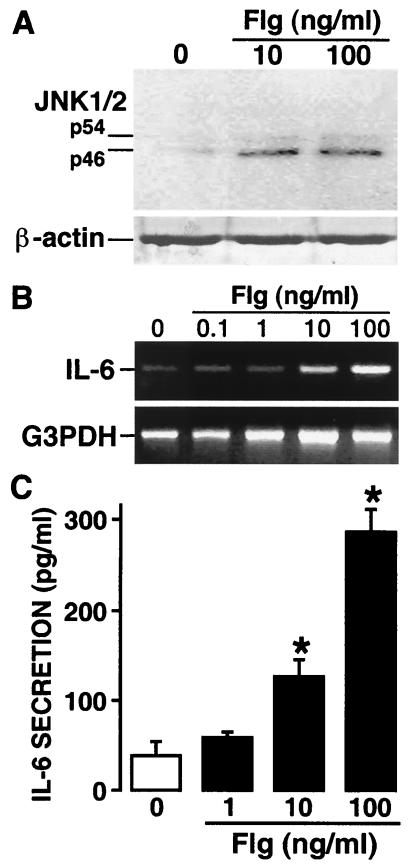
The TLR5 ligand flagellin elicits transcriptional factor activation and inflammatory cytokine production in murine osteoblasts. (A) Cells were unexposed or exposed to purified flagellin (10 and 100 ng/ml) for 90 min. Whole-cell lysates were analyzed by Western blotting for the presence of phosphorylated JNK1/2. (B) Cells were unexposed or exposed to purified flagellin (0.1, 1, 10, and 100 ng/ml) for 7 h prior to RNA isolation and RT-PCR for mRNA encoding IL-6. These studies were performed three times with similar results. (C) Cells were unexposed or exposed to purified flagellin (1, 10, and 100 ng/ml) for 24 h. Culture supernates were analyzed for the presence of IL-6 protein by specific capture ELISA. Results shown are the means ± standard errors of the means of replicate measurements in four separate preparations. *, significantly different from untreated cells (P < 0.05) when tested by Student's paired t test.
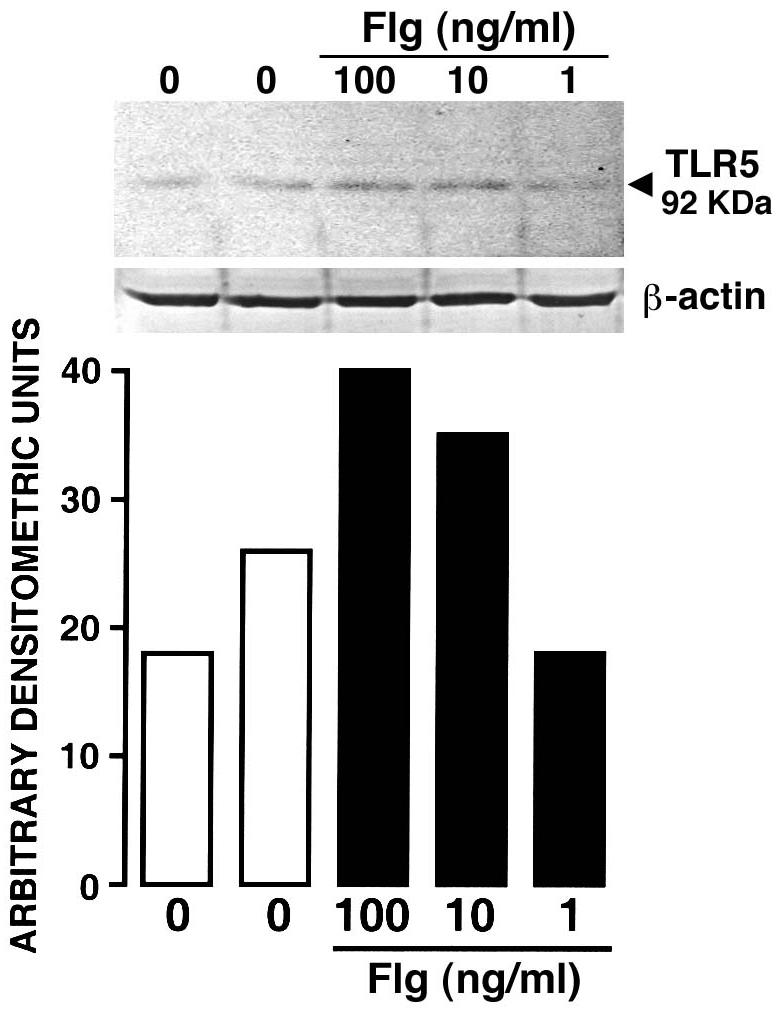
Expression of TLR5 protein in murine osteoblasts. Cells were unexposed or exposed to purified flagellin (1, 10, and 100 ng/ml) for 12 h. Whole-cell lysates were prepared and analyzed by Western blotting for the presence of TLR5. Below, densitometric analysis of this representative experiment is shown as arbitrary densitometric units corrected for background intensity for each lane. These studies were performed three times with similar results.
References
-
- Bost, K. L., J. L. Bento, C. C. Petty, L. W. Schrum, M. C. Hudson, and I. Marriott. 2001. Monocyte chemoattractant protein-1 expression by osteoblasts following infection with Staphylococcus aureus or Salmonella. J. Interferon Cytokine Res. 21:297-304. - PubMed
-
- Bost, K. L., W. K. Ramp, N. Nicholson, J. L. Bento, I. Marriott, and M. C. Hudson. 1999. Staphylococcus aureus infection of mouse or human osteoblasts induces high levels of IL-6 and IL-12 production. J. Infect. Dis. 180:1912-1920. - PubMed
-
- Bowman, C. C., A. Rasley, S. L. Tranguch, and I. Marriott. 2003. Cultured astrocytes express Toll-like receptors for bacterial products. Glia 43:281-291. - PubMed
-
- Chow, J. C., D. W. Young, D. T. Golenbock, W. J. Christ, and F. Gusovsky. 1999. Toll-like receptor 4 mediates lipopolysaccharide-induced signal transduction. J. Biol. Chem. 274:10689-10692. - PubMed
Publication types
MeSH terms
Substances
Grants and funding
LinkOut - more resources
Full Text Sources
