


Selecting controls for assessing interaction in nested case-control studies
- PMID: 12934962
- PMCID: PMC9663417
- DOI: 10.2188/jea.13.193
Selecting controls for assessing interaction in nested case-control studies
Abstract
Background: Two methods for selecting controls in nested case-control studies--matching on X and counter matching on X--are compared when interest is in interaction between a risk factor X measured in the full cohort and another risk factor Z measured only in the case-control sample. This is important because matching provides efficiency gains relative to random sampling when X is uncommon and the interaction is positive (greater than multiplicative), whereas counter matching is generally efficient compared to random sampling.
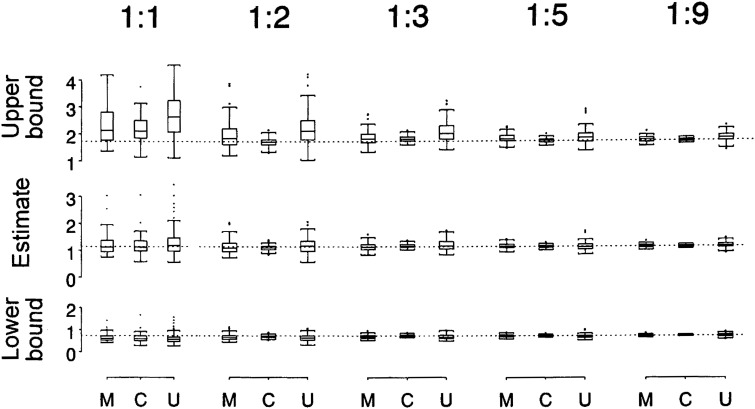
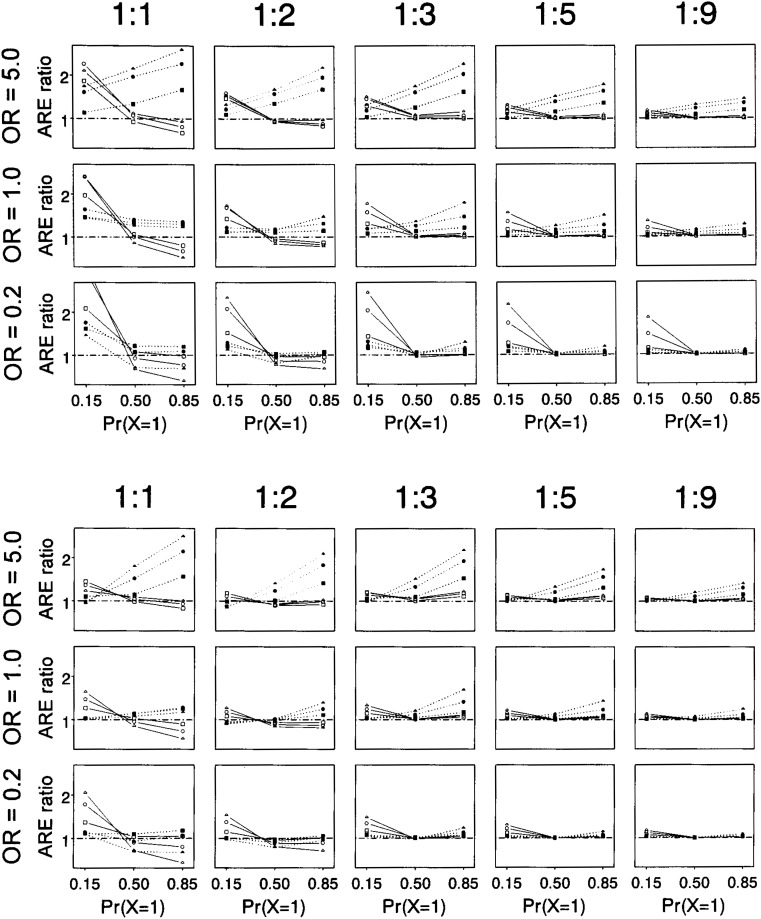
Methods: Matching and counter matching were compared to each other and to random sampling of controls for dichotomous X and Z. Comparison was by simulation, using as an example a published study of radiation and other risk factors for breast cancer in the Japanese atomic-bomb survivors, and by asymptotic relative efficiency calculations for a wide range of parameters specifying the prevalence of X and Z as well as the levels of correlation and interaction between them. Focus was on analyses utilizing general models for the joint risk of X and Z.
Results: Counter-matching performed better than matching or random sampling in terms of efficiency for inference about interaction in the case of a rare risk factor X and uncorrelated risk factor Z. Further, more general, efficiency calculations demonstrated that counter-matching is generally efficient relative to matched case-control designs for studying interaction.
Conclusions: Because counter-matched designs may be analyzed using standard statistical methods and allow investigation of confounding of the effect of X, whereas matched designs require a non-standard approach when fitting general risk models and do not allow investigating the adjusted risk of X, it is concluded that counter-matching on X can be a superior alternative to matching on X in nested case-control studies of interaction when X is known at the time of case-control sampling.
Figures
References
-
- Pierce DA, Shimizu Y, Preston DL, Vaeth M, Mabuchi K. Studies of the mortality of atomic bomb survivors. Report 12, Part I. Cancer: 1950-1990. Radiat Res 1996;146:1-27. - PubMed
-
- Land CE, Hayakawa N, Machado SG, Yamada Y, Pike MC, Akiba S, et al. A case-control interview study of breast cancer among Japanese A-bomb survivors. II. Interactions with radiation dose. Cancer Causes Control 1994;5:167-76. - PubMed
-
- Moolgavkar SH, Venzon DJ. General relative risk regression models for epidemiologic studies. Am J Epidemiol 1987;126:949-61. - PubMed
-
- Muirhead CR, Darby SC. Modelling the relative and absolute risks of radiation-induced cancers. J Royal Stat Soc (Series A) 1987;150:83-118.
-
- Thomas DC, Greenland S. The efficiency of matching in case-control studies of risk-factor interactions. J Chronic Dis 1985;38:569-74. - PubMed
