


Ice-Water Immersion and Cold-Water Immersion Provide Similar Cooling Rates in Runners With Exercise-Induced Hyperthermia
- PMID: 12937427
- PMCID: PMC164337
Ice-Water Immersion and Cold-Water Immersion Provide Similar Cooling Rates in Runners With Exercise-Induced Hyperthermia
Abstract
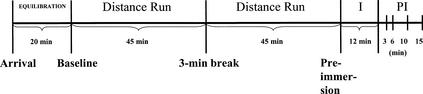
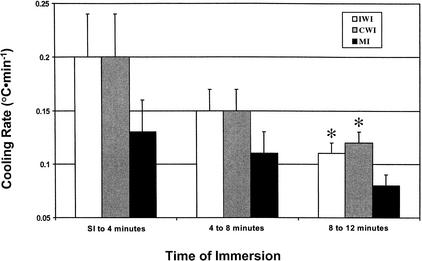
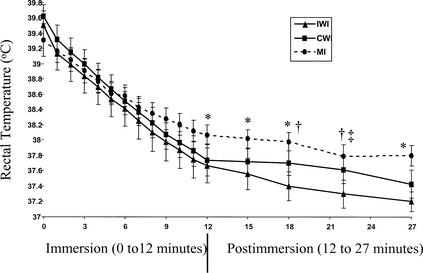
OBJECTIVE: To assess whether ice-water immersion or cold-water immersion is the more effective treatment for rapidly cooling hyperthermic runners. DESIGN AND SETTING: 17 heat-acclimated highly trained distance runners (age = 28 +/- 2 years, height = 180 +/- 2 cm, weight = 68.5 +/- 2.1 kg, body fat = 11.2 +/- 1.3%, training volume = 89 +/- 10 km/wk) completed a hilly trail run (approximately 19 km and 86 minutes) in the heat (wet-bulb globe temperature = 27 +/- 1 degrees C) at an individually selected "comfortable" pace on 3 occasions 1 week apart. The random, crossover design included (1) distance run, then 12 minutes of ice-water immersion (5.15 +/- 0.20 degrees C), (2) distance run, then 12 minutes of cold-water immersion (14.03 +/- 0.28 degrees C), or (3) distance run, then 12 minutes of mock immersion (no water, air temperature = 28.88 +/- 0.76 degrees C). MEASUREMENTS: Each subject was immersed from the shoulders to the hip joints for 12 minutes in a tub. Three minutes elapsed between the distance run and the start of immersion. Rectal temperature was recorded at the start of immersion, at each minute of immersion, and 3, 6, 10, and 15 minutes postimmersion. No rehydration occurred during any trial. RESULTS: Length of distance run, time to complete distance run, rectal temperature, and percentage of dehydration after distance run were similar (P >.05) among all trials, as was the wet-bulb globe temperature. No differences (P >.05) for cooling rates were found when comparing ice-water immersion, cold-water immersion, and mock immersion at the start of immersion to 4 minutes, 4 to 8 minutes, and the start of immersion to 8 minutes. Ice-water immersion and cold-water immersion cooling rates were similar (P >.05) to each other and greater (P <.05) than mock immersion at 8 to 12 minutes, the start of immersion to 10 minutes, and the start of immersion to every other time point thereafter. Rectal temperatures were similar (P >.05) between ice-water immersion and cold-water immersion at the completion of immersion and 15 minutes postimmersion, but ice-water immersion rectal temperatures were less (P <.05) than cold-water immersion at 6 and 10 minutes postimmersion. CONCLUSIONS: Cooling rates were nearly identical between ice-water immersion and cold-water immersion, while both were 38% more effective in cooling after 12 minutes of immersion than the mock-immersion trial. Given the similarities in cooling rates and rectal temperatures between ice-water immersion and cold-water immersion, either mode of cooling is recommended for treating the hyperthermic individual.
Figures
References
-
- Armstrong L E, Maresh C M. Can humans avoid and recover from exertional heatstroke? Adapt Biol Med. 1999;2:344–351.
-
- Casa D J, Roberts W O. Considerations for the medical staff: preventing, identifying and treating exertional heat illnesses. In: Armstrong L E, editor. Exertional Heat Illnesses. Human Kinetics; Champaign, IL: (in press)
-
- Casa D J, Armstrong L E. Heatstroke: a medical emergency. In: Armstrong L E, editor. Exertional Heat Illnesses. Human Kinetics; Champaign, IL: (in press)
-
- Armstrong L E, Maresh C M. The exertional heat illnesses: a risk of athletic participation. Med Sci Sports Exerc. 1993;2:125–134.
-
- Costrini A. Emergency treatment of exertional heatstroke and comparison of whole body cooling techniques. Med Sci Sports Exerc. 1990;22:15–18. - PubMed
LinkOut - more resources
Full Text Sources
Other Literature Sources