. 2001 Jun;36(2):109-118.

Neuromuscular Evaluation of Trunk-Training Exercises

Affiliations

Neuromuscular Evaluation of Trunk-Training Exercises

Peter Konrad et al. J Athl Train. 2001 Jun.

Abstract

OBJECTIVE: To evaluate the neuromuscular activation profiles of trunk muscles in commonly used gymnastic strength exercises with a polymyographic set-up and to describe the training effects of each exercise. DESIGN AND SETTING: Subjects performed 9 repetitions of each of 12 gymnastic exercises. Variations of 5 trunk flexions, 5 extensions, and 2 lateral-flexion movements were performed under standardized test conditions. SUBJECTS: Ten healthy subjects (men and women) who were familiar with the exercises participated in the study. MEASUREMENTS: We recorded surface electromyograms (EMGs) from the rectus abdominis, external oblique, rectus femoris, middle trapezius, erector spinae at T12 and L3, gluteus maximus, and semitendinosus and semimembranosus muscles. Recording of each repetition cycle was triggered by a flexible electronic goniometer attached to the trunk. The raw EMG signals were rectified, smoothed, amplitude normalized to maximal voluntary contraction (MVC), and averaged for the last 8 repetitions. RESULTS: Pure spine-flexion exercises, such as a curl-up, produced sufficient and isolated activation (greater than 50% MVC) of the abdominal muscles. When flexion of the spine was combined with hip flexion (sit-up), the peak activation was increased. Lateral-flexion tasks targeted primarily the external oblique muscle, which demonstrated high activity in side-lying flexion tasks. Back- and hip-extension exercises, such as bridging and diagonal hip and shoulder extension, produced only moderate mean activities (less than 35% MVC) in the trunk-extensor muscles. Trunk-extension exercises with combined hip extension increased the EMG activity to 50% MVC but only at the end of the extension. CONCLUSIONS: Individual responses to each exercise varied markedly, which complicated the classification of exercise effects. However, within the limitations of the study, we found that the chosen abdominal exercises provided an effective training stimulus for the trunk-flexor muscles, whereas in the back- and hip-extension exercises, the neuromuscular activation tended to be too low or unspecific to qualify as muscle-specific training.


Figures
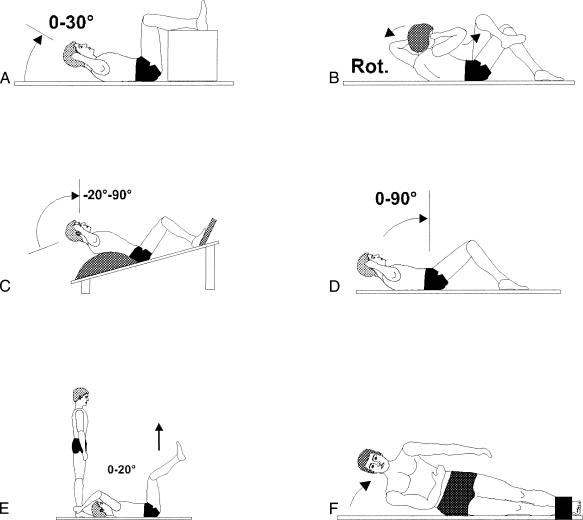
Figure 1
Figure 1
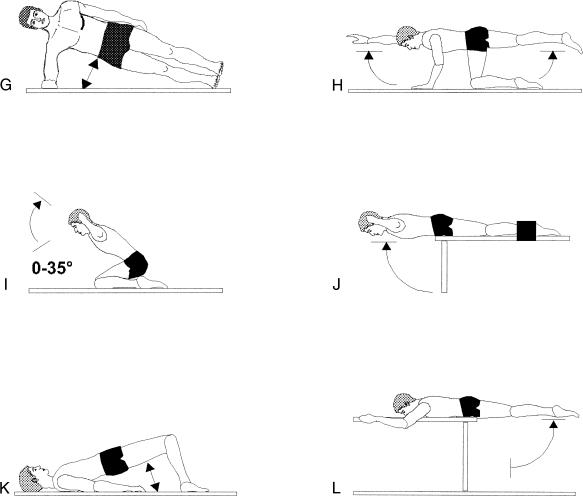
Gymnastic training exercises. A, Straight Curl-Up. Fingertips touch the temples, arms are in a fixed lateral position, the head and shoulders are lifted, and the feet are not fixed. B, Cross Curl-Up. As in A, but 1 leg is across the other, and the contralateral elbow is moved to the opposite knee. C, Curl Up, Hyperextended. Same arm position as A but inverse (-20°) starting position; trunk and hip flexion until the head and thorax are upright; no foot fixation. D, Sit-Up. Same arm position as A; trunk and hip flexion until the upper body is upright; no foot fixation. E, Vertical Hip Lift. Knees are flexed between 70° and 90°, arms are fixed, hip is lifted until lumbar spine is lifted from the ground. F, Lateral Flexion, Fixed Legs. Foot of upper leg is crossed over the lower leg and fixed; flexion until the upper body is lifted off the ground (30°). G, Lateral Hip Lift. Elbow support from a flexed position (30° from hip to ground), extension to the neutral position (0°). H, Diagonal Hip and Shoulder Extension. From a flexed position (elbow in contact with the contralateral knee), diagonal hip and shoulder extension to the horizontal position. I, Kneeling Back Extension. Same arm position as A, from a flexed position (chest-leg contact), isolated spine extension (head and thorax to 45°). J, Trunk Extension, Fixed Legs. Same arm position as A, fixed legs in prone position, from 90° hip flexion-extension to the horizontal (0°). K, Bridging. Supine position, trunk and arms resting on ground and knees bent (90°), hip extension to neutral position (0°). L, Hip Extension, Fixed Trunk. Fixed upper body in prone position, from 90° hip and knee flexion with extension of legs to the horizontal line (hip and knee, 0°).
Figure 1
Figure 1
Gymnastic training exercises. A, Straight Curl-Up. Fingertips touch the temples, arms are in a fixed lateral position, the head and shoulders are lifted, and the feet are not fixed. B, Cross Curl-Up. As in A, but 1 leg is across the other, and the contralateral elbow is moved to the opposite knee. C, Curl Up, Hyperextended. Same arm position as A but inverse (-20°) starting position; trunk and hip flexion until the head and thorax are upright; no foot fixation. D, Sit-Up. Same arm position as A; trunk and hip flexion until the upper body is upright; no foot fixation. E, Vertical Hip Lift. Knees are flexed between 70° and 90°, arms are fixed, hip is lifted until lumbar spine is lifted from the ground. F, Lateral Flexion, Fixed Legs. Foot of upper leg is crossed over the lower leg and fixed; flexion until the upper body is lifted off the ground (30°). G, Lateral Hip Lift. Elbow support from a flexed position (30° from hip to ground), extension to the neutral position (0°). H, Diagonal Hip and Shoulder Extension. From a flexed position (elbow in contact with the contralateral knee), diagonal hip and shoulder extension to the horizontal position. I, Kneeling Back Extension. Same arm position as A, from a flexed position (chest-leg contact), isolated spine extension (head and thorax to 45°). J, Trunk Extension, Fixed Legs. Same arm position as A, fixed legs in prone position, from 90° hip flexion-extension to the horizontal (0°). K, Bridging. Supine position, trunk and arms resting on ground and knees bent (90°), hip extension to neutral position (0°). L, Hip Extension, Fixed Trunk. Fixed upper body in prone position, from 90° hip and knee flexion with extension of legs to the horizontal line (hip and knee, 0°).
Figure 2
Figure 2
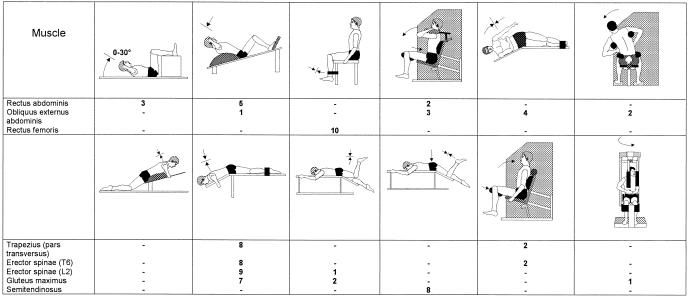
Static test positions used to determine the maximum voluntary contraction. Unless otherwise indicated (by arrow, straps, or lever arm), the static resistance was provided manually by assistants. The numbers below each exercise indicate, separately for each muscle, the number of subjects who reached their highest activity level with this exercise.
Figure 3
Figure 3
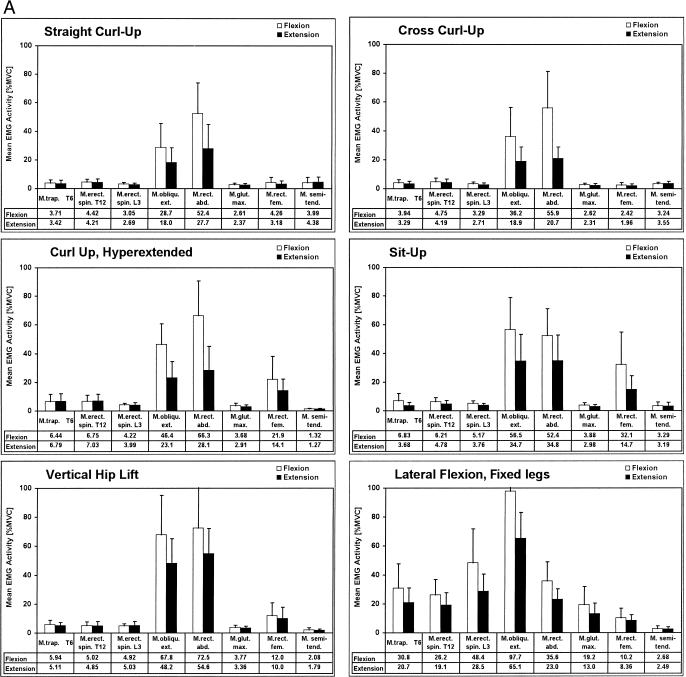
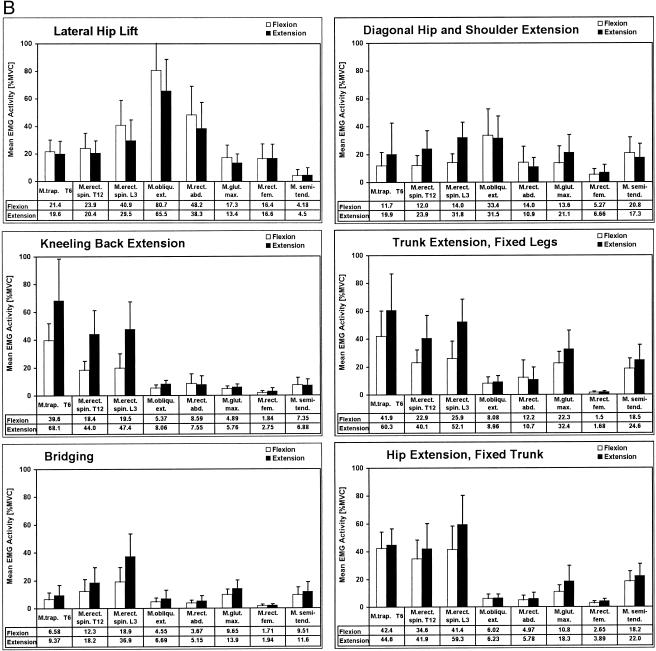
Mean activity distribution profiles. The mean electromyogram activity for the concentric and eccentric periods is calculated as the mean of 8 repetitions, which is averaged again for all subjects (n = 10). The thin lines indicate 1 SD. A, Profiles for exercises 1 through 6. B, Profiles for exercises 7 through 12.
Figure 3
Figure 3
Mean activity distribution profiles. The mean electromyogram activity for the concentric and eccentric periods is calculated as the mean of 8 repetitions, which is averaged again for all subjects (n = 10). The thin lines indicate 1 SD. A, Profiles for exercises 1 through 6. B, Profiles for exercises 7 through 12.
Figure 4
Figure 4
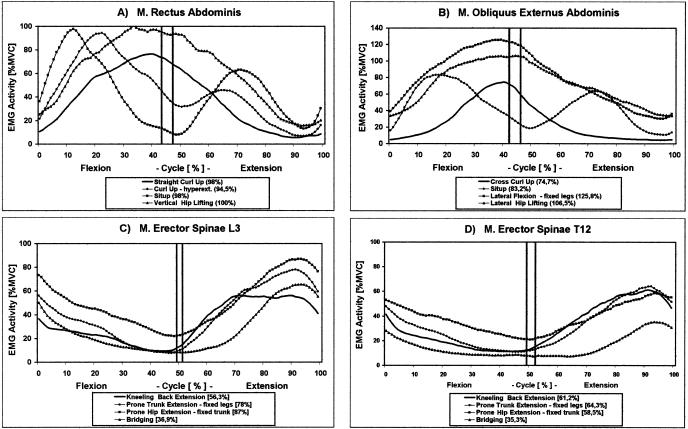
A through D, Time and maximal voluntary contraction–normalized electromyogram activation profiles (n = 10) of 4 target muscles in selected trunk exercises. The curves are based on individual average curves of 8 repetitions. The vertical lines indicate the range for point of return in these exercises. The peak activation value of each curve is specified in parentheses after each curve name. The corresponding mean values for each period and exercise are listed in Figure 3

References

    1. De Luca CJ. The use of surface electromyography in biomechanics. J Appl Biomech. 1997;13:135–163.
    1. Godfrey KE, Kindig LE, Windell EJ. Electromyographic study of duration of muscle activity in sit-up variations. Arch Phys Med Rehabil. 1977;58:132–135. - PubMed
    1. Halpern AA, Bleck EB. Sit-up exercises: an electromyographic study. Clin Orthop. 1979;145:172–178. - PubMed
    1. Ricci B, Marchetti M, Figura F. Biomechanics of sit-up exercises. Med Sci Sports Exerc. 1981;13:54–59. - PubMed
    1. Andersson EA, Oddsson L, Grundström H, Thorstensson A. The role of the psoas and iliacus muscles for stability and movement of the lumbar spine, pelvis and hip. Scand J Med Sci Sports. 1995;5:10–16. - PubMed

LinkOut - more resources