


Longitudinal Split of the Peroneus Brevis Tendon and Lateral Ankle Instability: Treatment of Concomitant Lesions
- PMID: 12937568
- PMCID: PMC164378
Longitudinal Split of the Peroneus Brevis Tendon and Lateral Ankle Instability: Treatment of Concomitant Lesions
Abstract
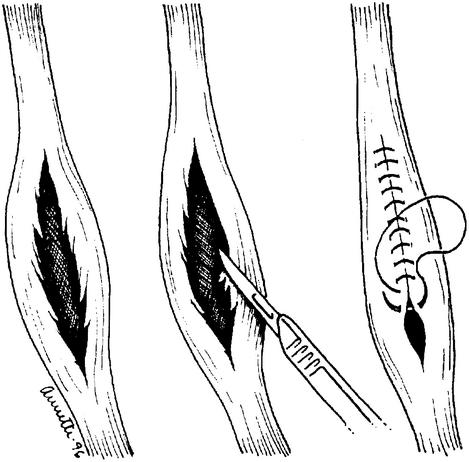
OBJECTIVE: To describe the clinical picture, pathophysiology, and treatment of concomitant lesions of the peroneus brevis tendon and lateral ligament injuries to the ankle. BACKGROUND: In some cases, chronic lateral ankle instability is associated with a longitudinal partial tear in the peroneus brevis tendon. Patients who suffer from this lesion usually have atypical posterolateral ankle pain combined with signs of recurrent ligament instability ("giving way"). The tendon injury is often overlooked because it is combined with the ligament injury, and the injury mechanisms are similar. DESCRIPTION: Tears or laxity in the superior peroneal retinaculum allow the anterior part of the injured peroneus brevis tendon to ride over the sharp posterior edge of the fibula, leading to a longitudinal tear in the tendon. This combined injury should be suspected in patients with recurrent giving way of the ankle joint and retromalleolar pain. The diagnosis can be established using either ultrasonography or magnetic resonance imaging. DIFFERENTIAL DIAGNOSIS: Ligament injury, tenosynovitis, peroneus longus tendon lesion, os peroneum fracture, distal peroneus brevis tendon tear, or anomalous peroneus tertius tendon. TREATMENT: The tendon injury and the ligament insufficiency should be repaired at the same time. CONCLUSIONS: We recommend reconstruction of the superior peroneal retinaculum, combined with repair of the tendon, using side-to-side sutures and anatomical reconstruction of the lateral ankle ligaments.
Figures
References
-
- Larsen E. Longitudinal rupture of the peroneus brevis tendon. J Bone Joint Surg Br. 1987;69:340–341. - PubMed
-
- Sobel M, DiCarlo E, Bohne W HO, Collins L. Longitudinal splitting of the peroneus brevis tendon: an anatomic and histologic study of cadaveric material. Foot Ankle. 1991;12:165–170. - PubMed
-
- Sobel M, Levy M E, Bohne W HO. Congenital variations of the peroneus quartus muscle: an anatomic study. Foot Ankle. 1990;11:81–89. - PubMed
-
- Sobel M, Bohne W HO, Markisz J A. Cadaver correlation of peroneal tendon changes with magnetic resonance imaging. Foot Ankle. 1991;11:384–388. - PubMed
-
- Karlsson J, Brandsson S, Kälebo P, Eriksson B I. Surgical treatment of concomitant chronic ankle instability and longitudinal rupture of the peroneus brevis tendon. Scand J Med Sci Sports. 1998;8:42–49. - PubMed
LinkOut - more resources
Full Text Sources