


Efficacy of the Star Excursion Balance Tests in Detecting Reach Deficits in Subjects With Chronic Ankle Instability
- PMID: 12937574
- PMCID: PMC164384
Efficacy of the Star Excursion Balance Tests in Detecting Reach Deficits in Subjects With Chronic Ankle Instability
Abstract
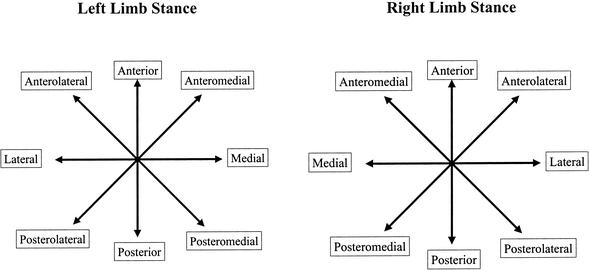
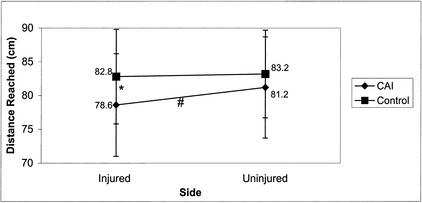
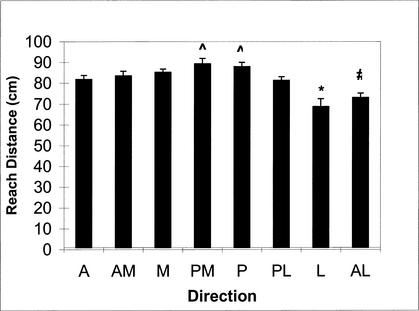
OBJECTIVE: Chronic instability after lateral ankle sprain has been shown to cause balance deficits during quiet standing. Although static balance assessment in those with ankle instability has been thoroughly examined in the literature, few researchers have studied performance on more dynamic tasks. Our purpose was to determine if the Star Excursion Balance Tests (SEBTs), lower extremity reach tests, can detect deficits in subjects with chronic ankle instability. DESIGN AND SETTING: We performed all testing in a university athletic training facility. We tested lower extremity reach using the SEBTs, which incorporates single-leg stance with maximal reach of the contralateral leg. SUBJECTS: Twenty subjects with unilateral, chronic ankle instability (age = 19.8 +/- 1.4 years, height = 176.8 +/- 4.5 cm, mass = 82.9 +/- 21.2 kg) and 20 uninjured subjects matched by sex, sport, and position (age = 20.2 +/- 1.4 years, height = 178.7 +/- 4.1 cm, mass = 82.7 +/- 19.9 kg). MEASUREMENTS: We measured the reach distances in centimeters (cm) and averaged 3 reaches in each of the 8 directions while the subjects stood on each leg for data analysis. RESULTS: The group with chronic ankle instability demonstrated significantly decreased reach while standing on the injured limb compared with the matched limb of the uninjured group (78.6 cm versus 82.8 cm). Additionally, subjects with chronic ankle instability reached significantly less when standing on their injured limbs as compared with their uninjured limbs (78.6 cm versus 81.2 cm). CONCLUSIONS: The SEBTs appear to be an effective means for determining reach deficits both between and within subjects with unilateral chronic ankle instability.
Figures

References
-
- Jackson D W, Ashley R L, Powell J W. Ankle sprains in your athletes: relation of severity and disability. Clin Orthop. 1974;101:201–215. - PubMed
-
- Brand R L, Black H M, Cox J S. The natural history of the inadequately treated ankle sprain. Am J Sports Med. 1977;5:248–249. - PubMed
-
- Garrick J G. The frequency of injury, mechanism of injury, and epidemiology of ankle sprains. Am J Sports Med. 1977;5:241–242. - PubMed
-
- Balduini F C, Tetzlaff J. Historical perspectives on injuries of the ligaments of the ankle. Clin Sports Med. 1992;1:3–12. - PubMed
-
- Han K H, Muwanga C L. The incidence of recurrent soft tissue ankle injuries. Br J Clin Pract. 1990;44:609–611. - PubMed
LinkOut - more resources
Full Text Sources
Medical