. 2003 Sep;23(18):6542-52.
doi: 10.1128/MCB.23.18.6542-6552.2003.

E2F3 loss has opposing effects on different pRB-deficient tumors, resulting in suppression of pituitary tumors but metastasis of medullary thyroid carcinomas

Affiliations

E2F3 loss has opposing effects on different pRB-deficient tumors, resulting in suppression of pituitary tumors but metastasis of medullary thyroid carcinomas

Ulrike Ziebold et al. Mol Cell Biol. 2003 Sep.

Abstract

The E2F transcription factors are key downstream targets of the retinoblastoma protein (pRB) tumor suppressor. We have previously shown that E2F3 plays a critical role in mediating the mitogen-induced activation of E2F-responsive genes and contributes to both the inappropriate proliferation and the p53-dependent apoptosis that arise in pRB-deficient embryos. Here we show that E2F3 also has a significant effect on the phenotype of tumor-prone Rb(+/-) mice. The absence of E2F3 results in a significant expansion in the life spans of these animals that correlates with a dramatic alteration in the tumor spectrum. E2F3 loss suppresses the development of the pituitary tumors that normally account for the death of Rb(+/-) mice. However, it also promotes the development of medullary thyroid carcinomas yielding metastases at a high frequency. This increased aggressiveness does not seem to result from any change in p53 levels or activity in these tumors. We show that, instead, E2F3 loss leads to an increase in the rate of tumor initiation. Finally, analysis of Rb(+/-); E2f3(+/-) mice shows that this tumor-suppressive function of E2F3 is dose dependent.


Figures
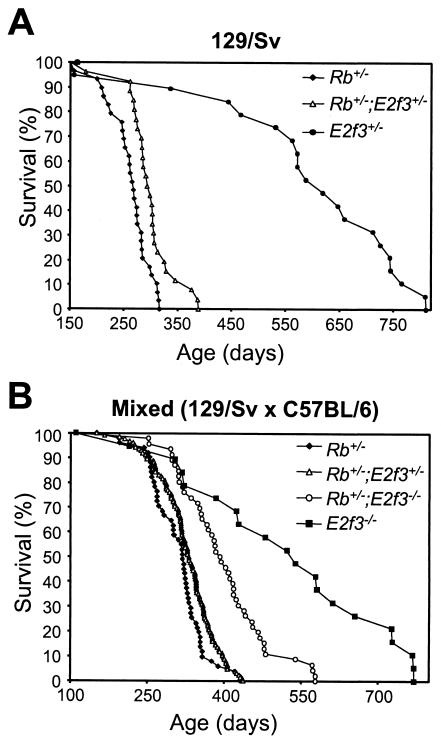
FIG. 1.
FIG. 1.
Effect of E2f3 status on the life spans of Rb heterozygous mice. Progeny arising from Rb+/−; E2f3+/− intercrosses were aged together. Shown are log rank survival curves obtained by plotting percent survival against age. (A) In the pure 129/Sv background, the life spans of Rb+/−; E2f3+/− animals (n = 25) were significantly higher than those of Rb+/− animals (n = 28). Additionally, E2f3+/− animals (n = 19) were aged as a control. (B) In the mixed 129/Sv × C57BL/6 background, the life spans of Rb+/−; E2f3+/− (n = 125) and Rb+/−; E2f3−/− (n = 40) animals were progressively longer than those of Rb+/− (n = 50) animals but shorter than those of E2f3−/− animals (n = 18).
FIG. 2.
FIG. 2.
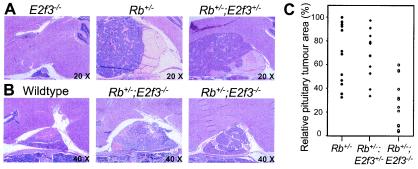
Loss of E3f3 suppresses tumor formation in the pituitary gland. (A) Hematoxylin-and-eosin-stained sections of pituitary glands from a healthy E2f3−/− animal that died at 14 months due to congestive heart failure and Rb+/− and Rb+/−; E2f3+/− mice that died at the age of 10.5 months due to the pituitary tumors. Magnification, ×20. (B) Hematoxylin-and-eosin-stained sections of pituitary glands from a healthy wild-type animal sacrificed at the age of 12 months and two Rb+/−; E2f3−/− mice that died at 10.5 and 12 months. Magnification, ×40. (C) Comparison of pituitary tumor sizes (as judged by the area of the median section) at the time of death for Rb+/− (n = 12), Rb+/−; E2f3+/− (n = 11), and Rb+/−; E2f3−/− (n = 15) mice.
FIG. 3.
FIG. 3.
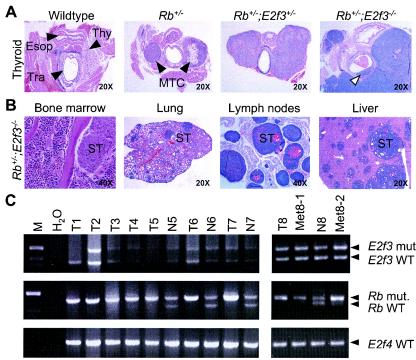
E2f3 mutation promotes thyroid tumor development. (A) Hematoxylin-and-eosin-stained sections of thyroids from a healthy control wild-type animal sacrificed at the age of 10.5 months and of MTCs derived from Rb+/−, Rb+/−; E2f3+/−, and Rb+/−; E2f3−/− mice that died at the ages of 10.5, 11, and 12 months, respectively. Arrowheads indicate the locations of the thyroid (Thy), trachea (Tra), and esophagus (Esop) in the wild-type control. The open arrowhead highlights the infiltration of the tumor into the intratracheal space in an Rb+/−; E2f3−/− animal. (B) Cross-section of metastatic tumor growth in the bone marrow, lungs, lymph nodes, and livers of four different Rb+/−; E2f3−/− animals. Selected sites of secondary tumor growth (ST) are indicated. (C) PCR-based LOH analysis of DNA extracted from freshly isolated biopsy specimens from either MTCs (T), metastases (Met), or matching normal tissues (N) derived from either Rb+/− (T1) or Rb+/−; E2f3+/− (T2 to T8; Met8-1 and Met8-2) mice alongside a water-only control reaction (H2O). All of the tumors showed LOH for Rb but not for E2f3. An E2f4-specific PCR was used to confirm equal input of DNA. WT, wild type; mut., mutant.
FIG. 4.
FIG. 4.
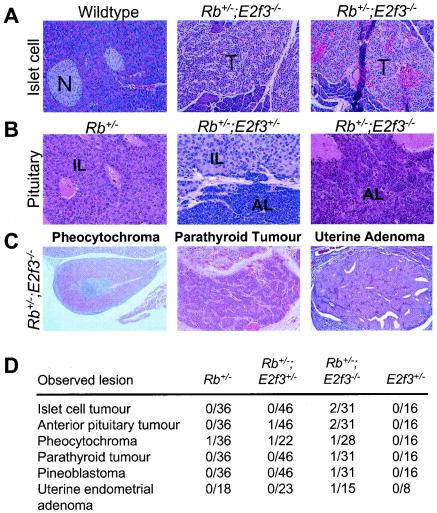
Additional, novel tumor types arise in Rb+/−; E2f3−/− mice. (A) Comparison of normal islets (N) in a wild-type mouse with islet-cell tumors (T) from two Rb+/−; E2f3−/− mice. Magnification, ×20. (B) Histological appearance of a typical Rb mutant intermediate-lobe (IL) pituitary tumor versus that of pituitary tumors from two different Rb+/−; E2f3−/− mice who had tumors initiating in both the intermediate lobe and the anterior lobe (AL) or solely in the anterior lobe of the pituitary gland. Magnification, ×40. (C) A pheocytochroma, a parathyroid tumor, and a uterine endometrial adenoma detected in different Rb+/−; E2f3−/− mice. (D) Incidences of various lesions in Rb+/−, Rb+/−; E2f3+/−, Rb+/−; E2f3−/−, and E2f3+/− mice. Magnification, ×40.
FIG. 5.
FIG. 5.
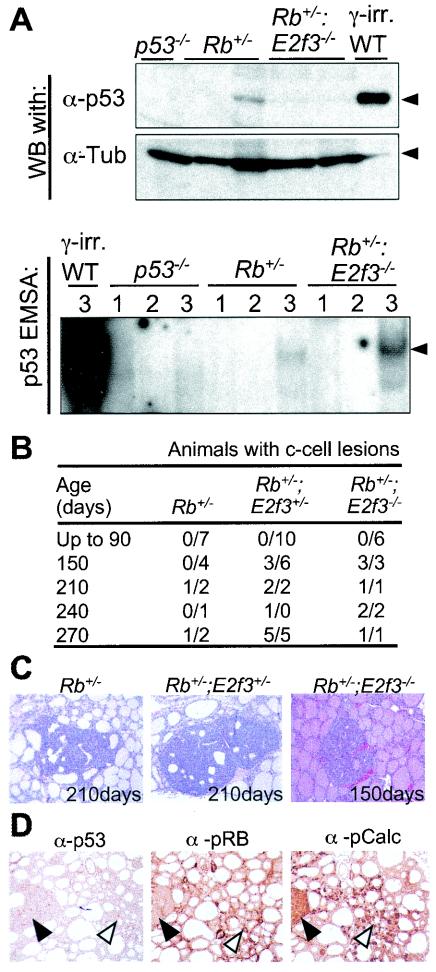
Further characterization of tumors derived from Rb; E2f3 mice. (A) (Upper panels) Levels of p53 protein in MTCs derived from Rb+/− versus Rb+/−; E2f3−/− mice were assayed by Western blotting (WB) of whole-cell extracts derived from various tumors. Whole-cell lysates from wild-type mouse embryonic fibroblasts that had been subjected to 1 Gy of γ-irradiation (γ-irr. WT) and a lymphoma derived from a p53−/− mouse (p53−/−) were used as positive and negative controls, respectively. β-Tubulin was used as a loading control. α-p53, antibody against p53; α-Tub, antibody against β-tubulin. (Lower panel) The same cell extracts were also screened for the presence of p53 activity by EMSAs. The samples were incubated with a mutant competitor (lanes 1), a wild-type competitor (lanes 2), and/or a mutant competitor that included a p53-specific antibody (lanes 3). Arrowhead indicates the p53-DNA complex. (B) Numbers of Rb+/−, Rb+/−; E2f3+/−, and Rb+/−; E2f3−/− animals that had c-cell lesions or developed MTCs at the indicated ages according to histological analysis of serial sections of thyroids. (C) There was a considerable difference in the sizes of tumors in the various Rb; E2f3 genotypes. For example, thetumor in a 210-day-old Rb+/− animal was smaller than that in an age-matched Rb+/−; E2f3+/− mouse and closely resembled that of a 150-day-old Rb+/−; E2f3−/− animal. Magnification, ×40. (D) Analysis of p53, pRB, and pCalc (calcitonin gene product) expression in early c-cell adenomas of Rb+/−; E2f3−/− mice by immunohistochemistry. Solid arrowheads highlight the presence of low levels of p53 and high levels of pCalc, but the absence of pRB expression, in early adenomas. Open arrowheads indicate expression of p53, pRB, and pCalc in c-cells of the thyroid. Magnification, ×40.
FIG. 6.
FIG. 6.
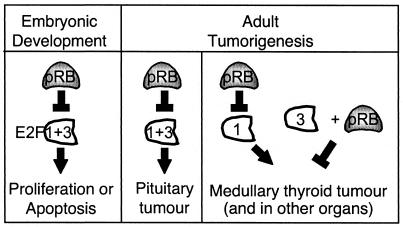
Relative roles of pRB and E2F3 in both development and tumorigenesis.

References

    1. Clarke, A. R., E. R. Maandag, M. van Roon, N. M. van der Lugt, M. van der Valk, M. L. Hooper, A. Berns, and H. te Riele. 1992. Requirement for a functional Rb-1 gene in murine development. Nature 359:328-330. - PubMed
    1. Cloud, J. E., C. Rogers, T. L. Reza, U. Ziebold, J. R. Stone, M. H. Picard, A. M. Caron, R. T. Bronson, and J. A. Lees. 2002. Mutant mouse models reveal the relative roles of E2F1 and E2F3 in vivo. Mol. Cell. Biol. 22:2663-2672. - PMC - PubMed
    1. Cook, W. D., and B. J. McCaw. 2000. Accommodating haploinsufficient tumor suppressor genes in Knudson's model. Oncogene 19:3434-3438. - PubMed
    1. DeGregori, J., G. Leone, A. Miron, L. Jakoi, and J. R. Nevins. 1997. Distinct roles for E2F proteins in cell growth control and apoptosis. Proc. Natl. Acad. Sci. USA 94:7245-7250. - PMC - PubMed
    1. Dyson, N. 1998. The regulation of E2F by pRB-family proteins. Genes Dev. 12:2245-2262. - PubMed

Publication types

MeSH terms