. 2003 Sep;23(18):6585-96.
doi: 10.1128/MCB.23.18.6585-6596.2003.

The checkpoint protein Rad24 of Saccharomyces cerevisiae is involved in processing double-strand break ends and in recombination partner choice

Affiliations

The checkpoint protein Rad24 of Saccharomyces cerevisiae is involved in processing double-strand break ends and in recombination partner choice

Yael Aylon et al. Mol Cell Biol. 2003 Sep.

Abstract

Upon chromosomal damage, cells activate a checkpoint response that includes cell cycle arrest and a stimulation of DNA repair. The checkpoint protein Rad24 is key to the survival of a single, repairable double-strand break (DSB). However, the low survival of rad24 cells is not due to their inability to arrest cell cycle progression. In rad24 mutants, processing of the broken ends is delayed and protracted, resulting in extended kinetics of DSB repair and in cell death. The limited resection of rad24 mutants also affects recombination partner choice by a mechanism dependent on the length of the interacting homologous donor sequences. Unexpectedly, rad24 cells with a DSB eventually accumulate and die at the G(2)/M phase of the cell cycle. This arrest depends on the spindle checkpoint protein Mad2.


Figures
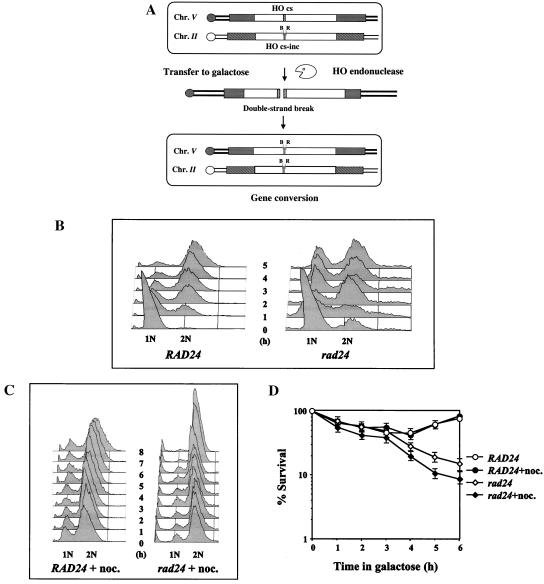
FIG. 1.
FIG. 1.
(A) Schematic representation of our experimental system. Open rectangles represent the ura3 alleles on chromosomes II and V. A stippled box represents the HOcs; a grey box depicts the inactive HOcs-inc flanked by the BamHI (designated B) and EcoRI (designated R) restriction sites. Transfer of the cells to galactose-containing medium results in a DSB that is repaired by gene conversion. (B) FACS analysis of strains MK203 and MK203rad24. Cells were synchronized at G1 with α-factor and released into medium containing galactose at 0 h. (C) Exponentially growing MK203 and MK203rad24 cells were artificially arrested at G2/M with nocodazole, transferred to galactose with nocodazole, and subjected to FACS analysis to confirm complete G2/M arrest. (D) Aliquots from the same experiment were also plated on glucose at different times after HO induction. Survival was determined as relative number of CFU.
FIG. 2.
FIG. 2.
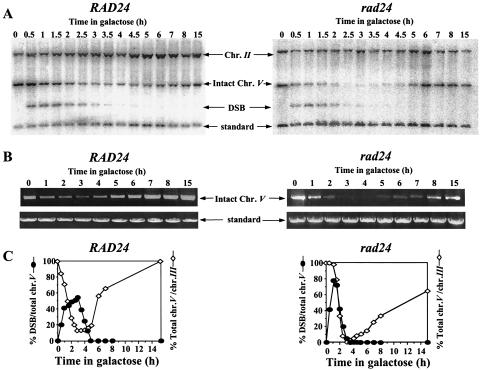
(A) Southern blot analysis of DNA extracted from MK203 and MK203rad24 cells at intervals after HO induction. The DNA was digested with ClaI and probed with the URA3 gene. A probe for the LEU2 sequence served as a loading standard. (B) Quantitative PCR of the relative amounts of intact chromosome V in MK203 and MK203rad24 cells. PCR was quantified relative to the unrelated gene PRP8 in the same PCR. (C) Quantitation of Southern blot and PCR analysis. “Total chr. V” refers to the sum of broken and intact chromosome V sequences detected in the Southern blot.
FIG. 3.
FIG. 3.
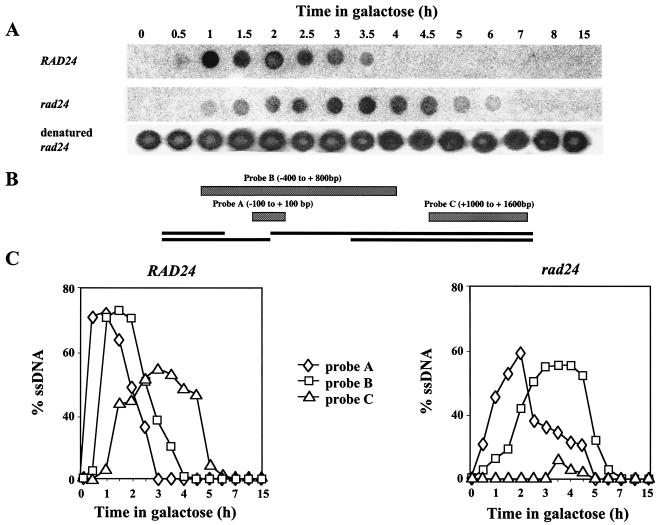
Dot blot assays. (A) A sample dot blot representing the differential accumulation of ssDNA intermediates in MK203 and MK203rad24 cells. Samples were hybridized with probe B. (B) Schematic representation of probes used in dot blot assays. Distance from HOcs is shown. (C) Quantitation of dot blots. The percentage of ssDNA was determined relative to the amount of denatured DNA hybridizing to the same probe in each sample.
FIG. 4.
FIG. 4.
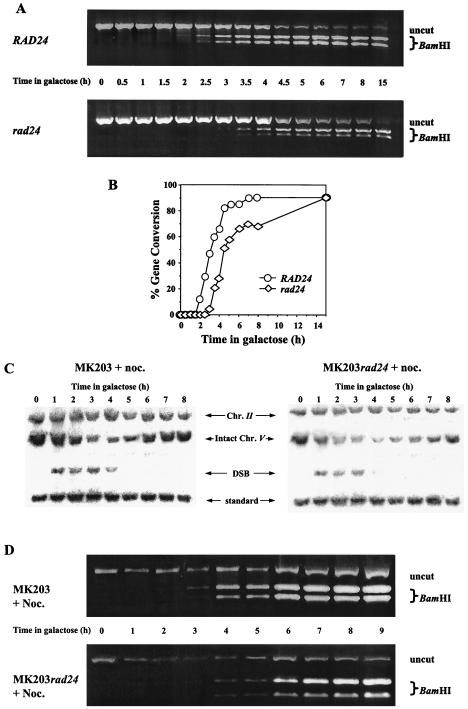
Real-time gene conversion assay. (A) DNA from MK203 and MK203rad24 cells was extracted at intervals after HO induction. Equal amounts of PCR products flanking the DSB were digested with BamHI. Only fragments originating from a template repaired by gene conversion can be digested. (B) Quantitation of PCR. Percent gene conversion represents the portion of PCR fragments cut by BamHI. (C and D) Exponentially growing MK203 and MK203rad24 cells were arrested at G2/M with nocodazole (noc.) and transferred to galactose in the presence of nocodazole. Southern blot (C) and PCR (D) analyses were carried out as described above.
FIG. 5.
FIG. 5.
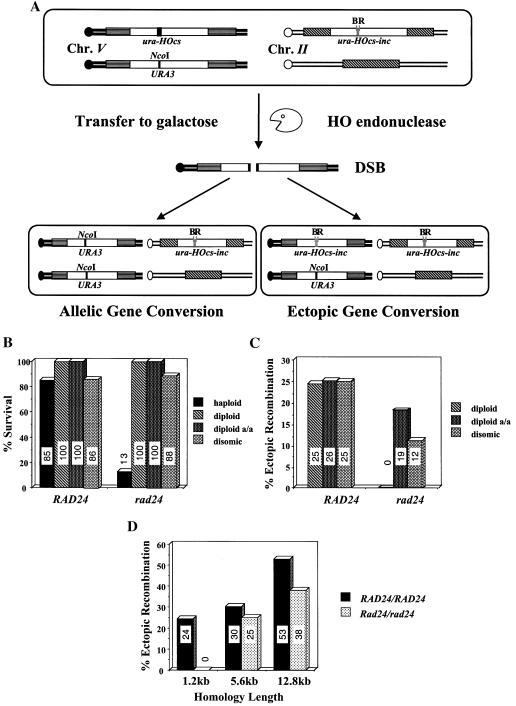
(A) A schematic representation of the diploid strain used to assay ectopic and allelic recombination. MK235 is an isogenic derivative of MK203 in which the DSB (chromosome V) can be repaired by recombination with either URA3 sequences (chromosome V) or ura-Hocs-inc sequences (chromosome II). A stippled box represents the HOcs; a light grey box depicts the inactive HOcs-inc flanked by the BamHI (designated B) and EcoRI (designated R) restriction sites; a dark grey line depicts the NcoI site in URA3. (B) Survival of wild-type and rad24 strains on YEPGal (constitutive expression of the HO endonuclease) compared to YEPD (no HO expression) plates. (C) Proportion of colonies that utilized an ectopic recombination donor in order to repair a single DSB. (D) Proportion of diploid colonies that utilized an ectopic recombination donor in order to repair a single DSB. Homology length indicates the extent of homologous sequences on chromosome II flanking the ura-HOcs-inc.
FIG. 6.
FIG. 6.
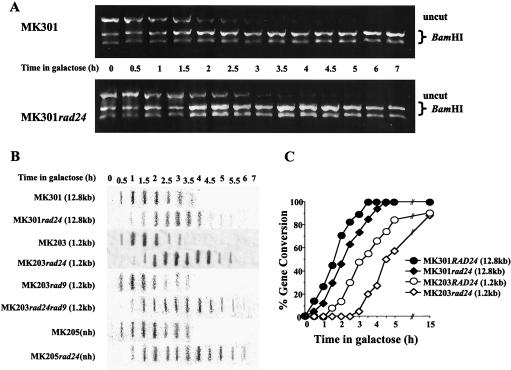
Real-time gene conversion assay. (A) DNA from MK301 and MK301rad24 cells was extracted at intervals after HO induction. Equal amounts of PCR products flanking the DSB were digested with BamHI. In this strain, homology length is 12.8 kb, and therefore the donor URA3 sequences are also detected in the PCR assay. At 0 h, only half the PCR products can be digested with BamHI. Repair of the broken chromosome by gene conversion progressively increases the relative proportion of BamHI-containing fragments. Uncut PCR fragments represent the portion of the population that has not undergone gene conversion. (B) Slot blot assays. Nondenatured DNA was hybridized with probe B (complementary to 1.2-kb URA3, as described previously). (C) Graphic representation of the kinetics of gene conversion. Percent gene conversion represents the relative percentage of PCR fragments digested by BamHI compared to those seen at 0 h.
FIG. 7.
FIG. 7.
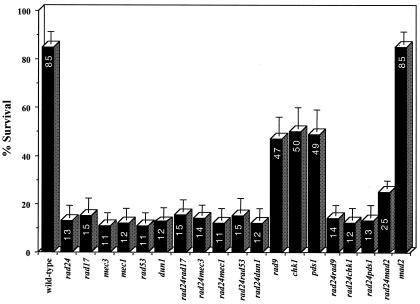
Survival of different strains on YEPGal (constitutive expression of the HO endonuclease) compared to YEPD (no HO expression) plates.
FIG. 8.
FIG. 8.
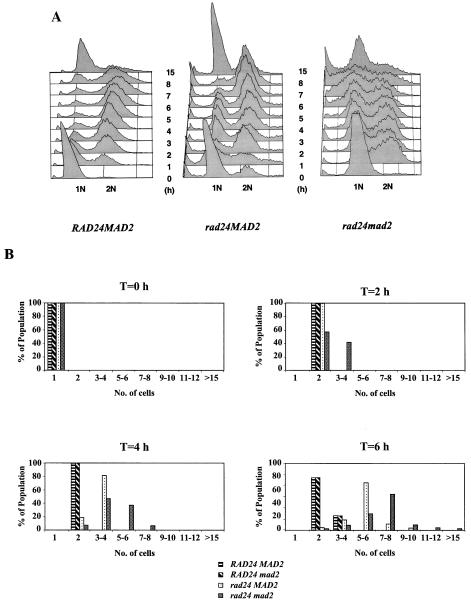
(A) FACS analysis of MK203, MK203rad24, and MK203rad24 mad2 strains. Cells were synchronized at G1 with α-factor and released into medium containing galactose at 0 h. (B) Single, unbudded MK203, MK203mad2, MK203rad24, and MK203rad24 mad2 cells were manipulated on galactose-containing medium, observed microscopically, and tallied.

References

    1. Aboussekhra, A., J. E. Vialard, D. E. Morrison, M. A. de la Torre-Ruiz, L. Cernakova, F. Fabre, and N. F. Lowndes. 1996. A novel role for the budding yeast RAD9 checkpoint gene in DNA damage-dependent transcription. EMBO J. 15:3912-3922. - PMC - PubMed
    1. Aylon, Y., B. Liefshietz, G. Bitan-Banin, and M. Kupiec. 2003. Molecular dissection of mitotic recombination in the yeast Saccharomyces cerevisiae. Mol. Cell. Biol. 23:1403-1417. - PMC - PubMed
    1. Bashkirov, V. I., J. S. King, E. V. Bashkirova, J. Schmuckli-Maurer, and W. D. Heyer. 2000. DNA repair protein Rad55 is a terminal substrate of the DNA damage checkpoints. Mol. Cell. Biol. 20:4393-4404. - PMC - PubMed
    1. Booth, C., E. Griffith, G. Brady, and D. Lydall. 2001. Quantitative amplification of single-stranded DNA (QAOS) demonstrates that cdc13-1 mutants generate ssDNA in a telomere to centromere direction. Nucleic Acids Res. 29:4414-4422. - PMC - PubMed
    1. Carr, A. M. 1997. Control of cell cycle arrest by the Mec1sc/Rad3sp DNA structure checkpoint pathway. Curr. Opin. Genet. Deversion 7:93-98. - PubMed

Publication types

MeSH terms

LinkOut - more resources