Comparative Study
. 2003 Sep;93(9):1509-16.
doi: 10.2105/ajph.93.9.1509.

Promoting safe walking and cycling to improve public health: lessons from The Netherlands and Germany

Affiliations
Comparative Study

Promoting safe walking and cycling to improve public health: lessons from The Netherlands and Germany

John Pucher et al. Am J Public Health. 2003 Sep.

Abstract

Objectives: We examined the public health consequences of unsafe and inconvenient walking and bicycling conditions in American cities to suggest improvements based on successful policies in The Netherlands and Germany.

Methods: Secondary data from national travel and crash surveys were used to compute fatality trends from 1975 to 2001 and fatality and injury rates for pedestrians and cyclists in The Netherlands, Germany, and the United States in 2000.

Results: American pedestrians and cyclists were much more likely to be killed or injured than were Dutch and German pedestrians and cyclists, both on a per-trip and on a per-kilometer basis.

Conclusions: A wide range of measures are available to improve the safety of walking and cycling in American cities, both to reduce fatalities and injuries and to encourage walking and cycling.


Figures
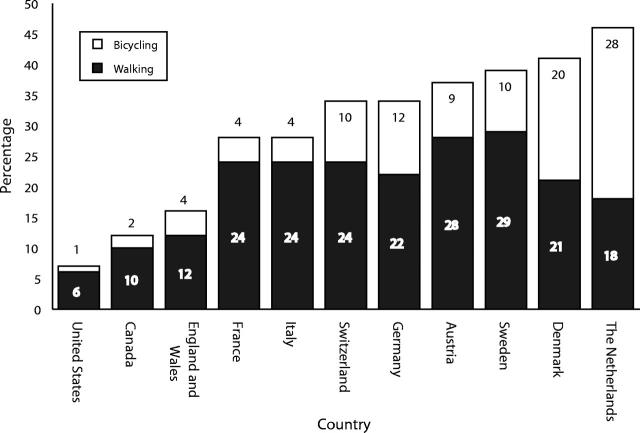
FIGURE 1—
FIGURE 1—
Percentage of trips in urban areas made by walking and bicycling in North America and Europe, 1995. Note. Modal split distributions for different countries are not fully comparable owing to differences in trip definitions, survey methodologies, and urban area boundaries. The distributions given here are intended to show the approximate differences among countries and should not be used for exact comparisons. Source. Transportation Research Board, Table 2–2, p. 30.
FIGURE 2—
FIGURE 2—
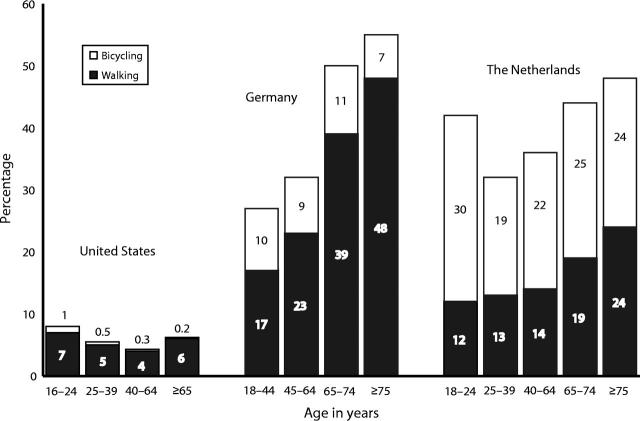
Percentage of trips in urban areas made by walking and bicycling in the United States, Germany, and The Netherlands, by age group, 1995. Source. US Department of Transportation, German Ministry of Transport, and Statistics Netherlands.
FIGURE 3—
FIGURE 3—
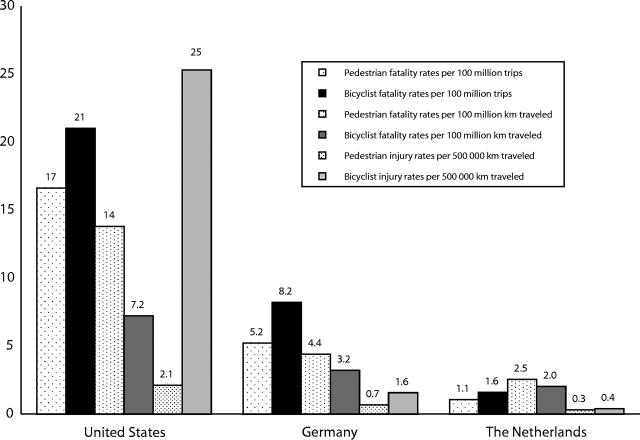
Pedestrian and bicycling fatality rates and nonfatal injury rates in the United States, Germany, and The Netherlands, 2000. Source. US Department of Transportation; Centers for Disease Control and Prevention; German Institute of Economic Research; German Federal Statistical Office; German Federal Traffic Institute; Statistics Netherlands; and Dutch Ministry for Transport, Public Works and Water Management.
FIGURE 4—
FIGURE 4—
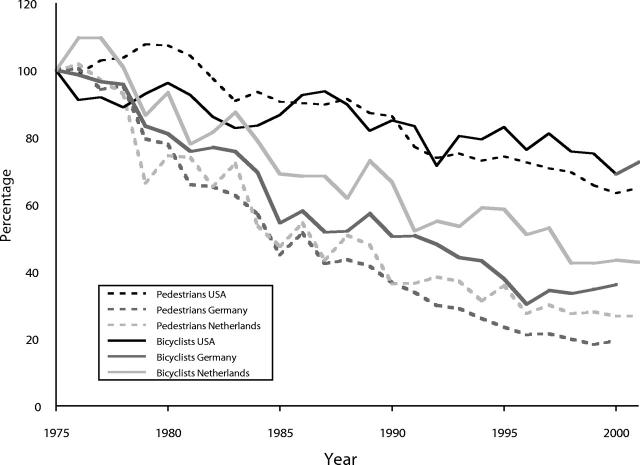
Trends in pedestrian and bicycling fatalities in the United States, Germany, and The Netherlands, 1975–2001 (1975 = 100%). Source. US Department of Transportation; German Federal Statistical Office; German Federal Traffic Institute; Statistics Netherlands; and Dutch Ministry for Transport, Public Works and Water Management.

References

    1. A. H. Mokdad, B. A. Bowman, E. S. Ford, F. Vivicor, J. S. Marks, and J. P. Koplan, “The Continuing Epidemics of Obesity and Diabetes in the United States,” JAMA 286 (2001): 1195–1200. - PubMed
    1. K. Flegal, M. Carroll, C. Ogden, and C. Johnson, “Prevalence and Trends in Obesity Among Adults, 1999–2000,” JAMA 288 (2002): 1723–1727. - PubMed
    1. C. Dora, “A Different Route to Health: Implications of Transport Policies,” British Medical Journal 318 (1999): 1686–1689. - PMC - PubMed
    1. J. Koplan and W. Dietz, “Caloric Imbalance and Public Health Policy,” JAMA 282 (1999): 1579–1581. - PubMed
    1. D. Carnall, “Cycling and Health Promotion,” British Medical Journal 320 (2000): 888. - PMC - PubMed

Publication types

MeSH terms