Social capital and the built environment: the importance of walkable neighborhoods
- PMID: 12948978
- PMCID: PMC1448008
- DOI: 10.2105/ajph.93.9.1546
Social capital and the built environment: the importance of walkable neighborhoods
Abstract
Objectives: I sought to examine whether pedestrian-oriented, mixed-use neighborhoods encourage enhanced levels of social and community engagement (i.e., social capital).
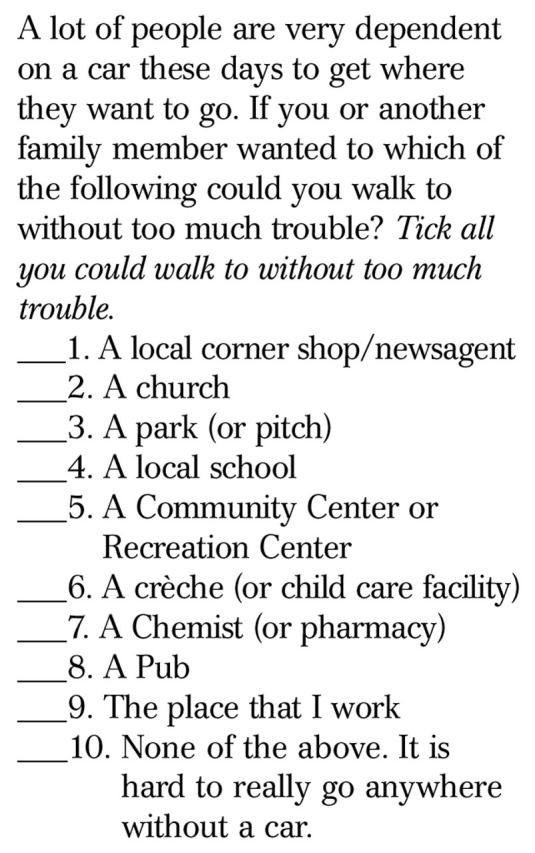
Methods: The study investigated the relationship between neighborhood design and individual levels of social capital. Data were obtained from a household survey that measured the social capital of citizens living in neighborhoods that ranged from traditional, mixed-use, pedestrian-oriented designs to modern, car-dependent suburban subdivisions in Galway, Ireland.
Results: The analyses indicate that persons living in walkable, mixed-use neighborhoods have higher levels of social capital compared with those living in car-oriented suburbs. Respondents living in walkable neighborhoods were more likely to know their neighbors, participate politically, trust others, and be socially engaged.
Conclusions: Walkable, mixed-use neighborhood designs can encourage the development of social capital.
Figures
References
-
- Kaplan GA. Social contacts and ischaemic heart disease. Ann Clin Res. 1988;20:131–136. - PubMed
-
- House JS, Landis KR, Umberson D. Social relationships and health. Science. 1988;241:540–545. - PubMed
-
- Berkman LF. The role of social relations in health promotion. Psychosomatic Med. 1995;57:245–254. - PubMed
-
- Berkman LF, Syme SL. Social networks, host resistance and mortality: a nine year follow-up of Alameda County residents. Am J Epidemiol. 1979;109:186–204. - PubMed
-
- House JS, Robbins C, Metzner HL. The association of social relationships and activities with mortality: prospective evidence from the Tecumseh Community Health Study. Am J Epidemiol. 1982;116:123–140. - PubMed
Publication types
MeSH terms
LinkOut - more resources
Full Text Sources