. 2003 Sep;185(18):5627-31.
doi: 10.1128/JB.185.18.5627-5631.2003.

Rapid surface motility in Bacillus subtilis is dependent on extracellular surfactin and potassium ion

Affiliations

Rapid surface motility in Bacillus subtilis is dependent on extracellular surfactin and potassium ion

Rebecca F Kinsinger et al. J Bacteriol. 2003 Sep.

Abstract

Motility on surfaces is an important mechanism for bacterial colonization of new environments. In this report, we describe detection of rapid surface motility in the wild-type Bacillus subtilis Marburg strain, but not in several B. subtilis 168 derivatives. Motility involved formation of rapidly spreading dendritic structures, followed by profuse surface colonies if sufficient potassium ion was present. Potassium ion stimulated surfactin secretion, and the role of surfactin in surface motility was confirmed by deletion of a surfactin synthase gene. Significantly, this motility was independent of flagella. These results demonstrate that wild-type B. subtilis strains can use both swimming and sliding-type mechanisms to move across surfaces.


Figures
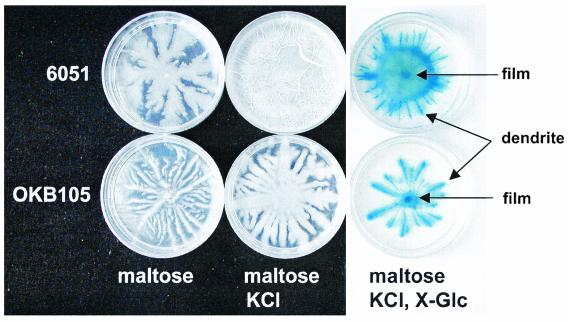
FIG. 1.
FIG. 1.
Effect of KCl on the surface growth of B. subtilis 6051and OKB105 and visualization of the stages of surface growth with X-Glc. Shown are CMal agarose plates (pH 7.5) with no added KCl (left), with 2 mM KCl added (center), or with 2 mM KCl and 80 μg ml−1 X-Glc added to visualize β-glucosidase activity (right). The arrows indicate (i) some of the many blue-stained dendrites of cells growing out from the central point of inoculation and (ii) a slower-growing surface film that fills in between the individual dendrites. It should be noted that in the presence of X-Glc in the CMal-KCl agarose medium, both dendritic growth and surface film growth were slower than in its absence (center plates). All plates were inoculated in the center and grown overnight at 37°C, and the results were replicated in three independent experiments.
FIG. 2.
FIG. 2.
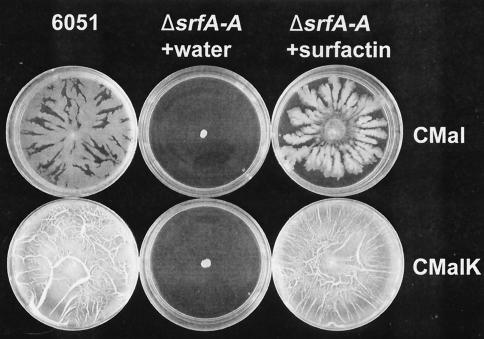
Insertional inactivation of the srfA-A gene in B. subtilis M1 blocks dendritic growth on a low-potassium medium and K+-dependent surface film formation on a high-potassium medium, and addition of authentic B. subtilis surfactin restores rapid surface growth. (Top row) Plates of CMal agarose (low potassium) were inoculated in duplicate with 6051 (B. subtilis Marburg), the ΔsrfA-A mutant, or the ΔsrfA-A mutant plus surfactin. For the latter two inoculations, the center of each plate was spotted with 10 μl of water or a surfactin solution (10 mg ml−1 in 20 mM NaOH) and dried 45 min before inoculation. The bottom row is the same as the top row, but plates containing 7 mM K2HPO4 (CMalK agarose) were used. The center of the plates was inoculated with sterile toothpicks from cultures grown on CMal agarose plates, and then the plates were incubated for 8 h at 40°C. All of the results shown are from multiple, independent experiments; similar results were seen if surfactin was dissolved in 20 mM Tris base.
FIG. 3.
FIG. 3.
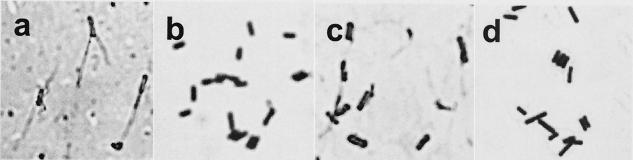
Flagellar staining of motile B. subtilis 6051cells from the leading edges of growth on motility agar (Bsa) (a) versus CM-K2HPO4 agarose (c). Gram stains are also shown for motile cells from Bsa (b) and CM-K2HPO4 agarose (d). Polar flagella are readily visible on motile cells from Bsa motility agar, but not on those from CM-K2HPO4 agarose. In numerous images like that shown in panel c, faint background structures were due to components of the stain and not detached flagella.

References

    1. Anagnostopolous, C., and J. Spizizen. 1961. Requirements for transformation in Bacillus subtilis. J. Bacteriol. 81:741-746. - PMC - PubMed
    1. Boudor, A. A., and R. M. Miller-Maier. 1998. Application of a modified drop-collapse technique for surfactant quantitation and screening of biosurfactant-producing microorganisms. J. Microbiol. Methods 32:273-280.
    1. Branda, S. S., J. E. González-Pastor, S. Ben-Yehuda, R. Losick, and R. Kolter. 2001. Fruiting body formation by Bacillus subtilis. Proc. Natl. Acad. Sci. USA 98:11621-11626. - PMC - PubMed
    1. Cutting, S. M., and P. B. Vander Horn. 1990. Genetic analysis, p. 27-74. In C. R. Harwood and S. M. Cutting (ed.), Molecular biological methods for Bacillus. John Wiley & Sons, Chichester, United Kingdom.
    1. Dunne, W. M., Jr. 2002. Bacterial adhesion: seen any good biofilms lately? Clin. Microbiol. Rev. 15:155-166. - PMC - PubMed

Publication types

LinkOut - more resources