


A short latency vestibulomasseteric reflex evoked by electrical stimulation over the mastoid in healthy humans
- PMID: 12949229
- PMCID: PMC2343496
- DOI: 10.1113/jphysiol.2003.047274
A short latency vestibulomasseteric reflex evoked by electrical stimulation over the mastoid in healthy humans
Abstract
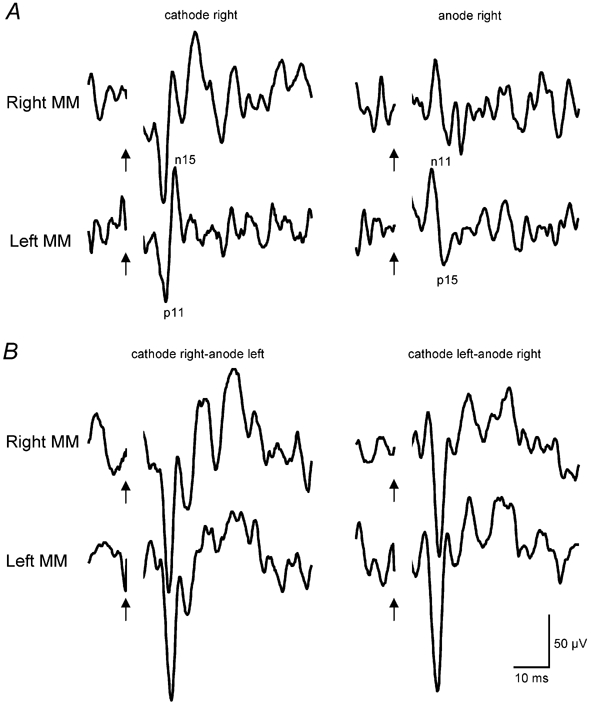
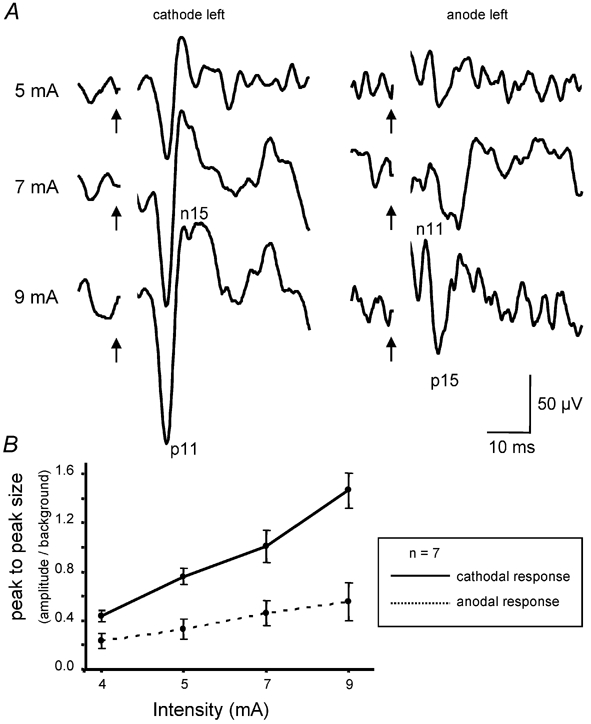
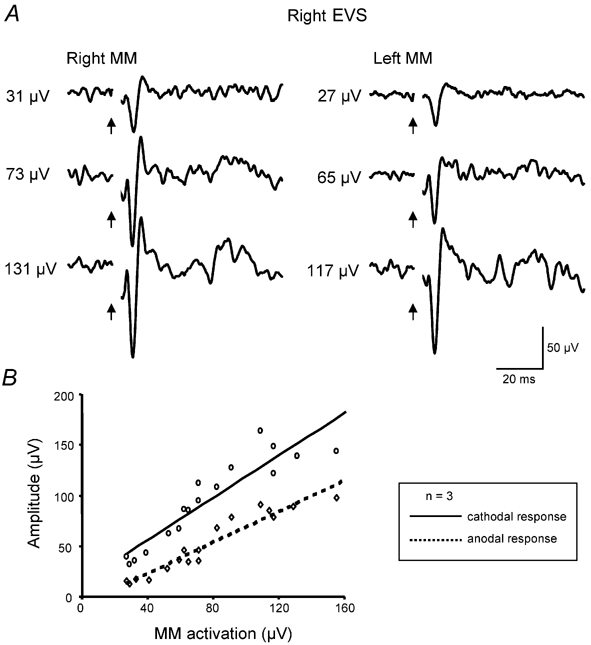
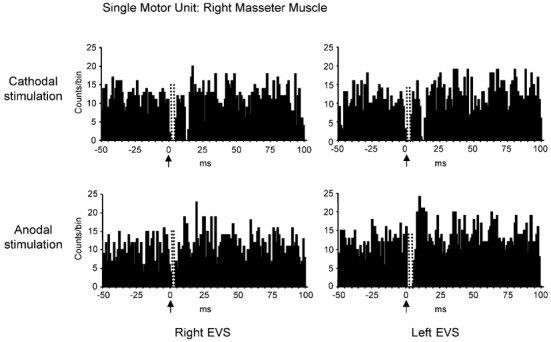
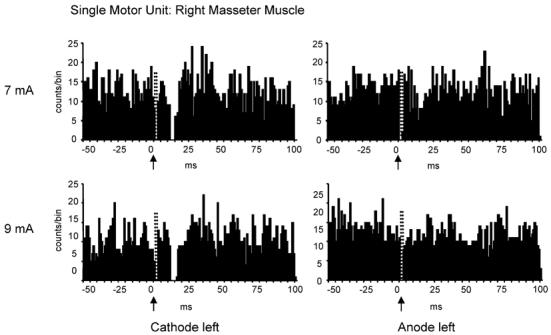
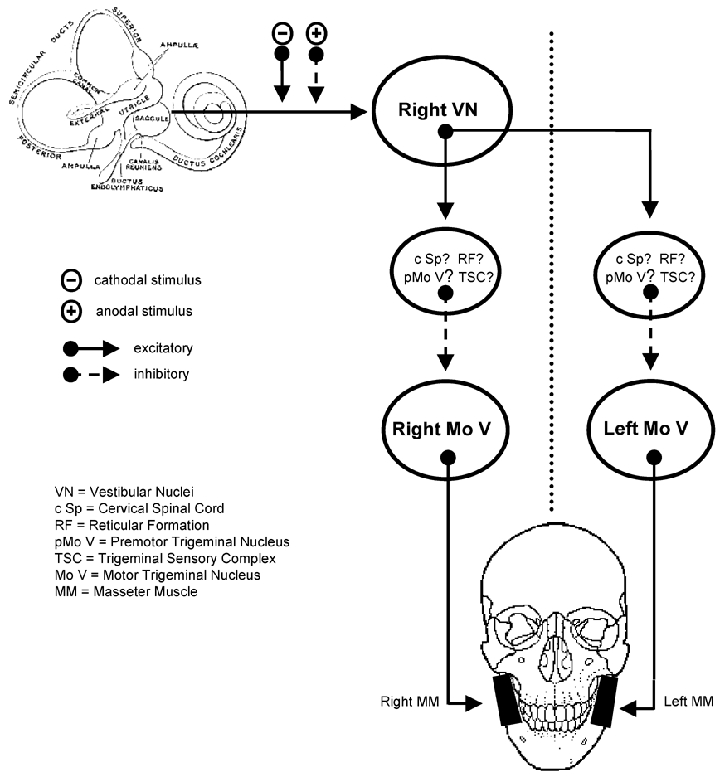
We describe EMG responses recorded in active masseter muscles following unilateral and bilateral electrical vestibular stimulation (EVS, current pulses of 5 mA intensity, 2 ms duration, 3 Hz frequency). Averaged responses in unrectified masseter EMG induced by unilateral EVS were examined in 16 healthy subjects; effects induced by bilateral (transmastoid) stimulation were studied in 10 subjects. Results showed that unilateral as well as bilateral EVS induces bilaterally a clear biphasic response (onset latency ranging from 7.2 to 8.8 ms), that is of equal amplitude and latency contra- and ipsilateral to the stimulation site. In all subjects, unilateral cathodal stimulation induced a positive-negative response termed p11/n15 according to its mean peak latency; the anodal stimulation induced a response of opposite polarity (n11/p15) in 11/16 subjects. Cathodal responses were significantly larger than anodal responses. Bilateral stimulation induced a p11/n15 response significantly larger than that induced by the unilateral cathodal stimulation. Recordings from single motor units showed that responses to cathodal stimulation corresponded to a brief (2-4 ms) silent period in motor unit discharge rate. The magnitude of EVS-induced masseter response was linearly related to current intensity and scaled with the mean level of EMG activity. The size of the p11/n15 response was asymmetrically modulated when subjects were tilted on both sides; in contrast head rotation did not exert any influence. Control experiments excluded a possible role of cutaneous receptors in generating the masseter response. We conclude that transmastoid electrical stimulation evokes vestibulomasseteric reflexes in healthy humans at latencies consistent with a di-trisynaptic pathway.
Figures
References
-
- Baird RA, Desmadryl G, Fernandez C, Goldberg JM. The vestibular nerve of the chinchilla. II. Relation between afferent response properties and peripheral innervation patterns in the semicircular canals. J Neurophysiol. 1988;60:182–203. - PubMed
-
- Bense S, Stephan T, Yousry TA, Brandt T, Dieterich M. Multisensory cortical signal increases and decreases during vestibular galvanic stimulation (fMRI) J Neurophysiol. 2001;85:886–899. - PubMed
-
- Berthoz A. Adaptive mechanisms in eye-head coordination. In: Berthoz A, Melvill Jones G, editors. Rev Oculomotor Control. Adaptative Mechanism in Gaze Control. Facts and Theories. Vol. 1. Amsterdam: Elsevier; 1985. pp. 178–201.
-
- Bickford RG, Jacobson JL, Cody D TH. Nature of average evoked potentials to sound and other stimuli in man. Ann N Y Acad Sci. 1964;112:204–218. - PubMed
-
- Britton TC, Day BL, Brown P, Rothwell JC, Thompson PD, Marsden CD. Postural electromyographic responses in the arm and leg following galvanic vestibular stimulation in man. Exp Brain Res. 1993;94:143–151. - PubMed
Publication types
MeSH terms
LinkOut - more resources
Full Text Sources
