. 2003 Sep;13(9):1984-97.
doi: 10.1101/gr.1191603.

Retrotransposons and their recognition of pol II promoters: a comprehensive survey of the transposable elements from the complete genome sequence of Schizosaccharomyces pombe

Affiliations

Retrotransposons and their recognition of pol II promoters: a comprehensive survey of the transposable elements from the complete genome sequence of Schizosaccharomyces pombe

Nathan J Bowen et al. Genome Res. 2003 Sep.

Abstract

The complete DNA sequence of the genome of Schizosaccharomyces pombe provides the opportunity to investigate the entire complement of transposable elements (TEs), their association with specific sequences, their chromosomal distribution, and their evolution. Using homology-based sequence identification, we found that the sequenced strain of S. pombe contained only one family of full-length transposons. This family, Tf2, consisted of 13 full-length copies of a long terminal repeat (LTR) retrotransposon. We found that LTR-LTR recombination of previously existing transposons had resulted in extensive populations of solo LTRs. These included 35 solo LTRs of Tf2, as well as 139 solo LTRs from other Tf families. Phylogenetic analysis of solo Tf LTRs reveals that Tf1 and Tf2 were the most recently active elements within the genome. The solo LTRs also served as footprints for previous insertion events by the Tf retrotransposons. Analysis of 186 genomic insertion events revealed a close association with RNA polymerase II promoters. These insertions clustered in the promoter-proximal regions of genes, upstream of protein coding regions by 100 to 400 nucleotides. The association of Tf insertions with pol II promoters was very similar to the preference previously observed for Tf1 integration. We found that the recently active Tf elements were absent from centromeres and pericentromeric regions of the genome containing tandem tRNA gene clusters. In addition, our analysis revealed that chromosome III has twice the density of insertion events compared to the other two chromosomes. Finally we describe a novel repetitive sequence, wtf, which was also preferentially located on chromosome III, and was often located near solo LTRs of Tf elements.


Figures
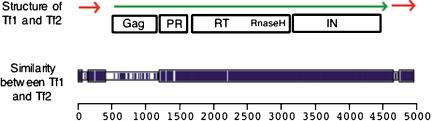
Figure 1
Figure 1
Tf1 and Tf2 diagram. The diagram at the top is the structure of Tf1 and Tf2. The positions of the LTRs are indicated by red arrows. Likewise, the long polyprotein is indicated by a green arrow. The locations of the protein domains are indicated in boxes below the polyprotein. The block diagram at the bottom was constructed with the program Macaw (Schuler et al. 1991) to indicate the regions of identity (shown in blue) between Tf1 and Tf2. The regions of extensive homology are indicated by the taller blue rectangles.
Figure 2
Figure 2
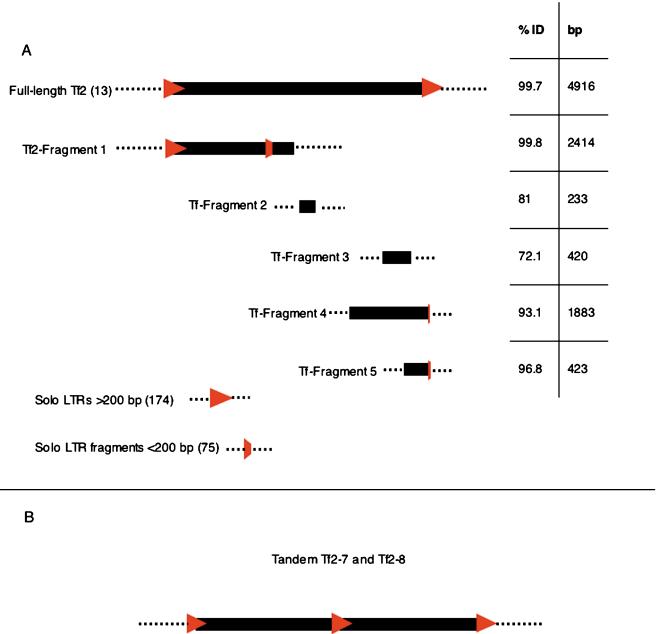
Transposon content of the S. pombe genome. (A) Schematics of each type of Tf sequence found in the genome. The Tf LTRs and LTR fragments are indicated by red triangles or portions thereof; the internal portions of Tf elements were depicted by black rectangles. The surrounding genomic DNA is indicated by dashed lines. The numbers in parentheses indicate the number of each sequence when multiples were found. The individual fragments are shown beneath a full-length Tf2 element to indicate their relative position in Tf2. (Top panel table) The left column indicates the average pairwise identity for the full-length elements and the identity of each individual fragment to a full-length Tf2 element. The right column indicates the size of each Tf sequence. (B) A depiction of the tandem elements.
Figure 3
Figure 3
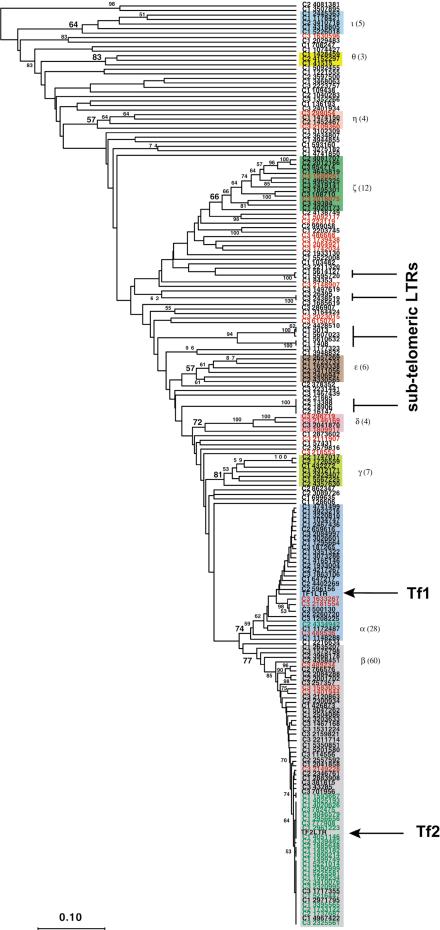
UPGMA phylogeny of Tf LTRs >200 bp in length. The phylogeny indicates the relationship between the LTRs found in the S. pombe genome. Branches with >50% bootstrap support are indicated. The branches with more than two members and >50% bootstrap support are designated LTR families and are indicated by Greek letters adjacent to the colored boxes that identify the members of each designated family. The number of members of each designated family is indicated in parentheses. Each LTR is labeled with the chromosome coordinate of its midpoint. The LTRs from the full-length elements are designated by coordinates in green. The query Tf1 and Tf2 LTRs are indicated by an arrow. The multiple subtelomeric LTRs are also indicated.
Figure 4
Figure 4
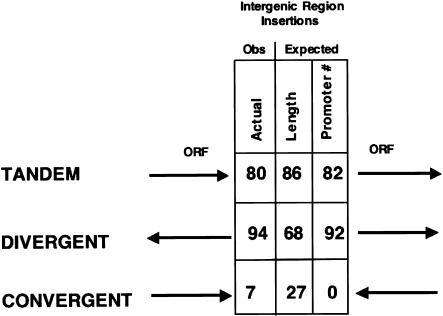
Schematic of intergenic insertions. (Left column) The number of Tf insertions found in intergenic regions between tandem, divergent, and convergent genes. (Center column) Number of insertions into these regions expected based on the size and number of intergenic sequences belonging to each class. (Right column) Number of insertions into these regions expected based on the number of RNA polymerase II promoters present in each type of intergenic sequence.
Figure 5
Figure 5
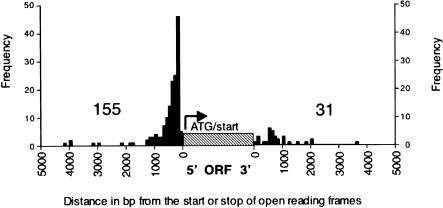
Histograms depicting the distance from Tf insertion sites to the nearest ORF. The numbers of Tf insertions closer to the 5′ ends of adjacent ORFs and to the 3′ ends of adjacent ORFs were determined. The corresponding histograms were constructed by including insertions closer to the 5′ end of an ORF on the upstream side of the ORF (cross-hatched). Insertions closer to the 3′ side of an ORF were included on the downstream side of the ORF. The insertions are binned in regions of 100 bp.
Figure 6
Figure 6
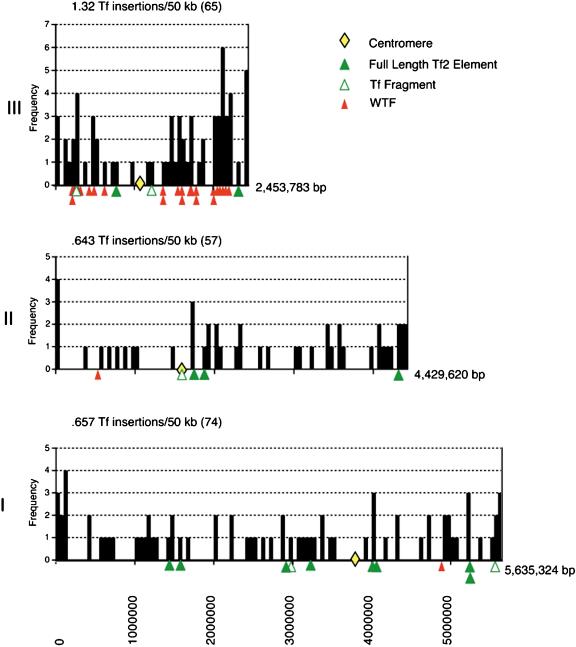
Chromosomal histograms. The chromosomal histograms indicate the number of Tf LTRs found in bins of 50-kb intervals along the chromosomal arms. The locations of the full-length elements, fragments, wtfs, and centromeres are also indicated on the axis of each chromosome. The length of each chromosome is shown to the right of the histograms. Note that 500 kbp of rDNA found on each end of chromosome III are not shown.
Figure 7
Figure 7
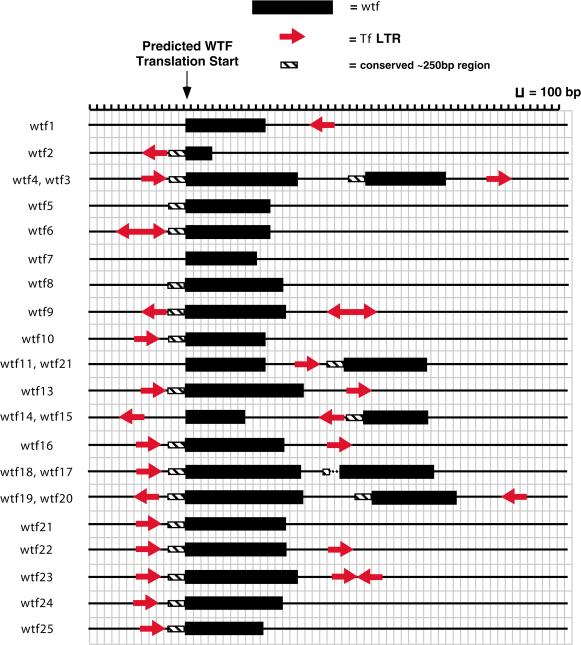
A scaled schematic of wtfs and flanking LTRs. The position and orientation of each LTR associated with wtfs is shown in a drawing made to scale. The wtfs are indicated by black rectangles and the LTRs by red arrows. The LTR arrowheads indicate the orientation relative to the neighboring wtf. In each case, the wtf is drawn 5′ to 3′ and its size corresponds to its current annotation in GenBank. The number of each wtf corresponds to those given in Table 3. The presence of the conserved sequence upstream of the wtfs is indicated by a cross-hatched rectangle. A truncated version of this conserved sequence is indicated by two dots.

References

    1. Ahmad, K. and Henikoff, S. 2002. The histone variant H3.3 marks active chromatin by replication-independent nucleosome assembly. Mol. Cell 9: 1191–1200. - PubMed
    1. Behrens, R., Hayles, J., and Nurse, P. 2000. Fission yeast retrotransposon Tf1 integration is targeted to 5′ ends of open reading frames. Nucleic Acids Res. 28: 4709–4716. - PMC - PubMed
    1. Berbee, M. L. and Taylor, J.W. 1993. Dating the evolutionary radiations of the true fungi. Canadian J. Botany-Revue Canadienne De Botanique 718: 1114–1127.
    1. Boeke, J.D. and Stoye, J.P. 1997. Retrotransposons, endogenous retroviruses, and the evolution of retroelements. In Retroviruses (eds. J.M. Coffin et al.), pp. 343–436. Cold Spring Harbor Laboratory Press, Cold Spring Harbor, NY. - PubMed
    1. Bowen, N.J. and McDonald, J.F. 1999. Genomic analysis of Caenorhabditis elegans reveals ancient families of retroviral-like elements. Genome Res. 9: 924–935. - PubMed

WEB SITE REFERENCES

    1. http://www.sanger.ac.uk/Projects/S_pombe/blast_server.shtml; S. pombe Blast Server.
    1. http://blast.wustl.edu/blast/cparms.html; Washington University description of parameters for WU BLAST.
    1. http://eclipse.nichd.nih.gov/nichd/lgrd/sete/index.htm; Levin lab Web site with supplemental data from this paper.

LinkOut - more resources