Asymmetric sequence divergence of duplicate genes
- PMID: 12952876
- PMCID: PMC403682
- DOI: 10.1101/gr.1252603
Asymmetric sequence divergence of duplicate genes
Abstract
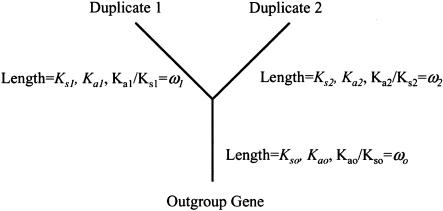
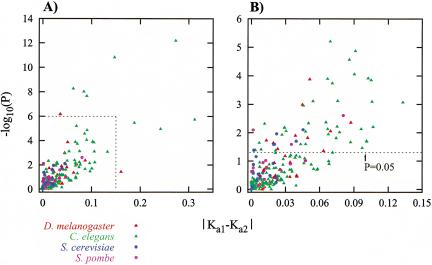
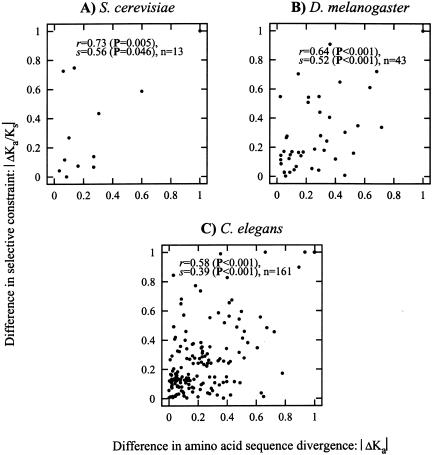
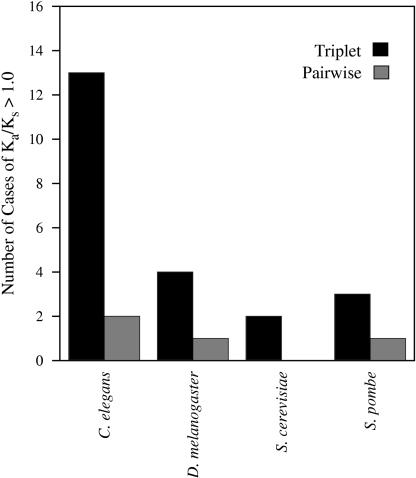
Much like humans, gene duplicates may be created equal, but they do not stay that way for long. For four completely sequenced genomes we show that 20%-30% of duplicate gene pairs show asymmetric evolution in the amino acid sequence of their protein products. That is, one of the duplicates evolves much faster than the other. The greater this asymmetry, the greater the ratio Ka/Ks of amino acid substitutions (Ka) to silent substitutions (Ks) in a gene pair. This indicates that most asymmetric divergence may be caused by relaxed selective constraints on one of the duplicates. However, we also find some candidate duplicates where positive (directional) selection of beneficial mutations (Ka/Ks > 1) may play a role in asymmetric divergence. Our analysis rests on a codon-based model of molecular evolution that allows a test for asymmetric divergence in Ka. The method is also more sensitive in detecting positive selection (Ka/Ks > 1) than models relying only on pairwise gene comparisons.
Figures
References
-
- Adams, M.D., Celniker, S.E., Holt, R.A., Evans, C.A., Gocayne, J.D., Amanatides, P.G., Scherer, S.E., Li, P.W., Hoskins, R.A., Galle, R.F. et. al. 2000. The genome sequence of Drosophila melanogaster. Science 287: 2185–2195. - PubMed
-
- Bennetzen, J.L. and Hall, B.D. 1982. Codon selection in yeast. Journal of Biological Chemistry 257: 3026–3031. - PubMed
-
- The C. elegans Sequencing Consortium. 1998. Genome sequence of the nematode C. elegans: A platform for investigating biology. Science 282: 2012–2018. - PubMed
Publication types
MeSH terms
Grants and funding
LinkOut - more resources
Full Text Sources
Molecular Biology Databases