. 2003 Sep;112(5):736-44.
doi: 10.1172/JCI17335.

Group B streptococcal beta-hemolysin/cytolysin activates neutrophil signaling pathways in brain endothelium and contributes to development of meningitis

Affiliations

Group B streptococcal beta-hemolysin/cytolysin activates neutrophil signaling pathways in brain endothelium and contributes to development of meningitis

Kelly S Doran et al. J Clin Invest. 2003 Sep.

Abstract

Meningitis occurs when blood-borne pathogens cross the blood-brain barrier (BBB) in a complex interplay between endothelial cells and microbial gene products. We sought to understand the initial response of the BBB to the human meningeal pathogen group B Streptococcus (GBS) and the organism's major virulence factors, the exopolysaccharide capsule and the beta-hemolysin/cytolysin toxin (beta-h/c). Using oligonucleotide microarrays, we found that GBS infection of human brain microvascular endothelial cells (HBMEC) induced a highly specific and coordinate set of genes including IL-8, Groalpha, Grobeta, IL-6, GM-CSF, myeloid cell leukemia sequence-1 (Mcl-1), and ICAM-1, which act to orchestrate neutrophil recruitment, activation, and enhanced survival. Most strikingly, infection with a GBS strain lacking beta-h/c resulted in a marked reduction in expression of genes involved in the immune response, while the unencapsulated strain generally induced similar or greater expression levels for the same subset of genes. Cell-free bacterial supernatants containing beta-h/c activity induced IL-8 release, identifying this toxin as a principal provocative factor for BBB activation. These findings were further substantiated in vitro and in vivo. Neutrophil migration across polar HBMEC monolayers was stimulated by GBS and its beta-h/c through a process involving IL-8 and ICAM-1. In a murine model of hematogenous meningitis, mice infected with beta-h/c mutants exhibited lower mortality and decreased brain bacterial counts compared with mice infected with the corresponding WT GBS strains.


Figures

Figure 1
Figure 1
Effect of GBS mutations on transcript levels. We used real-time RT-PCR to verify the differential expression for five transcripts (IL-8, Groβ, Groα, IL-6, and GM-CSF) after infection with WT, β-h/c–deficient (β-h/c), or capsule-deficient (cps) GBS. The levels of IL-8, IL-6, Groα, and GM-CSF message were normalized to the 18S rRNA standard and Groβ to GAPDH. Representative data from duplicate experiments are shown. The mean of triplicate wells resulted in SDs of less than ± 1.5 in all cases. *P < 0.05 compared with WT. **P < 0.001 compared with WT.
Figure 2
Figure 2
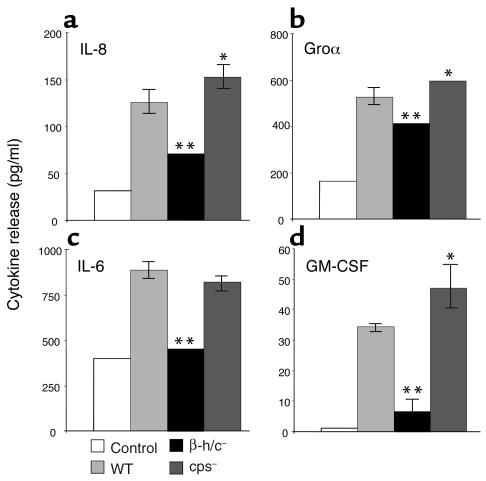
Changes in HBMEC chemokine and cytokine secretion after infection with WT, β-h/c–deficient, or capsule-deficient GBS. Cell culture supernatants were assayed after 4 hours of incubation with GBS. Assays were performed for IL-8 (a), Groα (b), IL-6 (c), and GM-CSF (d). Representative data from duplicate experiments are shown. Error bars represent the 95% confidence interval of the mean of six wells. Error bars that are not visible represent an SD of less than ± 1.5. *P < 0.05 compared with WT. **P < 0.001 compared with WT.
Figure 3
Figure 3
Stimulation of IL-8 release by HBMEC with supernatant (S/N) containing GBS β-h/c activity. Cell culture supernatants were assayed 4 hours after incubation with WT GBS, stabilized supernatant (∼25 U) from WT (β-h/c+) GBS, and stabilized supernatant from β-h/c mutant (β-h/c) GBS. Representative data from duplicate experiments are shown. Error bars represent the 95% confidence interval of the mean of four wells. *P < 0.001 compared with control. **P < 0.0001 compared with WT.
Figure 4
Figure 4
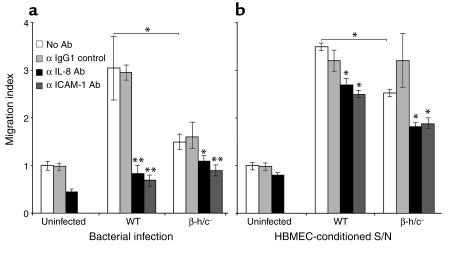
Transmigration of neutrophils in response to bacterial infection (a) and supernatants of GBS-infected HBMEC (b). In duplicate experiments, neutrophils migrated in response to GBS-induced gene products by the WT or β-h/c–deficient strain with or without 10 μg/ml anti–IL-8, anti–ICAM-1, or IgG1 isotype control antibody. Migration index is the ratio of cells that migrated during an infection or in response to a supernatant (S/N) in comparison with migration across an uninfected monolayer. Error bars represent the 95% confidence interval of the mean of three wells. *P < 0.05 compared with WT. ** P < 0.001 compared with WT or the β-h/c mutant.
Figure 5
Figure 5
Murine model of GBS meningitis. (a) Groups of 10–13 mice were inoculated intravenously with GBS strains of increasing β-h/c activity (A909 and NCTC10/84, respectively) and the corresponding β-h/c mutants. Seventy-two hours after infection, brains were harvested and bacterial counts (CFU/g brain) were determined. Solid shapes represent animals that died prior to the 72-hour timepoint. Letters with arrows indicate the mouse whose histopathology appears in panels bd. (bd) Histopathology of H&E-stained brain tissues of individual mice (identified by arrows) that developed meningitis. (b) Mouse infected with WT GBS with high CNS bacterial counts showing meningeal thrombosis, thickening, and cellular infiltration (open arrow) as well as bacterial microabscess formation (solid arrow). (c) Mouse infected with β-h/c mutant with low CNS bacterial counts and normal brain histopathology. (d) Neutrophilic and monocytic infiltrates typical of mice with high-grade CNS invasion with either WT or mutant GBS strains.

References

    1. Edwards MS, et al. Long-term sequelae of group B streptococcal meningitis in infants. J. Pediatr. 1985;106:717–722. - PubMed
    1. Ferrieri P, Burke B, Nelson J. Production of bacteremia and meningitis in infant rats with group B streptococcal serotypes. Infect. Immun. 1980;27:1023–1032. - PMC - PubMed
    1. Nizet V, et al. Invasion of brain microvascular endothelial cells by group B streptococci. Infect. Immun. 1997;65:5074–5081. - PMC - PubMed
    1. Nizet V, et al. Group B streptococcal beta-hemolysin expression is associated with injury of lung epithelial cells. Infect. Immun. 1996;64:3818–3826. - PMC - PubMed
    1. Gibson RL, Nizet V, Rubens CE. Group B streptococcal beta-hemolysin promotes injury of lung microvascular endothelial cells. Pediatr. Res. 1999;45:626–634. - PubMed

Publication types

MeSH terms