


Comment
doi: 10.1083/jcb.200307181.
When Wnts antagonize Wnts
Affiliations
- PMID: 12952929
- PMCID: PMC2172824
- DOI: 10.1083/jcb.200307181
Item in Clipboard
Comment
When Wnts antagonize Wnts
J Cell Biol.
.
Abstract
Secreted Wnt ligands appear to activate a variety of signaling pathways. Two papers in this issue now present genetic evidence that "noncanonical" Wnt signaling inhibits the "canonical" Wnt/beta-catenin pathway. Westfall et al. (2003a) show that zebrafish embryos lacking maternal Wnt-5 function are dorsalized due to ectopic activation of beta-catenin, whereas Topol et al. (2003) report that chondrogenesis in the distal mouse limb bud depends on inhibition of Wnt/beta-catenin signaling by a paralogue of Wnt-5. These studies present the first genetic confirmation of the previous hypothesis that vertebrate Wnt signaling pathways can act in an antagonistic manner.
Figures
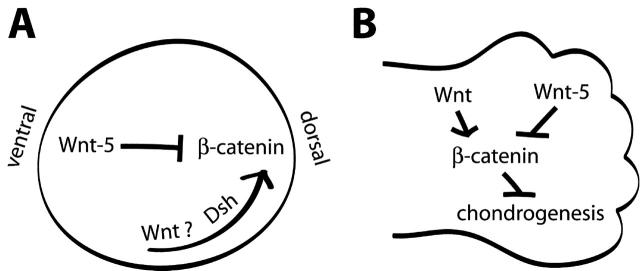
Vertebrate Wnt-5 paralogues antagonize Wnt/β-catenin signaling. (A) A highly schematized model of antagonistic interactions of maternal Wnt signaling pathways in early Xenopus or zebrafish embryos. In response to Dishevelled (Dsh) and perhaps a Wnt signal, high β-catenin levels specify the dorsal side. Maternal Wnt-5 is required for development of ventral cell fates by antagonizing β-catenin signaling, although where Wnt-5 is active remains unclear. (B) A simplistic model of Wnt antagonism in the mouse limb bud. The limb ectoderm and apical ectodermal ridge (AER) meet at the distal limb bud. As several Wnts (e.g., Wnt7a or Wnt3) that are able to activate canonical Wnt/β-catenin signaling are expressed in the limb ectoderm and apical ectodermal ridge, the distal limb bud has a higher level of canonical Wnt/β-catenin signaling, which suppresses chondrogenesis. In the distal limb bud, Wnt-5a signaling decreases β-catenin levels, which allows chondrogenesis to occur.
Comment on
-
Wnt-5/pipetail functions in vertebrate axis formation as a negative regulator of Wnt/beta-catenin activity.J Cell Biol. 2003 Sep 1;162(5):889-98. doi: 10.1083/jcb.200303107. J Cell Biol. 2003. PMID: 12952939 Free PMC article.
-
Wnt-5a inhibits the canonical Wnt pathway by promoting GSK-3-independent beta-catenin degradation.J Cell Biol. 2003 Sep 1;162(5):899-908. doi: 10.1083/jcb.200303158. J Cell Biol. 2003. PMID: 12952940 Free PMC article.
References
-
- Heisenberg, C.P., M. Tada, G.J. Rauch, L. Saude, M.L. Concha, R. Geisler, D.L. Stemple, J.C. Smith, and S.W. Wilson. 2000. Silberblick/Wnt11 mediates convergent extension movements during zebrafish gastrulation. Nature. 405:76–81. - PubMed
-
- Huelsken, J., and J. Behrens. 2002. The Wnt signalling pathway. J. Cell Sci. 115:3977–3978. - PubMed
-
- Ishitani, T., S. Kishida, J. Hyodo-Miura, N. Ueno, J. Yasuda, M. Waterman, H. Shibuya, R.T. Moon, J. Ninomiya-Tsuji, and K. Matsumoto. 2003. The TAK1-NLK mitogen-activated protein kinase cascade functions in the Wnt-5a/Ca2+ pathway to antagonize Wnt/beta-catenin signaling. Mol. Cell. Biol. 23:131–139. - PMC - PubMed
-
- Kühl, M., L.C. Sheldahl, C.C. Malbon, and R.T. Moon. 2000. a. Ca2+/calmodulin-dependent protein kinase II is stimulated by Wnt and Frizzled homologs and promotes ventral cell fates in Xenopus. J. Biol. Chem. 275:12701–12711. - PubMed
