. 2003 Sep 1;162(5):889-98.
doi: 10.1083/jcb.200303107.

Wnt-5/pipetail functions in vertebrate axis formation as a negative regulator of Wnt/beta-catenin activity

Affiliations

Wnt-5/pipetail functions in vertebrate axis formation as a negative regulator of Wnt/beta-catenin activity

Trudi A Westfall et al. J Cell Biol. .

Abstract

We provide genetic evidence defining a role for noncanonical Wnt function in vertebrate axis formation. In zebrafish, misexpression of Wnt-4, -5, and -11 stimulates calcium (Ca2+) release, defining the Wnt/Ca2+ class. We describe genetic interaction between two Wnt/Ca2+ members, Wnt-5 (pipetail) and Wnt-11 (silberblick), and a reduction of Ca2+ release in Wnt-5/pipetail. Embryos genetically depleted of both maternal and zygotic Wnt-5 product exhibit cell movement defects as well as hyperdorsalization and axis-duplication phenotypes. The dorsalized phenotypes result from increased beta-catenin accumulation and activation of downstream genes. The Wnt-5 loss-of-function defect is consistent with Ca2+ modulation having an antagonistic interaction with Wnt/beta-catenin signaling.


Figures
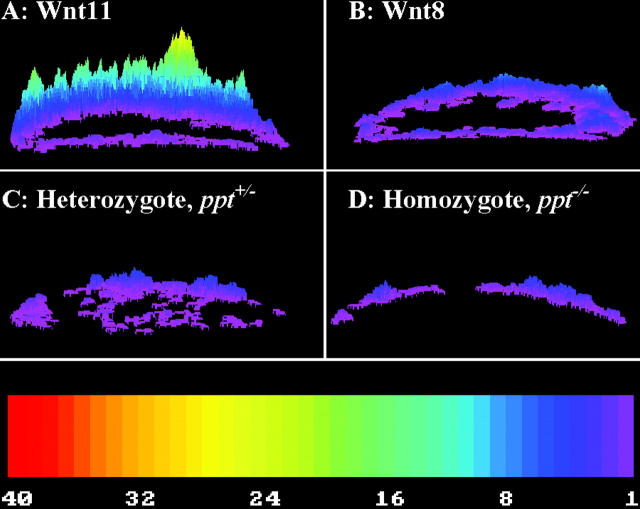
Figure 1.
Figure 1.
Ca 2+ release dynamics in zebrafish embryos expressing Wnts and in Wnt-5/ ppt mutants. Non-canonical Wnt members stimulate Ca2+ release in zebrafish and these changes were monitored with Fura-2 in live embryos. The representative embryo shown is a two-dimensional topographic image of the location of all the Ca2+ fluxes that occurred during the time course (50 min). Surface plots of Ca2+ release activity in embryos mis-expressing (A) Wnt-11 and (B) Wnt-8 RNA. Ca2+ release profile of endogenous activity in (C) heterozygous (ppt +/−) and (D) mutant (ppt / ) embryos from the same clutch. Height and color of peaks indicate the number of Ca2+ fluxes observed over the course of the experiment with the embryos oriented in a lateral position. The color bar indicates the pseudocolor representation of the number of transients from low (purple, 1) to high (red, 40).
Figure 2.
Figure 2.
Hyperventralization phenotypes of Wnt-5–injected embryos. Embryos mis-expressing Wnt-5 were evaluated for changes in D-V patterning by morphology and whole mount in situ. (A) Wild-type morphology with the arrow designating the anterior-most region. Loss of dorsal-anterior tissue and expansion of ventral-posterior tissue is evident by lack of head tissue arrow in B and an onion-like mass of ventralized tissue in C. Dual-hybridization whole mount in situ at shield stage with the dorsal-specific chordin domain (red) denoted by arrowheads flanked by the ventral-specific eve (blue) expression domain. Reduction of dorsal domains and expansion of ventral domains compared with (D) wild-type is seen in (E) Wnt-5-injected embryos. (A–C) Lateral orientation with anterior to the left and (D–E) animal pole orientation with dorsal to the right.
Figure 3.
Figure 3.
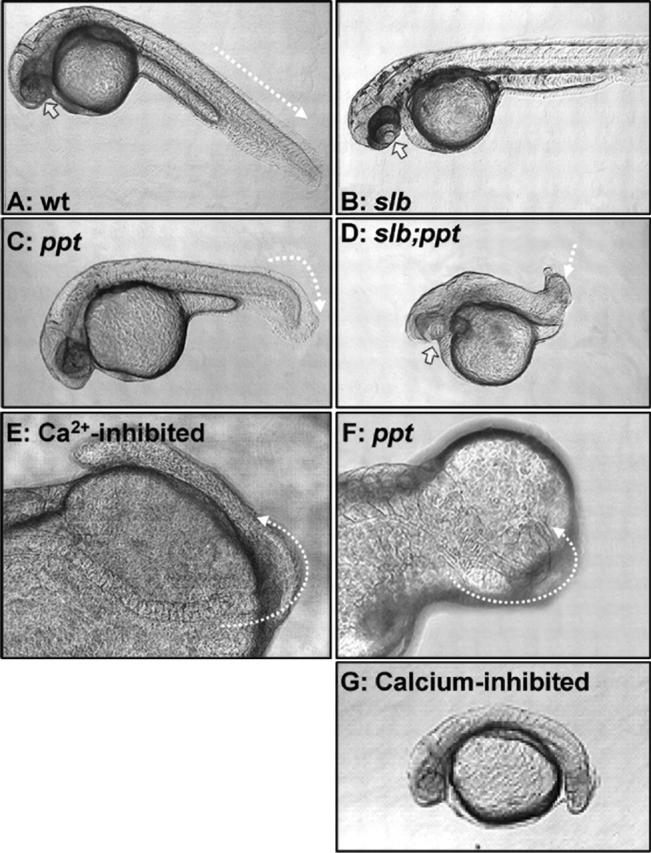
Morphological phenotypes in Wnt-5/ ppt and Ca 2+ - inhibited embryos. Lateral view, anterior to the right of 24–36 hpf embryos. (A) In wild-type, the block arrow indicates one eye, the other is out of the focal plane and the dashed lined demarcates the tail extending posteriorly off the yolk. (B) The Wnt-11 mutant (slb / ) embryo has a fused eye, the arrow indicates the lens. (C) In Wnt-5 mutant (ppt / ), the dashed arrow demarcates the shortened-curled tail defect and in the (D) double mutant (slb / ; ppt / ), the block arrow indicates the fused eye, whereas the dashed arrow marks the shortened-twisted tail. The notochord and one set of somites are highlighted by a dashed line in (E) IP3R-inhibited (XeC), and (F) ppt / embryos. The presence of a protruding yolk is an indication of incomplete epiboly cell movements. Fused eyes and shortened twisted trunks can also be observed in (G) Ca2+-inhibited (L-690,330-treated) embryos.
Figure 4.
Figure 4.
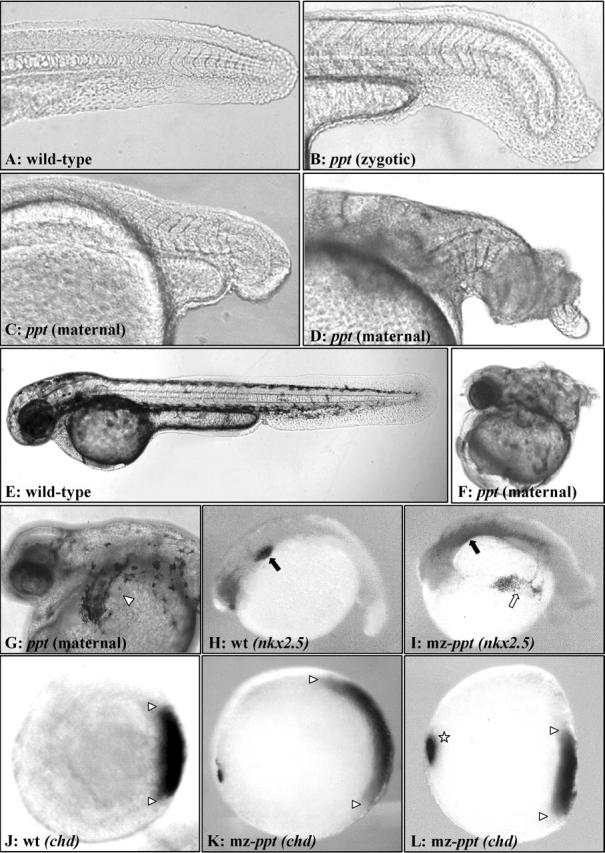
Phenotypes of Wnt-5/ ppt maternal-depleted embryos. Tail and trunk morphology in (A and E) wild-type, (B) zygotic ppt / , and embryos collected from ppt / females in C, D, F, and G. The embryo in C is an example of what was scored as a severe zygotic ppt-like phenotype with a severely shortened trunk. The phenotypes of embryos in D and F resemble two of the extreme classes of dorsalized mutants, whereas the embryo in G has a partial secondary axis (center, foreground) branching off of the primary axis (left, background). The ectopic axis has a beating heart and otic vesicles, an arrowhead highlighting one otic vesicle. Whole mount in situ analysis of embryos from ppt / females. After photographing, genotypes were determined by PCR. mz-ppt represents maternal and zygotic loss of Wnt-5. Lateral view of 36 hpf embryos probed for the heart with Nkx2.5 in (H) wild-type and (I) mz-ppt, the black arrows show the endogenous heart, whereas the ectopic staining is noted with a white arrow. Animal pole view of embryos at 50% epiboly with dorsal to the right and arrowheads marking the lateral extent of the chordin expression domain in (J) wild-type, (K) mz-ppt, and in (L) mz-ppt, the star demarcates an ectopic domain.
Figure 5.
Figure 5.
Increased β-catenin protein and boz expression in Wnt-5/ppt mutant embryos. Immunolocalization of β-catenin protein in sphere stage embryos. A panel from a confocal series collected with a 20× objective from (A) wild-type and (B) maternally depleted ppt embryos. White dots identify domains of nuclear β-catenin around the circumference of the embryos in an animal pole orientation. Additional confocal images were collected from the same embryos with a 63× objective. Representative β-catenin–positive nuclei noted by arrowheads with one B-catenin–positive nucleus in (C) wild-type and at least seven in (D) maternally depleted ppt embryo.
Figure 6.
Figure 6.
Increased bo z expression in Wnt-5/ppt mutant embryos. Whole mount in situ hybridization with boz; animal pole view of (A) wild-type and (B-D) mz-ppt embryos; dorsal view of (E) wild-type and (F) (ppt / ;slb / ) embryos. The arrows mark the lateral extent of the boz expression domain and plus marks highlight ectopic domains.
Figure 7.
Figure 7.
Activated CaMKII suppresses the Wnt-5/ ppt / tail defect. Tail morphology of (A) wild-type, (B) CaMKIItr-rescued ppt / , and (C) ppt / embryos are from the same clutch. Arrows denote the length from the end of the yolk tube to the tip of the tail. Zebrafish embryos from a standard ppt heterozygous cross were injected with CamKIItr. Injection sets with increased frequency of wild-type–like morphology (>90% compared with the expected 75%) were individually photographed and PCR genotyped.
Figure 8.
Figure 8.
Wnt signaling network. Schematic of the stimulation of (A) canonical Wnt and (B) non-canonical Wnt/Ca2+ and planar cell polarity signaling pathways. (Note: only a few of the known components are outlined.)

Comment in

  • When Wnts antagonize Wnts.
    Weidinger G, Moon RT. Weidinger G, et al. J Cell Biol. 2003 Sep 1;162(5):753-5. doi: 10.1083/jcb.200307181. J Cell Biol. 2003. PMID: 12952929 Free PMC article.

References

    1. Ahumada, A., D.C. Slusarski, X.X. Liu, R.T. Moon, C.C. Malbon, and H.Y. Wang. 2002. Signaling of rat Frizzled-2 through phosphodiesterase and cyclic GMP. Science. 298:2006–2010. - PubMed
    1. Atack, J.R., S.M. Cook, A.P. Watt, S.R. Fletcher, and C.I. Ragan. 1993. In vitro and in vivo inhibition of inositol monophosphatase by the bisphosphonate L-690,330. J. Neurochem. 60:652–658. - PubMed
    1. Berridge, M.J., M.D. Bootman, and P. Lipp. 1998. Calcium-a life and death signal. Nature. 395:645–648. - PubMed
    1. Bienz, M., and H. Clevers. 2003. Armadillo/beta-catenin signals in the nucleus—proof beyond a reasonable doubt? Nat. Cell Biol. 5:179–182. - PubMed
    1. Blader, P., U. Strahle, and P.W. Ingham. 1996. Three Wnt genes expressed in a wide variety of tissues during development of the zebrafish, Danio rerio: developmental and evolutionary perspectives. Development Genes and Evolution. 206:3–13. - PubMed

Publication types

MeSH terms