


Foreshore sand as a source of Escherichia coli in nearshore water of a Lake Michigan beach
- PMID: 12957945
- PMCID: PMC194947
- DOI: 10.1128/AEM.69.9.5555-5562.2003
Foreshore sand as a source of Escherichia coli in nearshore water of a Lake Michigan beach
Abstract
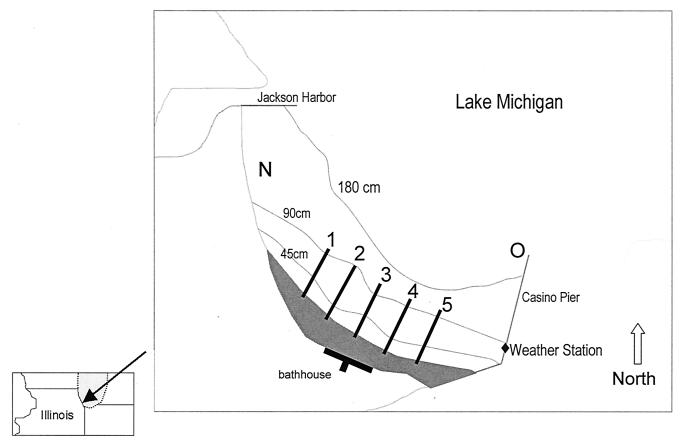
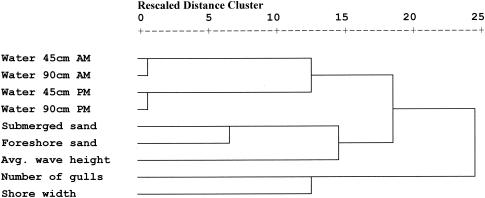
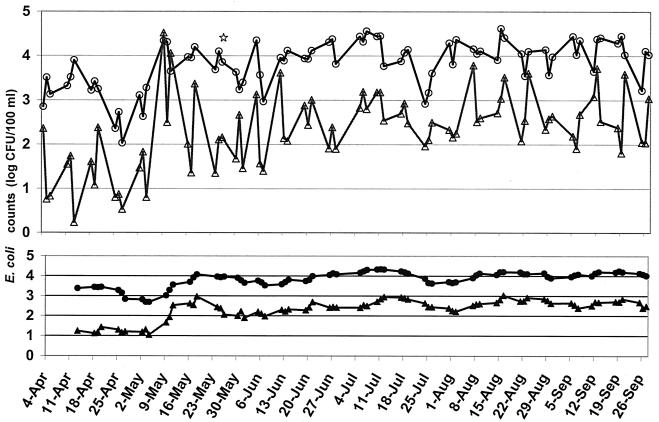
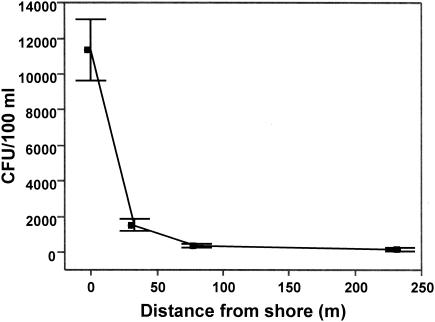
Swimming advisories due to excessive Escherichia coli concentrations are common at 63rd Street Beach, Chicago, Ill. An intensive study was undertaken to characterize the source and fate of E. coli in beach water and sand at the beach. From April through September 2000, water and sand samples were collected daily or twice daily at two depths on three consecutive days per week (water samples, n = 1,747; sand samples, n = 858); hydrometeorological conditions and bird and bather distributions were also recorded. E. coli concentrations in sand and water were significantly correlated, with the highest concentration being found in foreshore sand, followed by those in submerged sediment and water of increasing depth. Gull contributions to E. coli densities in sand and water were most apparent on the day following gull activity in a given area. E. coli recolonized newly placed foreshore sand within 2 weeks. Analysis of variance, correlation, cluster analyses, concentration gradients, temporal-spatial distribution, demographic patterns, and DNA fingerprinting suggest that E. coli may be able to sustain population density in temperate beach sand during summer months without external inputs. This research presents evidence that foreshore beach sand (i) plays a major role in bacterial lake water quality, (ii) is an important non-point source of E. coli to lake water rather than a net sink, (iii) may be environmentally, and perhaps hygienically, problematic, and (iv) is possibly capable of supporting an autochthonous, high density of indicator bacteria for sustained periods, independent of lake, human, or animal input.
Figures
References
-
- Adachi, K., K. Kimoto, and J. Higano. 1998. Primary productivity of sandy shores, p. 137-148. In W. H. Howell, B. J. Keller, P. K. Park, J. P. McVey, K. Takayanagi, and Y. Uekita (ed.), Nutrition and technical development of aquaculture. National Research Institute of Fisheries Engineering, Ibaraki, Japan.
-
- Alhajiar, B. J., S. L. Stramer, D. O. Cliver, and J. M. Harkin. 1988. Transport modelling of biological tracers from septic systems. Water Res. 22:907-915.
-
- American Public Health Association. 1998. Standard methods for the examination of water and wastewater, 20th ed. American Public Health Association, Washington, D.C.
-
- Anderson, S. A., S. J. Turner, and G. D. Lewis. 1997. Enterococci in the New Zealand environment: implications for water quality monitoring. Water Sci. Technol. 35:325-331.
Publication types
MeSH terms
Substances
LinkOut - more resources
Full Text Sources
Miscellaneous
