


doi: 10.1128/AEM.69.9.5716-5721.2003.
Dispersal and phylogenetic diversity of nonmarine picocyanobacteria, inferred from 16S rRNA gene and cpcBA-intergenic spacer sequence analyses
Affiliations
- PMID: 12957969
- PMCID: PMC194977
- DOI: 10.1128/AEM.69.9.5716-5721.2003
Item in Clipboard
Dispersal and phylogenetic diversity of nonmarine picocyanobacteria, inferred from 16S rRNA gene and cpcBA-intergenic spacer sequence analyses
Appl Environ Microbiol.
2003 Sep.
Abstract
More than 20 Synechococcus and Cyanobium isolates were obtained from central European subalpine lakes and sequenced for their 16S rRNA gene and part of the phycocyanin operon (cpc), specifically the intergenic spacer (IGS) between cpcB and cpcA, and corresponding flanking regions (cpcBA-IGS). Maximum-likelihood analyses revealed the existence of at least six to seven clusters of nonmarine picocyanobacteria within the picophytoplankton clade and support the conjecture of global dispersal for some closely related picocyanobacterial genotypes.
Figures
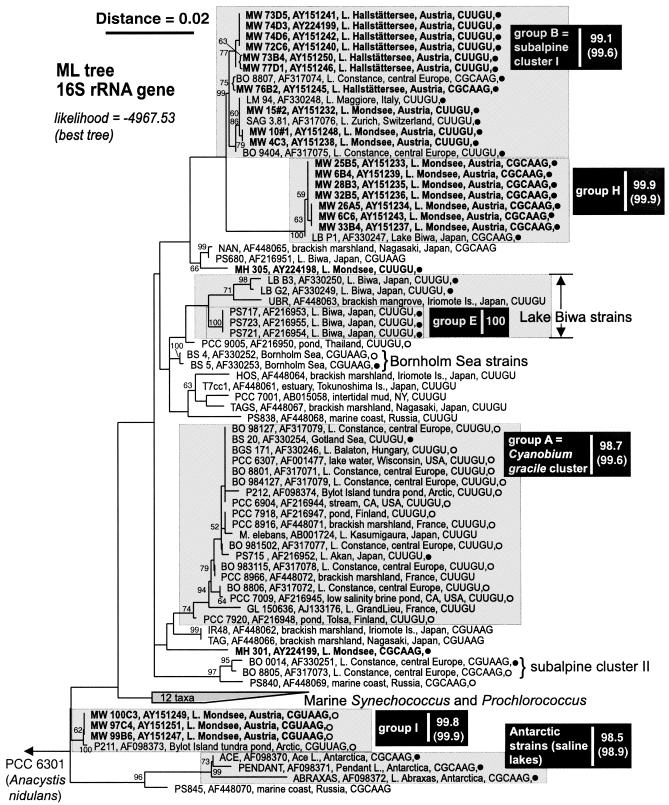
Maximum-likelihood tree of the picophytoplankton clade sensu Urbach et al. (38), inferred from 16S rRNA gene sequences (1,383 nt positions). Terminal branches display isolate and GenBank accession numbers (given in bold font for sequences determined in this study), isolation details (location, habitat), helix 49 tetraloop motif, and pigment group (•, PE rich; ○, PC rich). Numbers at nodes indicate the percent bootstrap frequency (1,000 replicates) obtained from neighbor-joining (31) trees calculated by TREECON for Windows (39) assuming a Jukes-Cantor model of nucleotide substitution. Bootstrap values of <50% are not shown. Minimum and mean (parentheses) pairwise percent similarities are shown on the right-hand side of each group label. Sources: results herein, references , , , and ; Warwick Vincent, personal communication (isolation details for P211 and P212); and Watanabe, personal communication (isolation details for NAN, UBR, HOS, T7cc1, TAG, TAGS, IR48 PS-838, PS-840, and PS-845). The Ernst et al. (10) cluster designations subalpine cluster I, Lake Biwa strains, Bornholm Sea strains, Cyanobium gracile cluster, and subalpine cluster II are also provided. The outgroup was Synechococcus PCC 6301 (formerly Anacystis nidulans).
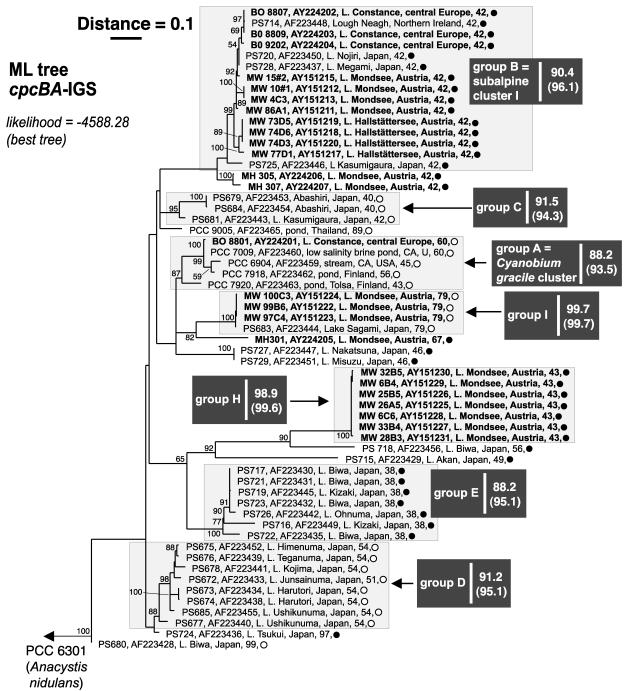
Maximum-likelihood tree of the picophytoplankton clade sensu Urbach et al. (38), inferred from cpcBA-IGS gene sequences (362 nt positions). Terminal branches display isolate and GenBank accession numbers (given in bold font for sequences determined in this study), isolation details (location, habitat), IGS length (number of nucleotides), and pigment group (•, PE rich; ○, PC rich). Numbers at nodes indicate the percent bootstrap frequency (1,000 replicates) obtained from neighbor-joining (31) trees calculated by TREECON for Windows (39) assuming a Jukes-Cantor model of nucleotide substitution. Bootstrap values of <50% are not shown. Minimum and mean (parentheses) pairwise percent similarities are shown on the right-hand side of each group label. Sources: results herein and reference . The Ernst et al. (10) cluster designations subalpine cluster I and Cyanobium gracile cluster are also provided. The outgroup was Synechococcus PCC 6301 (formerly Anacystis nidulans).
References
-
- Agron, P. G., M. Macht, L. Radnedge, E. W. Skowronski, W. Miller, and G. L. Andersen. 2002. Use of subtractive hybridization for comprehensive surveys of prokaryotic genome differences. FEMS Microbiol. Lett. 211:175-182. - PubMed
-
- Amann, R., and R. Roselló-Mora. 2001. Mikrobiologische Aspekte der Biodiversität, p. 161-180. In P. Janich, M. Gutmann, and K Prieβ (ed.), Biodiversität. Springer, Berlin, Germany.
-
- Callieri, C., and J. G. Stockner. 2002. Freshwater autotrophic picoplankton: a review. J. Limnol. 61:1-14.
-
- Castenholz, R. W. 2001. Phylum BX. Cyanobacteria, oxygenic photosynthetic bacteria, p. 473-599. In D. R. Boone and R. W. Castenholz (ed.), Bergey's manual of systematic bacteriology, vol. 1. Springer, New York, N.Y.
Publication types
MeSH terms
Substances
Associated data
- Actions
- Actions
- Actions
- Actions
LinkOut - more resources
Full Text Sources
Other Literature Sources
Molecular Biology Databases
Research Materials
