


Detection of infectious human immunodeficiency virus type 1 in female genital secretions by a short-term culture method
- PMID: 12958229
- PMCID: PMC193780
- DOI: 10.1128/JCM.41.9.4081-4088.2003
Detection of infectious human immunodeficiency virus type 1 in female genital secretions by a short-term culture method
Abstract
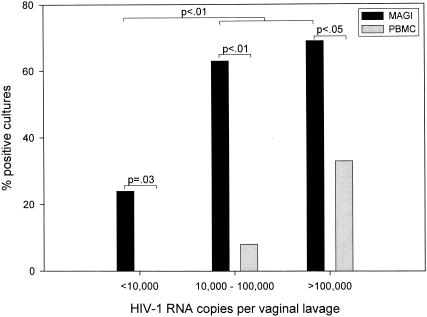
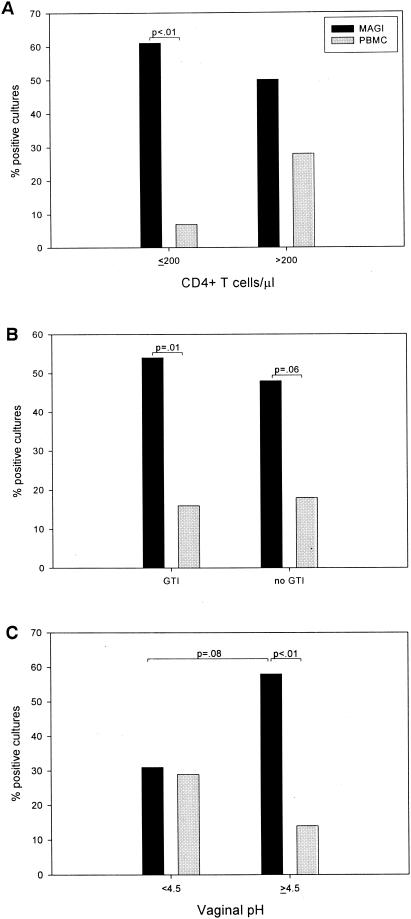
Infectious human immunodeficiency virus type 1 (HIV-1) is difficult to detect in female genital secretions by standard virus culture techniques. To improve detection of cell-free HIV-1 in female genital secretions, we adapted a short-term assay that uses the multinuclear-activation galactosidase indicator (MAGI) assay. When vaginal lavages from HIV-1-infected women were tested with the adapted MAGI assay, 25 (64%) of 39 lavages with detectable, cell-free HIV-1 RNA were shown to have infectious virus. No infectious virus was found in 10 vaginal lavages from HIV-1-infected women with undetectable vaginal viral loads. Significantly (P < 0.01) more lavages from HIV-1-infected women tested positive for infectious virus by the MAGI assay than by standard peripheral blood mononuclear cell (PBMC) coculture, which detected infectious virus in only 6 (17%) of 35 vaginal lavages. Lavages with viral loads of >10,000 copies per lavage yielded significantly (P < 0.01) more positive cultures than those with <10,000 copies by using the MAGI assay. Detection of infectious HIV-1 in vaginal lavages was not associated with the presence of genital tract infections or CD4(+)-T-cell counts. However, although the results were not significant (P = 0.08), the MAGI assay detected infectious virus from more vaginal lavages at a vaginal pH of >/=4.5 than at a pH of <4.5. These results indicate that the MAGI assay is more sensitive than PBMC culture methods for detecting infectious virus in female genital secretions. Accurate measurements of infectious virus in genital secretions will improve studies that evaluate sexual transmission of HIV-1.
Figures
References
-
- Alfsen, A., P. Iniguez, E. Bouguyon, and M. Bomsel. 2001. Secretory IgA specific for a conserved epitope on gp41 envelope glycoprotein inhibits epithelial transcytosis of HIV-1. J. Immunol. 166:6257-6265. - PubMed
-
- Al-Harthi, L., G. T. Spear, F. B. Hashemi, A. Landay, B. E. Sha, and K. A. Roebuck. 1998. A human immunodeficiency virus (HIV)-inducing factor from the female genital tract activates HIV-1 gene expression through the κB enhancer. J. Infect. Dis. 178:1343-1351. - PubMed
-
- Anderson, D. J., J. A. Politch, L. D. Tucker, R. Fichorova, F. Haimovici, R. E. Tuomala, and K. H. Mayer. 1998. Quantitation of mediators of inflammation and immunity in genital tract secretions and their relevance to HIV type 1 transmission. AIDS Res. Hum. Retrovir. 14:S43-S49. - PubMed
-
- Belec, L., R. Gherardi, C. Payan, T. Prazuck, J. E. Malkin, C. Tevi-Benissan, and J. Pillot. 1995. Proinflammatory cytokine expression in cervicovaginal secretions of normal and HIV-infected women. Cytokine 7:568-574. - PubMed
-
- Blaak, H., L. J. Ran, R. Rientsma, and H. Schuitemaker. 2000. Susceptibility of in vitro stimulated PBMC to infection with NSI HIV-1 is associated with levels of CCR5 expression and β-chemokine production. Virology 267:237-246. - PubMed
Publication types
MeSH terms
Substances
Grants and funding
LinkOut - more resources
Full Text Sources
Research Materials
