Monitoring proteinase 3 antineutrophil cytoplasmic antibodies for detection of relapses in small vessel vasculitis
- PMID: 12965902
- PMCID: PMC193911
- DOI: 10.1128/cdli.10.5.769-774.2003
Monitoring proteinase 3 antineutrophil cytoplasmic antibodies for detection of relapses in small vessel vasculitis
Abstract
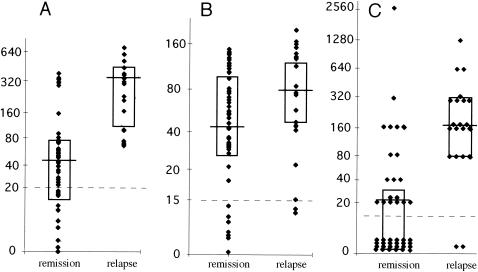
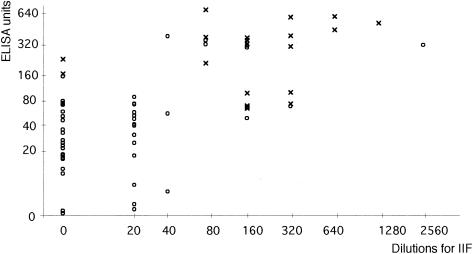
The clinical usefulness of antineutrophil cytoplasmic antibodies (ANCAs) in the monitoring of patients treated for small vessel vasculitis is debated. A capture enzyme-linked immunosorbent assay (ELISA) based on anti-proteinase 3 (anti-PR3) monoclonal antibody 4A3 has previously been proven to be superior to indirect immunofluorescence (IIF) and standard ELISA for the diagnosis of vasculitis. The present study compared the effectiveness of the capture ELISA for the detection of disease relapse. Samples from patients with relapses and remissions (relapse and remission samples, respectively) were identified through the database of the Glomerular Disease Collaborate Network. Twenty-one relapse samples and 49 remission samples were analyzed by the capture PR3-ANCA ELISA from Wieslab AB, the standard PR3-ANCA ELISA from Inova, and IIF. A Medline search was performed to identify published data on ANCA status at relapse. The capture ELISA was positive for 21 instances of relapses in 14 patients, while the standard ELISA and IIF each failed to detect 2 relapses (P was not significant). By using a higher cutoff value, the capture ELISA correctly categorized 84% of the remission samples and 81% of the relapse samples. Similar degrees of discrimination could be achieved by IIF but not by the standard ELISA. In previously published series, the median proportions of patients positive at relapse were 100% by IIF (range, 75 to 100%) and 86% by standard ELISA (range, 38 to 100%). The corresponding values for a rise that accompanied or preceded a relapse were 75% (range, 20 to 100%) for IIF and 50% (range, 25 to 81%) for ELISA. The capture PR3-ANCA ELISA is a sensitive tool for the detection of relapses. Larger studies are needed to detect differences between methods. Negative results by tests for ANCAs are rare during relapses.
Figures
References
-
- Arranz, O., J. Ara, R. Rodriguez, L. Quinto, J. Font, E. Mirapeix, and A. Darnell. 2001. Comparison of anti-PR3 capture and anti-PR3 direct ELISA for detection of antineutrophil cytoplasmic antibodies (ANCA) in long-term clinical follow-up of PR3-ANCA-associated vasculitis patients. Clin. Nephrol. 56:295-301. - PubMed
-
- Boomsma, M. M., C. A. Stegeman, M. J. van der Leij, W. Oost, J. Hermans, C. G. Kallenberg, P. C. Limburg, and J. W. Cohen Tervaert. 2000. Prediction of relapses in Wegener's granulomatosis by measurement of antineutrophil cytoplasmic antibody levels: a prospective study. Arthritis Rheum. 43:2025-2033. - PubMed
-
- Cohen, L. H., C. B. Wilson, and R. M. Freeman. 1976. Goodpasture syndrome: recovery after severe renal insufficiency. Arch. Intern. Med. 136:835-837. - PubMed
-
- Cohen Tervaert, J. W., M. G. Huitema, R. J. Hene, W. J. Sluiter, T. H. The, G. K. van der Hem, and C. G. Kallenberg. 1990. Prevention of relapses in Wegener's granulomatosis by treatment based on antineutrophil cytoplasmic antibody titre. Lancet 336:709-711. - PubMed
Publication types
MeSH terms
Substances
LinkOut - more resources
Full Text Sources
Medical