Enzyme-linked immunoassay using recombinant trans-sialidase of Trypanosoma cruzi can be employed for monitoring of patients with Chagas' disease after drug treatment
- PMID: 12965912
- PMCID: PMC193901
- DOI: 10.1128/cdli.10.5.826-830.2003
Enzyme-linked immunoassay using recombinant trans-sialidase of Trypanosoma cruzi can be employed for monitoring of patients with Chagas' disease after drug treatment
Abstract
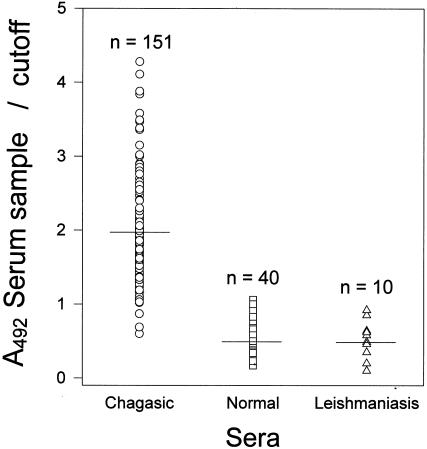
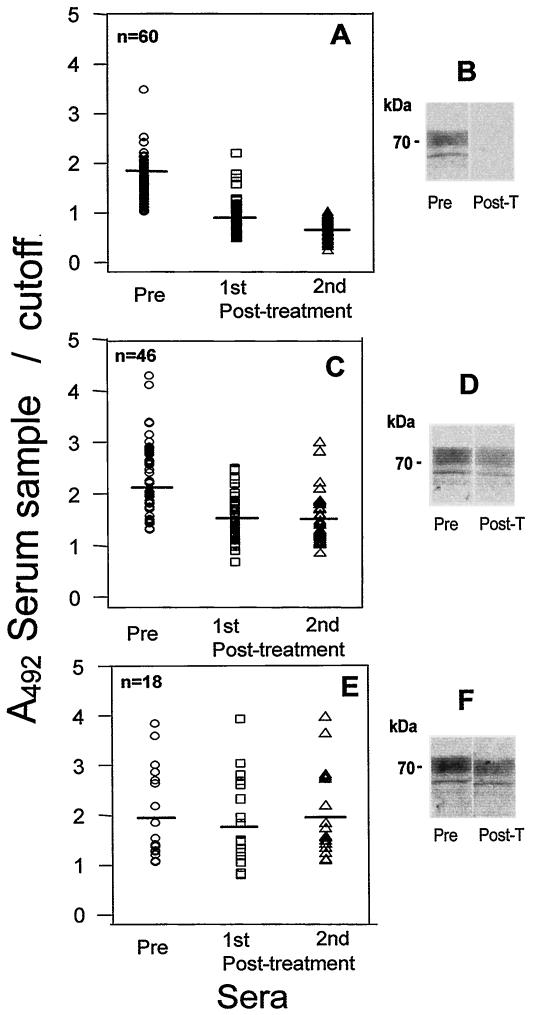
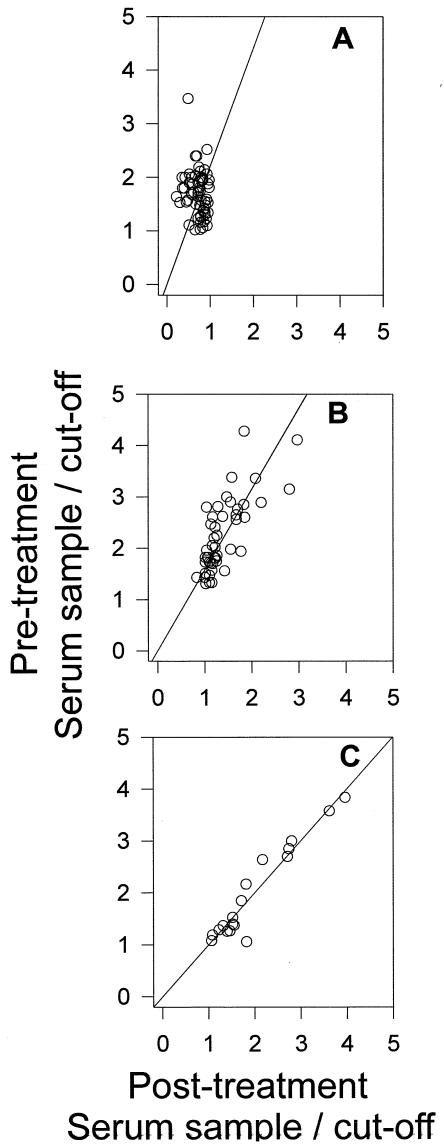
trans-Sialidase is an enzyme present on the surface of Trypanosoma cruzi and is an important antigen recognized by sera from patients with Chagas' disease. In the present study we investigated whether the benznidazole treatment of patients with Chagas' disease induced changes in the reactivity of serum toward a recombinant form of trans-sialidase in order to develop an assay for monitoring of patients after treatment for Chagas' disease, which is needed at Chagas' disease control centers. By using an enzyme-linked immunosorbent assay containing a recombinant protein corresponding to the catalytic domain of trans-sialidase, we found that the antigen had a high specificity for sera from untreated patients with Chagas' disease. Sera from healthy individuals or patients with active visceral leishmaniasis minimally cross-reacted with the antigen. Anti-trans-sialidase immunoglobulin was detected in 98% of 151 untreated patients with Chagas' disease. Of these, 124 patients were treated for 60 days with benznidazole (5 mg/kg of body weight/day), and their sera were assayed for reactivity with the recombinant trans-sialidase. By using this methodology, three groups of patients could be established. The first group (60 patients), which was considered to have been successfully treated, showed no reactivity after treatment. The second group (46 patients) still showed signs of infection, and after treatment their sera recognized trans-sialidase, but with reduced titers. The third group (18 patients) was considered to be resistant to drug treatment, and their sera presented identical reactivities before and after treatment. These results suggest that determination of the absence of antibodies to recombinant trans-sialidase in treated patients by the present assay is indicative of treatment success, while the presence of antibodies may indicate the persistence of infection. Therefore, this method may be useful for the diagnosis and monitoring of patients undergoing benznidazole treatment.
Figures
References
-
- Almeida, I. C., D. T. Covas, L. M. Soussumi, and L. R. Travassos. 1993. A highly sensitive and specific chemiluminescent enzyme-linked immunosorbent assay for diagnosis of active Trypanosoma cruzi infection. Transfusion 37:850-857. - PubMed
-
- Almeida, I. C., G. M. Krautz, A. U. Krettli, and L. R. Travassos. 1993. Glycoconjugates of Trypanosoma cruzi: a 74 kD antigen of trypomastigotes specifically reacts with lytic anti-α-galactosyl antibodies from patients with chronic Chagas disease. J. Clin. Lab. Anal. 7:307-316. - PubMed
-
- Camargo, M. E. 1966. Fluorescent antibody test for the serodiagnosis of American trypanosomiasis. Technical modification employing preserved culture forms of Trypanosoma cruzi in a slide test. Rev. Inst. Med. Trop. Sao Paulo 8:227-235. - PubMed
-
- Camargo, M. E., S. Hoshino, and G. R. Siqueira. 1973. Hemagglutination with preserved, sensitized cells, a practical test for routine serologic diagnosis of American trypanosomiasis. Rev. Inst. Med. Trop. Sao Paulo 15:81-85. - PubMed
Publication types
MeSH terms
Substances
LinkOut - more resources
Full Text Sources
Medical