Serum glucan levels are not specific for presence of fungal infections in intensive care unit patients
- PMID: 12965921
- PMCID: PMC193887
- DOI: 10.1128/cdli.10.5.882-885.2003
Serum glucan levels are not specific for presence of fungal infections in intensive care unit patients
Abstract
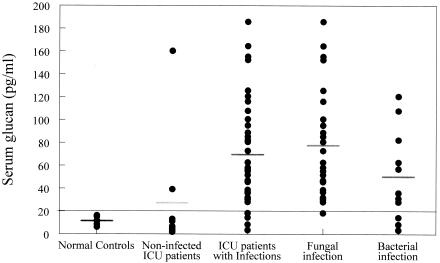
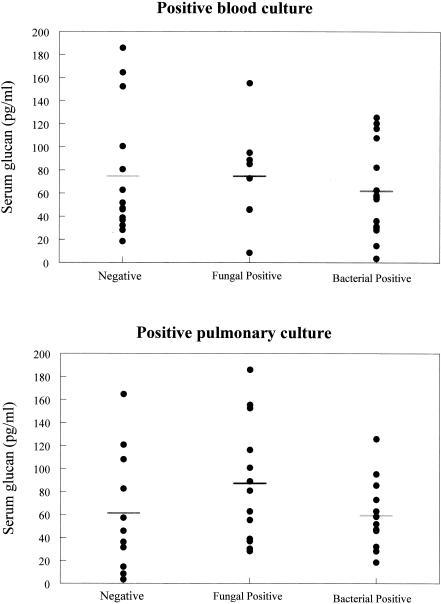
Fungal infections in the critically ill patient are difficult to diagnose and are associated with a high mortality rate. A major obstacle to managing fungal infection is the lack of a reliable clinical assay that will rapidly identify patients with fungal sepsis. Glucans are polymers of glucose that are found in the cell wall of fungi and certain bacteria. Glucans are also released from the fungal cell wall into the extracellular milieu. Several studies have reported that detection of fungal glucan in serum or plasma is useful in the diagnosis of mycoses. However, recent studies have questioned the clinical utility of this assay. In this study, we examined serum glucan levels in intensive care unit (ICU) patients and attempt to correlate serum glucan levels with the presence of fungal infection. Following attainment of informed consent, serum was harvested from 46 ICU patients with confirmed fungal infections, confirmed bacterial infections, or no evidence of infection. Sera from eight healthy volunteers served as control. Serum glucan was assayed with a glucan-specific Limulus assay. Serum glucan levels were increased (69.6 +/- 17 pg/ml; P < 0.001) in ICU patients versus the normal (11.5 +/- 1.3 pg/ml) and noninfected ICU (27.4 +/- 17 pg/ml) controls. However, serum glucan levels were not different in patients with confirmed fungal infections versus those with confirmed bacterial infections. Thus, serum glucan levels did not show a correlation with the presence of fungal infections and do not appear to be specific for fungal infections. However, the assay may be useful as a negative predictor of infection.
Figures

References
-
- Hiyoshi, M., S. Tagawa, S. Hashimoto, C. Sakamoto, and N. Tatsumi. 1999. Evaluation of a new laboratory test measuring plasma (1→3)-β-D-glucan in the diagnosis of Candida deep mycosis: comparison with a serologic test. Kansenshogaku Zasshi 73:1-6. - PubMed
-
- Iwama, A., M. Yoshida, A. Miwa, T. Obayashi, S. Sakamoto, and Y. Miura. 1993. Improved survival from fungaemia in patients with haematological malignancies: analysis of risk factors for death and usefulness of early antifungal therapy. Eur. J. Haematol. 51:156-160. - PubMed
-
- Kami, M., Y. Tanaka, Y. Kanda, S. Ogawa, T. Masumoto, K. Ohtomo, T. Matsumura, T. Saito, U. Machida, T. Kashima, and H. Hirai. 2000. Computer tomographic scan of the chest, latex agglutination test and plasma (1→3)-β-D-glucan assay in early diagnosis of invasive pulmonary aspergillosis: a prospective study of 215 patients. Haematologica 85:745-752. - PubMed
-
- Kohno, S., K. Mitsutake, S. Maesaki, A. Yasuoka, T. Miyazaki, M. Kaku, H. Koga, and Hara K. 1993. An evaluation of serodiagnostic tests in patients with candidemia: beta-glucan, mannan, candida antigen by Cand-Tec and D-arabinitol. Microbiol. Immunol. 37:207-212. - PubMed
-
- Mori, T., H. Ikemoto, M. Matsumura, M. Yoshida, K. Inada, S. Endo, A. Ito, S. Watanabe, H. Yamaguchi, M. Mitsuya, M. Kodama, T. Tani, T. Yokota, T. Kobayashi, J. Kambayashi, T. Nakamura, T. Masaoka, H. Teshima, T. Yoshinaga, S. Kohno, K. Hara, and S. Miyazaki. 1997. Evaluation of plasma (1→3)-beta-D-glucan measurement by the kinetic turbidimetric Limulus test, for the clinical diagnosis of mycotic infections. Eur. J. Clin. Chem. Biochem. 35:553-560. - PubMed
Publication types
MeSH terms
Substances
Grants and funding
LinkOut - more resources
Full Text Sources
Medical