Diagnostic implications of antigen-induced gamma interferon, nitric oxide, and tumor necrosis factor alpha production by peripheral blood mononuclear cells from Mycobacterium bovis-infected cattle
- PMID: 12965934
- PMCID: PMC193881
- DOI: 10.1128/cdli.10.5.960-966.2003
Diagnostic implications of antigen-induced gamma interferon, nitric oxide, and tumor necrosis factor alpha production by peripheral blood mononuclear cells from Mycobacterium bovis-infected cattle
Abstract
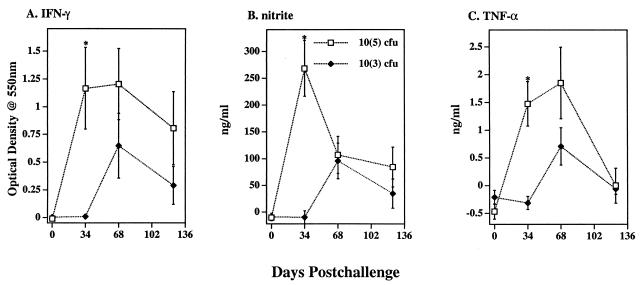
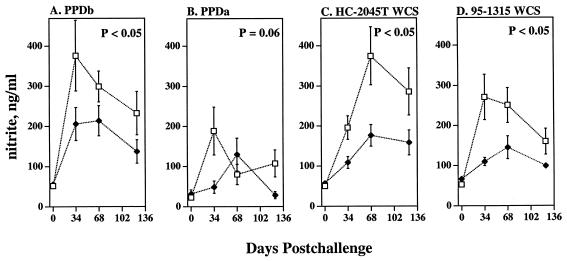
Bovine tuberculosis in the United States has proven costly to cattle producers as well as to government regulatory agencies. While in vivo responsiveness to mycobacterial antigens is the current standard for the diagnosis of tuberculosis, in vitro assays are gaining acceptance, especially as ancillary or complementary tests. To evaluate in vitro indices of cellular sensitization, antigen-induced gamma interferon (IFN-gamma), nitric oxide (NO), and tumor necrosis factor alpha (TNF-alpha) responses by blood mononuclear cells from Mycobacterium bovis-infected cattle were quantified and compared. Using an aerosol model of infection, two doses of each of two strains of M. bovis (95-1315 and HC-2045T) were used to induce a range of IFN-gamma, NO, and TNF-alpha responses. Infection-specific increases in NO, but not in IFN-gamma or TNF-alpha, were detected in nonstimulated cultures at 48 h, a finding that is indicative of nonspecific activation and spontaneous release of NO. The infective dose of M. bovis organisms also influenced responses. At 34 days postinfection, IFN-gamma, NO, and TNF-alpha responses in antigen-stimulated cells from cattle receiving 10(5) CFU of M. bovis organisms were greater than responses of cells from cattle infected with 10(3) CFU of M. bovis organisms. The NO response, but not the IFN-gamma and TNF-alpha responses, was influenced by infective strains of M. bovis. The TNF-alpha, NO, and IFN-gamma responses followed similar kinetics, with strong positive associations among the three readouts. Overall, these findings indicate that NO and TNF-alpha, like IFN-gamma, may prove useful as indices for the diagnosis of bovine tuberculosis.
Figures
References
-
- Bean, A. G., D. R. Roach, H. Briscoe, M. P. France, H. Korner, J. D. Sedgwick, and W. J. Britton. 1999. Structural deficiencies in granuloma formation in TNF gene-targeted mice underlie the heightened susceptibility to aerosol Mycobacterium tuberculosis infection, which is not compensated for by lymphotoxin. J. Immunol. 162:3504-3511. - PubMed
-
- Bolin, C. A., D. L. Whipple, K. V. Khanna, J. M. Risdahl, P. K. Peterson, and T. W. Molitor. 1997. Infection of swine with Mycobacterium bovis as a model of human tuberculosis. J. Infect. Dis. 176:1559-1566. - PubMed
-
- Buddle, B. M., T. J. Ryan, J. M. Pollock, P. Andersen, and G. W. de Lisle. 2001. Use of ESAT-6 in the interferon-gamma test for diagnosis of bovine tuberculosis following skin testing. Vet. Microbiol. 80:37-46. - PubMed
-
- Burton, J. L., and M. E. Kehrli. 1996. Effects of dexamethasone on bovine circulating T lymphocyte populations. J. Leukoc. Biol. 59:90-99. - PubMed
Publication types
MeSH terms
Substances
LinkOut - more resources
Full Text Sources