Pharmacokinetics and clinical effect of phenobarbital in children with severe falciparum malaria and convulsions
- PMID: 12968992
- PMCID: PMC1884365
- DOI: 10.1046/j.1365-2125.2003.01951.x
Pharmacokinetics and clinical effect of phenobarbital in children with severe falciparum malaria and convulsions
Abstract
Aims: Phenobarbital is commonly used to treat status epilepticus in resource-poor countries. Although a dose of 20 mg kg(-1) is recommended, this dose, administered intramuscularly (i.m.) for prophylaxis, is associated with an increase in mortality in children with cerebral malaria. We evaluated a 15-mg kg(-1) intravenous (i.v.) dose of phenobarbital to determine its pharmacokinetics and clinical effects in children with severe falciparum malaria and status epilepticus.
Methods: Twelve children (M/F: 11/1), aged 7-62 months, received a loading dose of phenobarbital (15 mg kg(-1)) as an i.v. infusion over 20 min and maintenance dose of 5 mg kg(-1) at 24 and 48 h later. The duration of convulsions and their recurrence were recorded. Vital signs were monitored. Plasma and cerebrospinal fluid (CSF) phenobarbital concentrations were measured with an Abbott TDx FLx fluorescence polarisation immunoassay analyser (Abbott Laboratories, Diagnostic Division, Abbott Park, IL, USA). Simulations were performed to predict the optimum dosage regimen that would maintain plasma phenobarbital concentrations between 15 and 20 mg l(-1) for 72 h.
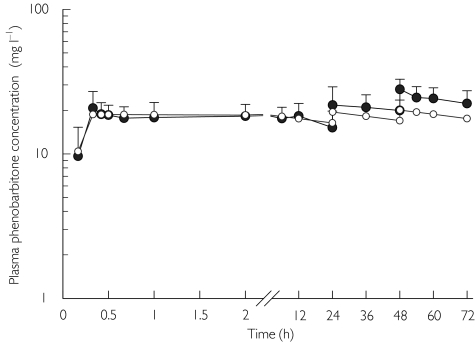
Results: All the children achieved plasma concentrations above 15 mg l(-1) by the end of the infusion. Mean (95% confidence interval or median and range for Cmax) pharmacokinetic parameters were: area under curve [AUC (0, infinity)]: 4259 (3169, 5448) mg l(-1).h, t(1/2): 82.9 (62, 103) h, CL: 5.8 (4.4, 7.3) ml kg(-1) h(-1), Vss: 0.8 (0.7, 0.9) l kg (-1), CSF: plasma phenobarbital concentration ratio: 0.7 (0.5, 0.8; n= 6) and Cmax: 19.9 (17.9-27.9) mg l(-1). Eight of the children had their convulsions controlled and none of them had recurrence of convulsions. Simulations suggested that a loading dose of 15 mg kg(-1) followed by two maintenance doses of 2.5 mg kg(-1) at 24 h and 48 h would maintain plasma phenobarbital concentrations between 16.4 and 20 mg l(-1) for 72 h.
Conclusions: Phenobarbital, given as an i.v. loading dose, 15 mg kg(-1), achieves maximum plasma concentrations of greater than 15 mg l(-1) with good clinical effect and no significant adverse events in children with severe falciparum malaria. A maintenance dose of 2.5 mg kg(-1) at 24 h and 48 h was predicted to be sufficient to maintain concentrations of 15-20 mg l(-1) for 72 h, and may be a suitable regimen for treatment of convulsions in these children.
Figures
References
-
- Crawley J, Smith S, Kirkham F, Muthinji P, Waruiru C, Marsh K. Seizures and status epilepticus in childhood cerebral malaria. Q J Med. 1996;89:591–597. - PubMed
-
- Crawley J, Waruiru C, Mithwani S, et al. Effect of phenobarbital on seizure frequency and mortality in childhood cerebral malaria: a randomised, controlled intervention study. Lancet. 2000;355:701–706. - PubMed
-
- Marsh K, Forster D, Waruiru C, et al. Indicators of life-threatening malaria in African children. N Engl J Med. 1995;332:1399–1404. - PubMed
Publication types
MeSH terms
Substances
LinkOut - more resources
Full Text Sources