


Possible involvement of IGF-1 receptor and IGF-binding protein in insulin-induced enhancement of noradrenaline response in diabetic rat aorta
- PMID: 12970107
- PMCID: PMC1574034
- DOI: 10.1038/sj.bjp.0705438
Possible involvement of IGF-1 receptor and IGF-binding protein in insulin-induced enhancement of noradrenaline response in diabetic rat aorta
Abstract
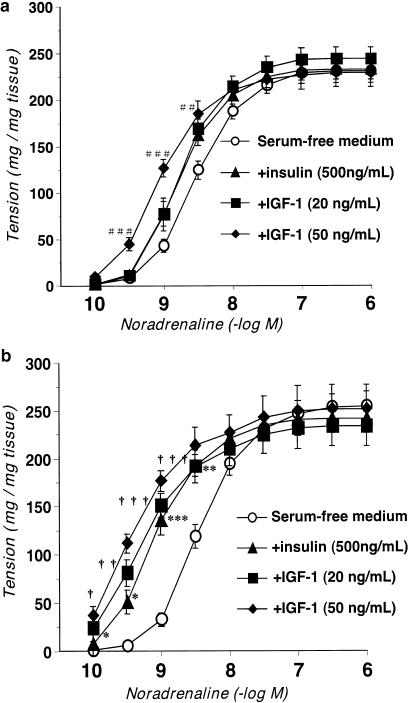
1. We investigated the mechanisms underlying the changes in vascular contractile responsiveness induced by chronic treatment with insulin in controls and established streptozotocin (STZ)-induced diabetic rats. 2. The aortic contractile response to noradrenaline (NA) showed no significant difference between controls and diabetics, but it was significantly greater in insulin-treated diabetic rats than in the other groups. To investigate the mechanism, we examined the changes in NA-induced contractility following treatment with insulin and insulin-like growth factor-1 (IGF-1) in organ-cultured control and diabetic aortas. 3. The contractile response to NA in organ-cultured diabetic rat aortas treated with insulin (500 ng ml-1, 16 h) or IGF-1 (20 ng ml-1, 16 h) was significantly greater than the corresponding values for (a) diabetic rat aortas cultured in serum-free medium, and (b) control aortas incubated with insulin or IGF-1. Incubating control aortas with insulin or IGF-1 had no significant effect on the contraction induced by NA. 4. The expressions of the IGF-1 receptor mRNA and protein were increased in STZ-induced diabetic aortas and further increased in insulin-treated diabetics. The mRNA expressions of IGF-binding protein (IGFBP)-2 and IGFBP-3 were normal in diabetic aortas. In contrast, those of IGFBP-4 and IGFBP-5 were significantly decreased in diabetic aortas, and not restored by insulin treatment. 5. These results suggest that the insulin deficiency and chronic hyperinsulinemia in diabetes upregulate the IGF-1 receptor and downregulate IGFBP-4 and IGFBP-5 in the aorta. This may be a major cause of the increased vascular contractility induced by insulin administration and by hyperinsulinemia in established diabetes, resulting in hypertension.
Figures



References
-
- ABE H., YAMADA N., KAMATA K., KUWAKI T., SHIMADA M., OSUGA J., SHIONOIRI F., YAHAGI N., KADOWAKI T., TAMEMOTO H., ISHIBASHI S., YAZAKI Y., MAKUUCHI M. Hypertension, hypertriglyceridemia, and impaired endothelium-dependent vascular relaxation in mice lacking insulin receptor substrate-1. J. Clin. Invest. 1998;101:1784–1788. - PMC - PubMed
-
- ANWAR A., ZAHID A.A., PHILLIPS L., DELAFONTAINE P. Insulin-like growth factor binding protein-4 expression is decreased by angiotensin II and thrombin in rat aortic vascular smooth muscle cells. Arterioscler. Thromb. Vasc. Biol. 2000;20:370–376. - PubMed
-
- BAYES-GENIS A., CONOVER C.A., SCHWARTZ R.S. The insulin-like growth factor axis: a review of atherosclerosis and restenosis. Circ. Res. 2000;86:125–130. - PubMed
-
- BLAKESLEY V.A., SCRIMGEOUR A., ESPOSITO D., LE ROITH D. Signaling via the insulin-like growth factor-I receptor: does it differ from insulin receptor signaling. Cytokine Growth Factor Rev. 1996;7:153–159. - PubMed
-
- BORNFELDT K.E., ARNQVIST H.J., CAPRON L. In vivo proliferation of vascular smooth muscle in relation to diabetes mellitus, insulin-like growth factor I and insulin. Diabetologia. 1992;35:104–108. - PubMed
Publication types
MeSH terms
Substances
LinkOut - more resources
Full Text Sources
Medical
Miscellaneous
