. 2003 Oct;52(10):1500-4.
doi: 10.1136/gut.52.10.1500.

Evaluation of a prison outreach clinic for the diagnosis and prevention of hepatitis C: implications for the national strategy

Affiliations

Evaluation of a prison outreach clinic for the diagnosis and prevention of hepatitis C: implications for the national strategy

C Skipper et al. Gut. 2003 Oct.

Abstract

Background: Hepatitis C virus (HCV) infection is a major public health problem recognised by the UK National Strategy that proposes that a care pathway for assessment, diagnosis, and treatment be established in all prisons, integrated within managed clinical networks. A prison sentence provides the opportunity to focus on traditionally hard to reach patients.

Aims: To evaluate the prevalence of HCV infection in a UK prison cluster and to assess the effectiveness of a prison outreach service for hepatitis C.

Subjects: Male prisoners.

Methods: A nurse specialist led clinic within a cluster of adult prisons was established, offering health education on hepatitis C, advice on harm minimisation, and HCV testing. Infected prisoners were offered access to a care pathway leading to treatment. Outcome measures were uptake of the service, and diagnosis and treatment of hepatitis C.

Results: A total of 8.5% of 1618 prisoners accepted testing: 30% had active infection with HCV. Most were ineligible for treatment due to psychiatric illness or did not receive treatment for logistic reasons. Injecting drug use was the major risk factor in all cases. Only 7% of HCV polymerase chain amplification positive inmates received treatment in prison.

Conclusion: There is a large pool of HCV infected prisoners at risk of complications, constituting a source of infection during their sentence and after discharge. A prison outreach clinic and care pathway was perceived as effective in delivering health education, reducing the burden on prison and hospital services. It provided an opportunity for intervention but had a limited effect in eradicating HCV in prisoners and it remains unclear how this might be achieved.


Figures
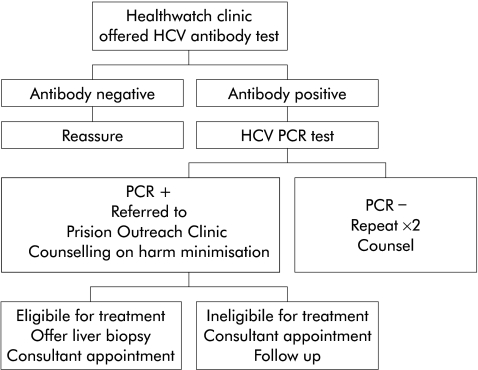
Figure 1
Figure 1
Flow chart depicting the management algorithm for hepatitis C virus (HCV) testing in the Isle of Wight Prisons. Prisoners were offered the opportunity to make appointments for confidential testing for antibodies to hepatitis viruses and human immunodeficiency virus. Pretest counselling was provided by the prison nurse, with the results fed back to prisoners by the prison nurse or a health advisor with post test counselling. Patients found to have a positive antibody test for HCV were informed that they had evidence of contact with HCV. A polymerase chain amplification (PCR) test for the presence of HCV viral RNA as a marker of ongoing infection was offered and a blood sample was obtained to test liver function. Prisoners positive for HCV by antibody testing but negative on a single PCR test were offered two further PCR tests. If repeated PCR tests were negative, the prisoner was informed that they were not currently infected with HCV and they were offered the opportunity of a consultation in the prison outreach clinic (POC). Prisoners who tested positive for HCV RNA were informed that they had ongoing HCV infection. They were counselled on harm minimisation with respect to alcohol consumption and continued injecting drug use, sharing razors and tooth brushes, personal grooming equipment, and sex. All patients testing positive for HCV by PCR were offered an appointment in the POC. New inmates were seen by a hepatology clinical nurse specialist, a clinical history obtained, and the results of the tests performed explained. The consultations follow a prescribed protocol and cover HCV transmission; the natural history of hepatitis C, including modifying factors and harm minimisation; indications for treatment; and the outcome of treatment, including beneficial and harmful effects of therapy. All patients with a positive HCV PCR test were considered eligible for a liver biopsy in order to determine prognosis and indication for therapy on the basis of the histological severity of liver disease. Patients were counselled about the indications for liver biopsy and the relevance of the histological findings in determining prognosis and taking decisions about treatment. Investigations were described and patients were informed of the adverse effects and complications of liver biopsy. Patients were considered to be ineligible for liver biopsy if they declined the offer of biopsy, if they had a history of significant psychiatric morbidity, or if they expressed the intention to return to chaotic drug or alcohol use or admitted to continuing drug use. Prior to liver biopsy, patients were seen in prison by the consultant at the POC and indications for biopsy were reviewed. Patients were subsequently transferred to Southampton University Hospital Trust for ultrasound guided liver biopsies which were performed during an overnight stay. The results of the biopsies were fed back to the patients by the consultant at the POC. The implications of the biopsy findings were discussed and indications for treatment were reviewed. Patients eligible for therapy were then offered treatment in prison where appropriate. For prisoners about to be released or seeking transfer, referral was made to an appropriate local specialist. Patients who were not eligible for a biopsy or therapy were offered annual follow up appointments in the POC. On release, all patients who had attended the POC were offered referral to a local specialist.
Figure 2
Figure 2
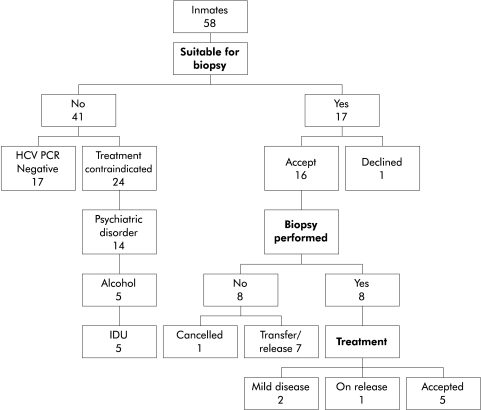
Outcome of prisoners accepting testing. The outcomes for the 58 prisoners who tested positive for hepatitis C virus (HCV) antibodies in the prison outreach clinic. Prisoners were managed according to the algorithm shown in figure 1 ▶. PCR, polymerase chain amplification; IDU, injecting drug users.

Comment in

References

    1. Department of Health. Hepatitis C Strategy for England, 2002. http://www.doh.gov.uk/cmo/hcvstrategy/77097dhhepcstrat.pdf (accessed 14 July 2003).
    1. Atrah HI, Ala FA, Ahmed MM, et al. Unexplained hepatitis C virus antibody seroconversion in established blood donors. Transfusion 1996;36:339–43. - PubMed
    1. Ward C, Tudor-Williams G, Cotzias T, et al. Prevalence of hepatitis C among pregnant women attending an inner London obstetric department: uptake and acceptability of named antenatal testing. Gut 2000;47:277–80. - PMC - PubMed
    1. Crofts N, Hopper JL, Milner R, et al. Blood-borne virus infections among Australian injecting drug users: implications for spread of HIV. Eur J Epidemiol 1994;10:687–94. - PubMed
    1. Goldberg D, Cameron S, McMenamin J. Hepatitis C virus antibody prevalence among injecting drug users in Glasgow has fallen but remains high. Commun Dis Public Health 1998;1:95–7. - PubMed

Publication types