. 2003 Sep;133(1):73-83.
doi: 10.1104/pp.103.022442.

Three distinct rice cellulose synthase catalytic subunit genes required for cellulose synthesis in the secondary wall

Affiliations

Three distinct rice cellulose synthase catalytic subunit genes required for cellulose synthesis in the secondary wall

Katsuyuki Tanaka et al. Plant Physiol. 2003 Sep.

Abstract

Several brittle culm mutations of rice (Oryza sativa) causing fragility of plant tissues have been identified genetically but not characterized at a molecular level. We show here that the genes responsible for three distinct brittle mutations of rice, induced by the insertion of the endogenous retrotransposon Tos17, correspond to CesA (cellulose synthase catalytic subunit) genes, OsCesA4, OsCesA7 and OsCesA9. Three CesA genes were expressed in seedlings, culms, premature panicles, and roots but not in mature leaves, and the expression profiles were almost identical among the three genes. Cellulose contents were dramatically decreased (8.9%-25.5% of the wild-type level) in the culms of null mutants of the three genes, indicating that these genes are not functionally redundant. Consistent with these results, cell walls in the cortical fiber cells were shown to be thinner in all the mutants than in wild-type plants. Based on these observations, the structure of a cellulose-synthesizing complex involved in the synthesis of the secondary cell wall is discussed.


Figures
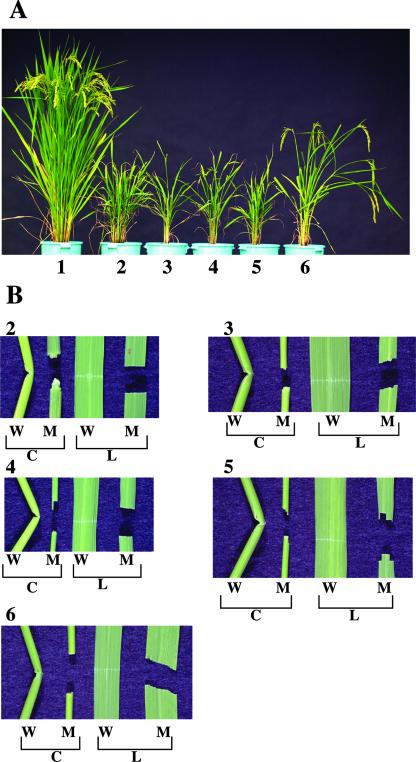
Figure 1.
Figure 1.
Phenotypes of the five rice brittle culm mutants. A, Plant heights of the wild-type plant (1) and the mutants of NC0259 (2), ND8759 (3), NE1031 (4), ND2395 (5), and NF1011 (6). B, Brittleness of culm (C) and mature leaf (L) from wild-type plant (W) and the mutant (M) as demonstrated by the damage caused by stressing between fingers. Numbers indicate mutant lines as described above. All culms were prepared from the second internodes.
Figure 2.
Figure 2.
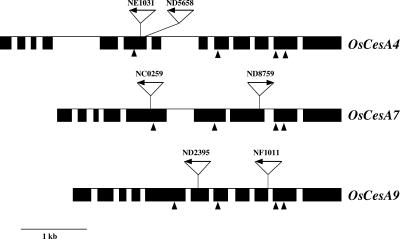
Genomic structure of three rice CesA genes, OsCesA4, -7, and -9. The black boxes and lines indicate exon and intron sequences, respectively. Scale bar = 1 kb. Arrows and numbers indicate the Tos17 insertion sites and mutant lines, respectively. Arrowheads indicate the positions of the four UDP-Glc-binding motifs shown in Figure 3.
Figure 3.
Figure 3.
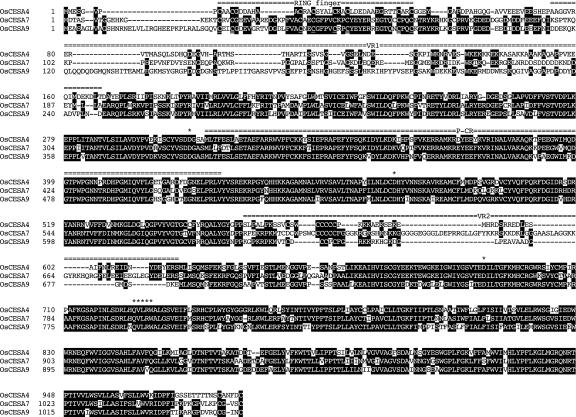
Alignment of the deduced amino acid sequences of OsCesA4, -7, and -9. Numbers indicate the position of the amino acid residues of each protein. The residues that are identical in at least two CesA genes are marked in reverse contrast letters. The three Asp (D) residues and the QxxRW motif that are critical for the function of CESA (see text) are marked by asterisks. The plant conserved region (P-CR), variable regions (VR1 and -2), and RING finger motif are also shown by overhead double-dashed lines.
Figure 4.
Figure 4.
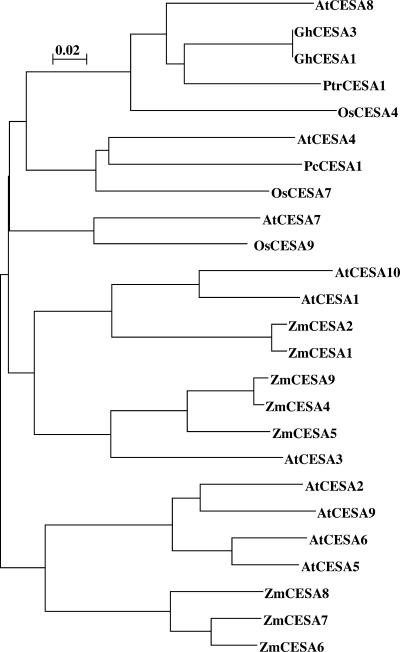
Phylogenetic relationships of CesA genes from higher plants. Phylogenetic trees based on the complete amino acid sequences were generated by using ClustalX (version 1.8), then bootstrapping at random number generator seed = 1,000 and number of bootstrap trials = 10,000. Plant species are as follows: At, Arabidopsis; Gc, cotton; Os, rice; Pc, Populus × canescens; Ptr, Populus tremuloides; and Zm, maize.
Figure 5.
Figure 5.
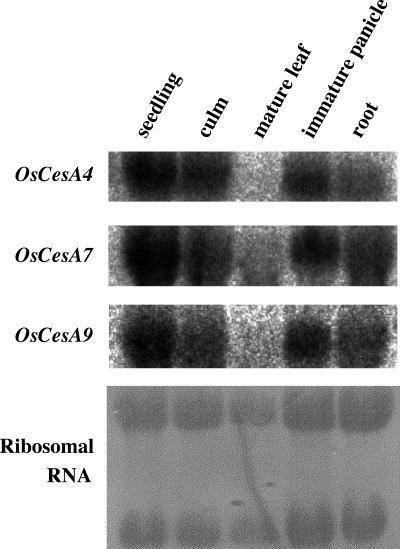
Expression profiles of OsCesA4, -7, and -9 in wild-type plant. Total RNAs were prepared from 2-week-old seedlings, culms, mature leaves, immature panicles, and roots and subjected to northern-blot analysis with probes for OsCesA4, -7, and -9. Equal loading of the gel was confirmed by staining of ribosomal RNA with methylene blue.
Figure 6.
Figure 6.
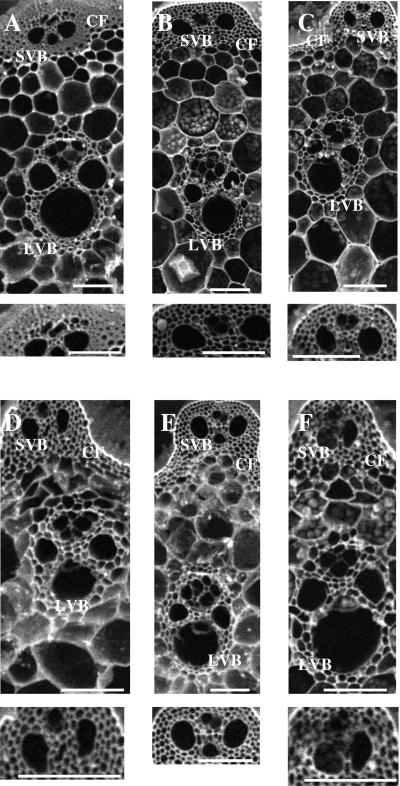
Scanning electron micrographs of cross sections of the culms of the wild-type plant and five brittle culm mutants. The cross sections were prepared from the second internode of wild-type plant (A) and the mutants of NC0259 (B), ND8759 (C), ND2395 (D), NF1011 (E), and NE1031 (F). White scale bars = 100 μm. CF, LVB, and SVB, Cortical fiber, large vascular bundle, and small vascular bundle, respectively. Lower panels show tissues of CF and SVB corresponding to upper panels of the wild-type plant and five mutants.

References

    1. Agrawal GK, Yamazaki M, Kobayashi M, Hirochika R, Miyao A, Hirochika H (2001) Screening of the rice viviparous mutants generated by endogenous retrotransposon Tos17 insertion: tagging of a zeaxanthin epoxidase gene and a novel OsTATC gene. Plant Physiol 125: 1248-1257 - PMC - PubMed
    1. Arioli T, Peng L, Betzner AS, Burn J, Wittke W, Herth W, Camilleri C, Hofte H, Plazinski J, Birch R et al. (1998) Molecular analysis of cellulose biosynthesis in Arabidopsis. Science 279: 717-720 - PubMed
    1. Beeckman T, Przemeck GKD, Stamatiou G, Lau R, Terryn N, Rycke RD, Inze D, Berleth T (2002) Genetic complexity of cellulose synthase A gene function in Arabidopsis embryogenesis. Plant Physiol 130: 1883-1893 - PMC - PubMed
    1. Briggs RW, Robert W (1966) Recognition and classification of some genetic traits in maize. J Hered 57: 35-42
    1. Carpita NC (1996) Structure and biogenesis of the cell walls of grasses. Annu Rev Plant Physiol Plant Mol Biol 47: 445-476 - PubMed

Publication types

MeSH terms