. 2003 Sep;133(1):253-62.
doi: 10.1104/pp.102.016766.

Does lowering glutamine synthetase activity in nodules modify nitrogen metabolism and growth of Lotus japonicus?

Affiliations

Does lowering glutamine synthetase activity in nodules modify nitrogen metabolism and growth of Lotus japonicus?

Judith Harrison et al. Plant Physiol. 2003 Sep.

Abstract

A cDNA encoding cytosolic glutamine synthetase (GS) from Lotus japonicus was fused in the antisense orientation relative to the nodule-specific LBC3 promoter of soybean (Glycine max) and introduced into L. japonicus via transformation with Agrobacterium tumefaciens. Among the 12 independent transformed lines into which the construct was introduced, some of them showed diminished levels of GS1 mRNA and lower levels of GS activity. Three of these lines were selected and their T(1) progeny was further analyzed both for plant biomass production and carbon and nitrogen (N) metabolites content under symbiotic N-fixing conditions. Analysis of these plants revealed an increase in fresh weight in nodules, roots and shoots. The reduction in GS activity was found to correlate with an increase in amino acid content of the nodules, which was primarily due to an increase in asparagine content. Thus, this study supports the hypothesis that when GS becomes limiting, other enzymes (e.g. asparagine synthetase) that have the capacity to assimilate ammonium may be important in controlling the flux of reduced N in temperate legumes such as L. japonicus. Whether these alternative metabolic pathways are important in the control of plant biomass production still remains to be fully elucidated.


Figures
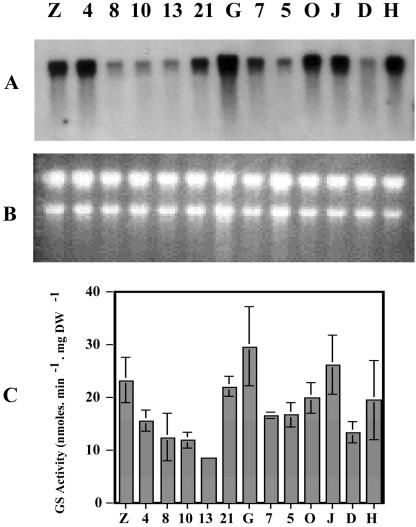
Figure 1.
Figure 1.
Expression of GS in nodules of primary transformants of L. japonicus expressing a GS1 antisense RNA under the control of the leghemoglobin promoter. A, Northern-blot analysis of GS1 mRNA in nodules of LBC3-LjGS1As L. japonicus primary transformants (10 μg of total RNA was loaded into each lane and probed with a 32P-labeled DNA fragment of the L. japonicus cDNA Ljgln1). B, Ethidium bromide-stained gel to show equal RNA loading in all lanes. C, GS activity of nodules of LBC3-LjGS1As L. japonicus primary transformants. Numbers and letters refer to the 12 transgenic lines that have been generated. G, Parental line Gifu used for transformation. Plants were grown under symbiotic N-fixing conditions for 4 weeks before harvest. Values are the mean ± se of three individual plants.
Figure 2.
Figure 2.
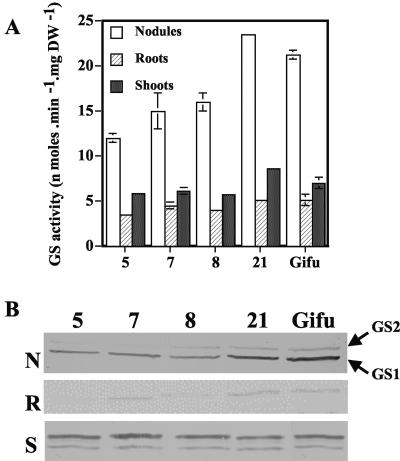
Expression of GS in three T1 transformants of L. japonicus expressing a GS1 antisense RNA in the nodules. The three T1 generation plants are lines 5, 7, and 8, and the controls are lines Gifu and 21. Plants were grown for 4 weeks under symbiotic N-fixing conditions before harvest. A, GS activity in nodules, roots, and shoots. Values are the mean ± se of eight individual plants. Bars for the se are not presented when they are below the thickness of the line. B, Western-blot analysis of GS subunits in nodules (N), roots (R), and shoots (S). GS1, Cytosolic GS subunits (molecular mass = 41 kD); GS2, Plastidic GS subunits (molecular mass = 45 kD). Ten micrograms of soluble protein was loaded into each lane.
Figure 3.
Figure 3.
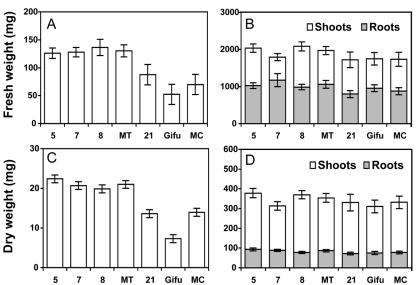
Fresh weight and dry weight accumulation in nodulated transgenic L. japonicus expressing a GS1 antisense RNA in the nodules. The three T1 generation plants are lines 5, 7, and 8, and the controls are lines Gifu and 21. A, Nodule fresh weight. B, Root and shoot fresh weight. C, Nodule dry weight D, Root and shoot dry weight. Plants were grown for 4 weeks under symbiotic N-fixing conditions before harvest. Values are the mean ± se of eight individual plants. MT is the mean of the three independent transformed plants. MC is the mean of the two control lines used in the study.
Figure 4.
Figure 4.
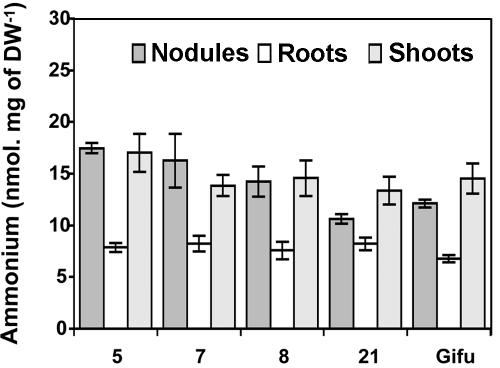
Free ammonium concentration of the nodules, roots, and shoots of L. japonicus expressing a GS1 antisense RNA in the nodules. The three T1 generation plants are lines 5, 7, and 8 and the controls lines Gifu and 21. Plants were grown for 4 weeks under symbiotic N-fixing conditions before harvest. Values are the mean ± se of eight individual plants.
Figure 5.
Figure 5.
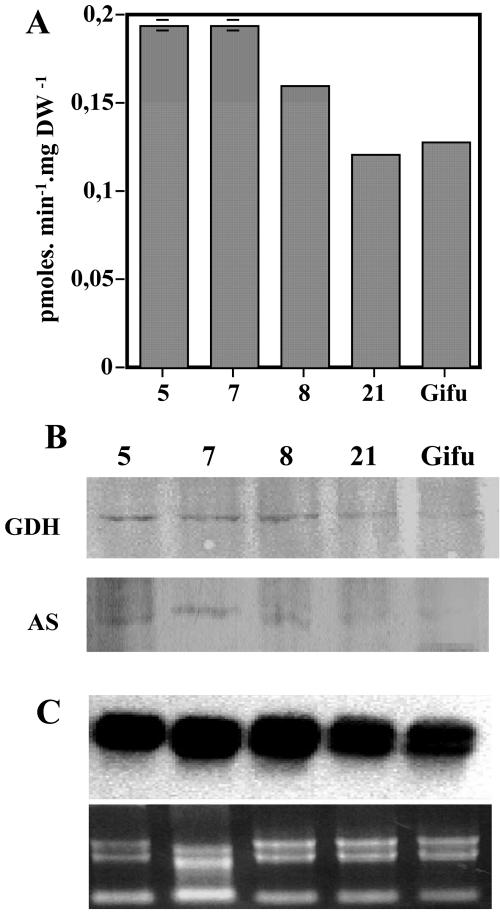
Expression of Glu dehydrogenase (GDH) and Asn synthetase (AS) in nodules of transgenic L. japonicus expressing a GS1 antisense RNA in the nodules. The three T1 generation plants are lines 5, 7, and 8, and the controls lines are Gifu and 21. Plants were grown for 4 weeks under symbiotic N-fixing conditions before harvest. A, NADH-dependent GDH activity. Values are the mean ± se of eight individual plants. Bars for the se are not presented when they are below the thickness of the line B. Western-blot analysis of GDH and AS proteins in nodules. Twenty micrograms of soluble protein was loaded into each lane. C, Northern-blot analysis of AS mRNA in nodules of LBC3-LjGS1As L. japonicus transformants (10 μg of total RNA was loaded into each lane and probed with a 32P-labeled DNA fragment of the L. japonicus cDNA LJAS2; Waterhouse et al., 1996). Below is shown an ethidium bromide-stained gel to show equal RNA loading in all lanes.
Figure 6.
Figure 6.
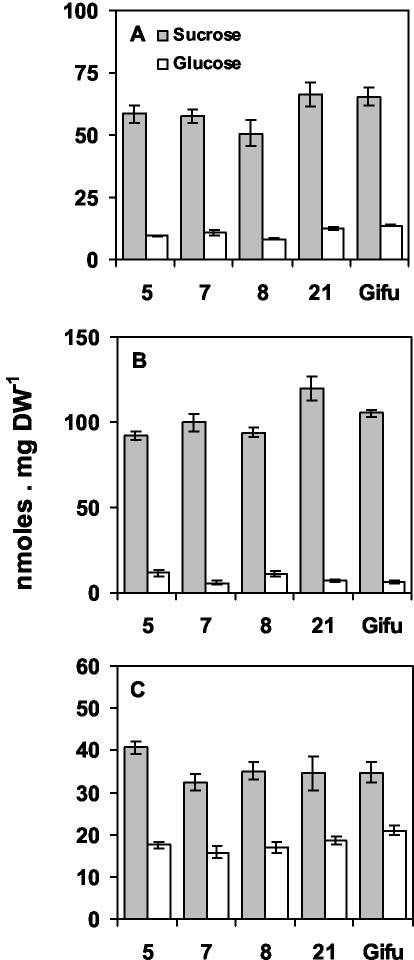
Carbohydrate content in transgenic L. japonicus expressing a GS1 antisense RNA in the nodules. Suc and Glc content of nodules (A), roots (B), and shoots (C) of lines 5, 7, and 8 and the two control lines 21 and Gifu. Plants were grown for 4 weeks under symbiotic N-fixing conditions before harvest. Values are the mean ± se of eight individual plants. Bars for the se are not presented when they are below the thickness of the line.

References

    1. Becker D, Kemper E, Schell J, Masterson R (1992a) New plant binary vectors with selectable markers located proximal to the left T-DNA border. Plant Mol Biol 20: 1195-1197 - PubMed
    1. Becker TW, Caboche M, Carrayol E, Hirel B (1992b) Nucleotide sequence of a tobacco cDNA encoding plastidic glutamine synthetase and light-inducibility, organ specificity and diurnal rhythmicity in the expression of the corresponding genes of tobacco and tomato. Plant Mol Biol 19: 367-379 - PubMed
    1. Beevers L (1976) Nitrogen Metabolism in Plants. EJW Barrington, AJ Willis, eds, E Arnold, London, UK pp 1-333
    1. Benes V, Pekny V, Skorepa J, Vrba J (1989) Impact of diffuse nitrate pollution sources on groundwater quality-some examples from Czechoslovakia. Environ Health Perspect 83: 5-24 - PMC - PubMed
    1. Bergmeyer HU (1974). Methods of Enzymatic Analysis, Vol. 3. Academic Press, New York, pp 1176-1179

Publication types

MeSH terms

LinkOut - more resources