


Reduction of stability of arabidopsis genomic and transgenic DNA-repeat sequences (microsatellites) by inactivation of AtMSH2 mismatch-repair function
- PMID: 12970498
- PMCID: PMC196609
- DOI: 10.1104/pp.103.023952
Reduction of stability of arabidopsis genomic and transgenic DNA-repeat sequences (microsatellites) by inactivation of AtMSH2 mismatch-repair function
Abstract
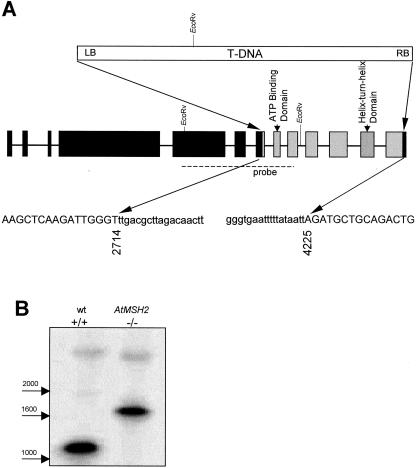
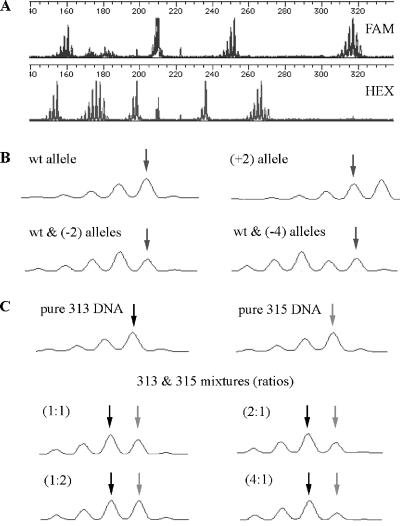
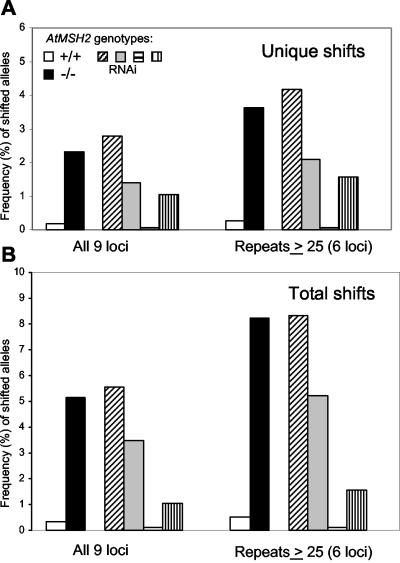
Highly conserved mismatch repair (MMR) systems promote genomic stability by correcting DNA replication errors, antagonizing homeologous recombination, and responding to various DNA lesions. Arabidopsis and other plants encode a suite of MMR protein orthologs, including MSH2, the constant component of various specialized eukaryotic mismatch recognition heterodimers. To study MMR roles in plant genomic stability, we used Arabidopsis AtMSH2::TDNA mutant SALK_002708 and AtMSH2 RNA-interference (RNAi) lines. AtMSH2::TDNA and RNAi lines show normal growth, development, and fertility. To analyze AtMSH2 effects on germ line DNA fidelity, we measured insertion-deletion mutation of dinucleotide-repeat sequences (microsatellite instability) at nine loci in 16 or more progeny of two to four different wild-type or AtMSH2-deficient plants. Scoring 992 total alleles revealed 23 (2.3%) unique and 51 (5.1%) total repeat length shifts ([+2], [-2], [+4], or [-4] bp). For the six longest repeat loci, the corresponding frequencies were 22/608 and 50/608. Two of four AtMSH2-RNAi plants showed similar microsatellite instability. In wild-type progeny, only one unique repeat length allele was found in 576 alleles tested. This endogenous microsatellite instability, shown for the first time in MMR-defective plants, is similar to that seen in MMR-defective yeast and mice, indicating that plants also use MMR to promote germ line fidelity. We used a frameshifted reporter transgene, (G)(7)GUS, to measure insertion-deletion reversion as blue-staining beta-glucuronidase-positive leaf spots. Reversion rates increased only 5-fold in AtMSH2::TDNA plants, considerably less than increases in MSH2-deficient yeast or mammalian cells for similar mononucleotide repeats. Thus, MMR-dependent error correction may be less stringent in differentiated leaf cells than in plant equivalents of germ line tissue.
Figures
References
-
- Ade J, Belzile F, Philippe H, Doutriaux M-P (1999) Four mismatch repair paralogues coexist in Arabidopsis thaliana: AtMSH2, AtMSH3, AtMSH6-1 and AtMSH6-2. Mol Gen Genet 262: 239-249 - PubMed
-
- Baker SM, Bronner CE, Zhang L, Plug AW, Robatzek M, Warren G, Elliott EA, Yu J, Ashley T, Arnheim N et al. (1995) Male mice defective in the DNA mismatch repair gene PMS2 exhibit abnormal chromosome synapsis in meiosis. Cell 82: 309-319 - PubMed
-
- Bell CJ, Ecker JR (1994) Assignment of 30 microsatellite loci to the linkage map of Arabidopsis. Genomics 19: 137-144 - PubMed
-
- Boyer JC, Yamada NA, Roques CN, Hatch SB, Riess K, Farber RA (2002) Sequence dependent instability of mononucleotide microsatellites in cultured mismatch repair proficient and deficient mammalian cells. Human Mol Genet 11: 707-713 - PubMed
Publication types
MeSH terms
Substances
Grants and funding
LinkOut - more resources
Full Text Sources
Other Literature Sources
Molecular Biology Databases
