Directed expression of the HIV-1 accessory protein Vpu in Drosophila fat-body cells inhibits Toll-dependent immune responses
- PMID: 12973300
- PMCID: PMC1326394
- DOI: 10.1038/sj.embor.embor936
Directed expression of the HIV-1 accessory protein Vpu in Drosophila fat-body cells inhibits Toll-dependent immune responses
Abstract
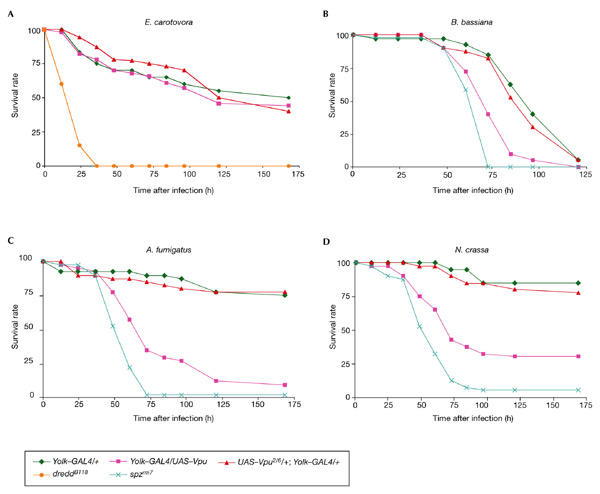
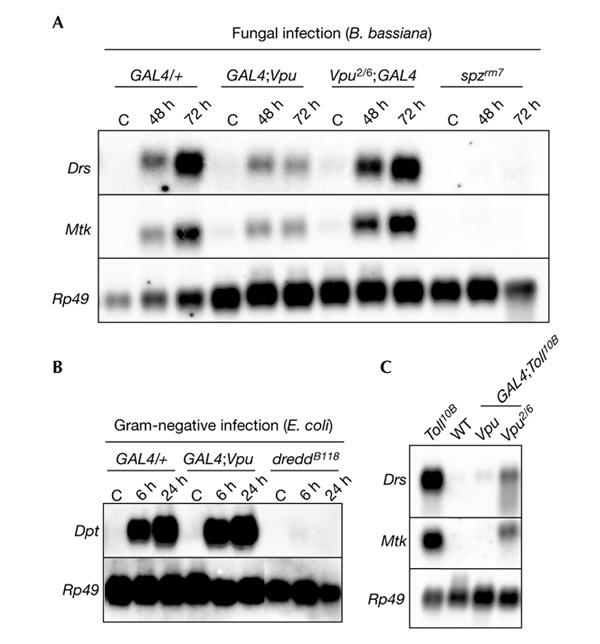
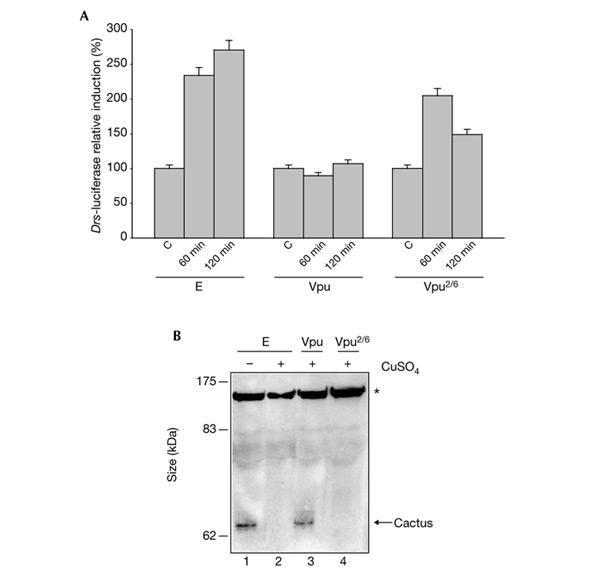
Human immunodeficiency virus 1 (HIV-1) expresses several accessory proteins that manipulate various host-cell processes to achieve optimum replicative efficiency. One of them, viral protein U (Vpu), has been shown to interfere with the cellular degradation machinery through interaction with SCF(beta-TrCP) complexes. To learn more about Vpu function in vivo, we used the genetically tractable fruit fly, Drosophila melanogaster. Our results show that the directed expression of Vpu, but not the non-phosphorylated form, Vpu2/6, in fat-body cells affects Drosophila antimicrobial responses. In flies, the Toll and Imd pathways regulate antimicrobial-peptide gene expression. We show that Vpu specifically affects Toll pathway activation by inhibiting Cactus degradation. Given the conservation of the Toll/nuclear factor-kappa B (NF-kappa B) signalling pathways between flies and mammals, our results suggest a function for Vpu in the inhibition of host NF-kappa B-mediated innate immune defences and provide a powerful genetic approach for studying Vpu inhibition of NF-kappa B signalling in vivo.
Figures

References
-
- Alexopoulou L., Holt A.C., Medzhitov R. & Flavell R.A. ( 2001) Recognition of double-stranded RNA and activation of NF-κB by Toll-like receptor 3. Nature, 413, 732–738. - PubMed
-
- Belvin M.P. & Anderson K.V. ( 1996) A conserved signaling pathway: the Drosophila toll–dorsal pathway. Annu. Rev. Cell Dev. Biol., 12, 393–416. - PubMed
-
- Bour S., Perrin C., Akari H. & Strebel K. ( 2001) The human immunodeficiency virus type 1 Vpu protein inhibits NF-κB activation by interfering with βTrCP-mediated degradation of IκB. J. Biol. Chem., 276, 15920–15928. - PubMed
-
- Doyle S. et al. ( 2002) IRF3 mediates a TLR3/TLR4-specific antiviral gene program. Immunity, 17, 251–263. - PubMed
Publication types
MeSH terms
Substances
LinkOut - more resources
Full Text Sources
Molecular Biology Databases