


Spironolactone inhibits production of proinflammatory cytokines, including tumour necrosis factor-alpha and interferon-gamma, and has potential in the treatment of arthritis
- PMID: 12974768
- PMCID: PMC1808828
- DOI: 10.1046/j.1365-2249.2003.02249.x
Spironolactone inhibits production of proinflammatory cytokines, including tumour necrosis factor-alpha and interferon-gamma, and has potential in the treatment of arthritis
Abstract
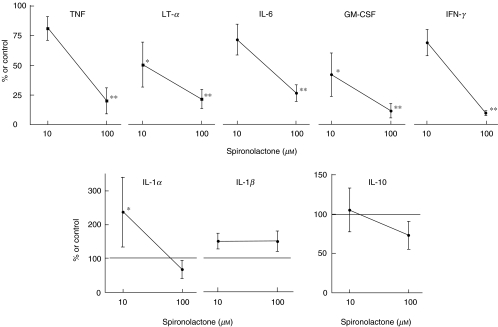
Evidence suggests that spironolactone, an aldosterone antagonist, has effects on many cell types independent of its binding to cytosolic mineralocorticoid receptors. We tested the effects of spironolactone on ex vivo-activated human blood leucocytes using gene expression analyses (GeneChip, 12,000 genes) and enzyme immunoassay for quantitating secreted pro- and anti-inflammatory cytokines. Furthermore, to evaluate the safety and efficacy of spironolactone as an anti-inflammatory drug 21 patients with rheumatoid arthritis (RA), juvenile idiopathic arthritis (JIA) or other arthritides were treated for up to 22 months with 1-3 mg/kg/day. Spironolactone, at in vivo attainable doses, markedly suppressed transcription of several proinflammatory cytokines and, accordingly, inhibited release of tumour necrosis factor, lymphotoxin, interferon-gamma, granulocyte-macrophage colony-stimulating factor and interleukin 6 (70-90% inhibition). Release of these cytokines was also suppressed when testing whole blood from RA patients receiving 50 mg spironolactone twice daily, indicating that pharmaceutical use of the drug may suppress the release of inflammatory cytokines. Spironolactone therapy was generally well tolerated, although treatment had to be stopped in two adults on concomitant methotrexate therapy. Sixteen patients (76%) responded favourably. American College of Rheumatology criteria (ACR)20 or better was achieved in six of nine RA patients; four reached ACR70. Eight of nine JIA patients improved. In conclusion, spironolactone inhibits production of several proinflammatory cytokines considered to be of pathogenic importance in many immunoinflammatory diseases and shows positive effect in patients with chronic arthritis. Its effect as an anti-inflammatory drug should be explored, because prolonged spironolactone therapy is reasonably safe and economically attractive compared with many modern anti-inflammatory therapies.
Figures
References
-
- Doggrell SA, Brown L. The spironolactone renaissance. Expert Opin Invest Drugs. 2001;10:943–54. - PubMed
-
- Sorrentino R, Autore G, Cirino G, et al. Effect of spironolactone and its metabolites on contractile property of isolated rat aorta rings. J Cardiovasc Pharmacol. 2000;36:230–5. - PubMed
-
- Pitt B, Zannad F, Remme WJ, et al. The effect of spironolactone on morbidity and mortality in patients with severe heart failure. N Engl J Med. 1999;341:709–17. Randomized Aldactone Evaluation Study Investigators. - PubMed
-
- Zannad F, Alla F, Dousset B, et al. Limitation of excessive extracellular matrix turnover may contribute to survival benefit of spironolactone therapy in patients with congestive heart failure: insights from the randomized aldactone evaluation study (RALES) Rales Investigators Circulation. 2000;102:2700–6. - PubMed
-
- Feldmann M, Brennan FM, Maini R. Cytokines in autoimmune disorders. Int Rev Immunol. 1998;17:217–28. - PubMed
Publication types
MeSH terms
Substances
LinkOut - more resources
Full Text Sources
Other Literature Sources
Medical
