. 2003 Oct;13(10):2325-32.
doi: 10.1101/gr.1332603. Epub 2003 Sep 15.

Adenoviral vectors expressing siRNAs for discovery and validation of gene function

Affiliations

Adenoviral vectors expressing siRNAs for discovery and validation of gene function

Gert-Jan Arts et al. Genome Res. 2003 Oct.

Abstract

RNA interference is a powerful tool for studying gene function and for drug target discovery in diverse organisms and cell types. In mammalian systems, small interfering RNAs (siRNAs), or DNA plasmids expressing these siRNAs, have been used to down-modulate gene expression. However, inefficient transfection protocols, in particular, for primary cell types, have hampered the use of these tools in disease-relevant cellular assays. To be able to use this technology for genome-wide function screening, a more robust transduction protocol, resulting in a longer duration of the knock-down effect, is required. Here, we describe the validation of adenoviral vectors that express hairpin RNAs that are further processed to siRNAs. Infection of cell lines, or primary human cells, with these viruses leads to an efficient, sequence-specific, and prolonged reduction of the corresponding target mRNA, resulting in a reduction of the encoded protein level in the cell. For knock-down of one of the targets, GalphaS, we have measured inhibition of ligand-dependent, G-protein-coupled signaling. It is expected that this technology will prove to be of great value in target validation and target discovery efforts.


Figures

Figure 1
Figure 1
Adenoviruses efficiently deliver and express siRNAs with multiple target sequences. (A) Schematic representation of the U6-promoter-based siRNA expression cassette integrated in the adenoviral vector. The starting G and the stretch of Ts present for efficient transcription purposes are indicated. The replication-competent adenoviral molecule based on serotype 5 (Ad5), lacking the E1 and the E2A regions, is generated in Per.C6/E2A packaging cells by homologous recombination. Not drawn to scale. (B) Predicted secondary structures of hairpin RNAs derived from the adenoviral U6-driven expression constructs. The structure with GNAS (guanine nucleotide-binding protein α stimulating activity polypeptide 1) target sequence CGATGTGACTGCCATCATC (corresponding to the lower strand in the hairpin structure) is given as example, as well as that of the mutant version GNASm with a point mutation at the central position (lower case) of the target sequence (CGATGTGACaGCCATCATC). The variable sequence in the hairpin RNA that is dependent on the target sequence is underlined. (C) Expression analysis of small RNAs by Northern blotting using denaturing 15% polyacrylamide gels. Samples were isolated 3 d postinfection from U2OS cells that were infected at m.o.i. 3000 with the various adenoviral constructs as indicated. The blots were hybridized with labeled oligonucleotides recognizing either the antisense strand of the target sequence (upper panel, sense probe) or sense strand of the target sequence (lower panel, antisense probe). (D) Real-time reverse transcriptase (RT)-PCR expression analyses measuring the endogenous mRNA levels for GNAS, IKBKB (IKKβ, inhibitor of κ light polypeptide gene enhancer in B-cells, kinase β), or M6PR (mannose-6-phosphate receptor) of samples derived from U2OS cells 3 d after infection at m.o.i. 3000 with the indicated siRNA expression viruses. Values are plotted relative to samples derived from cells infected with control virus Ad-siRNA-GL2 and are normalized to GAPD (GAPDH, glyceraldehyde-3-phosphate dehydrogenase) mRNA as an internal reference. Values are obtained from three independent infection experiments; error bars show standard deviation. (E) Comparison of Ad-siRNA-GNAS versus Ad-siRNA-GNASm vectors by real-time RT-PCR analyses on samples derived from U2OS cells infected at m.o.i. 3000 6 d postinfection. See Figure 1B for sequences. Shown are the representative results from two independent experiments. Error bars indicate high-low values.
Figure 2
Figure 2
Adenoviral siRNA expression reduces target mRNA levels in a time- and m.o.i.-dependent manner. (A) Northern blot analysis of adenoviral expression of siRNAs against GNAS (Ad-siRNA-GNAS) in U2OS cells (m.o.i. 3000) in a time course from day 1 to 10 postinfection (p.i.). The viruses were removed from the cells at day 3, and medium was refreshed at days 3, 6, and 8. Cells reached confluency at day 4. From day 8, cultures still appeared viable, although some cells detached. In spite of these observations, the RNA yield as well as the absolute Ct values of the GAPD mRNA did not show large variations between these samples, indicating no significant adverse effects during this long experiment. As control for equal loading of the gel, the results of rehybridization with a probe against endogenous U6 snRNA is given at the bottom. (B) Real-time RT-PCR expression analyses for GNAS mRNA of the same samples as used in panel A. Data were plotted relative to samples derived from uninfected cells. The results of the infections of Ad-siRNA-GNAS (solid bars) as well as for control virus (open bars) are given. As control virus, Ad-siRNA-GL2 is used for the data point of day 3, and Ad-siRNA-empty (a construct lacking a hairpin sequence downstream of the U6 promoter) for the other data points. The GNAS mRNA expression of each individual sample was normalized for GAPD. (C) Real-time PCR expression analysis for GNAS mRNA of samples derived from U2OS cells infected with Ad-siRNA-GNAS at m.o.i. 300, 1000, or 3000 harvested at 1, 2, 3, or 6 d postinfection. The values are plotted relative to samples derived from cells infected with control virus Ad-siRNAGL2 harvested at the same time points. Shown are representative results from independent experiments.
Figure 3
Figure 3
Adenoviral mediated knock-down in primary cell types. (A) Knock-down activity was measured for CHUK (IKKα, conserved helix-loop-helix ubiquitous kinase), IKBKB and GNAS at 3 and 6 d postinfection of primary keratinocytes (NHEK) at m.o.i. 500 using adenoviral siRNA expression constructs with a modified capsid. Analyses were performed by real-time RT-PCR as described. (B) Adenoviral knock-down activity was measured 6 d after infecting primary synoviocytes at m.o.i. 7500 for IKBKB and MMP2 (matrix metalloproteinase) using two constructs for each target. Analyses were performed as described. (C) Knock-down activity of siRNA-expressing adenoviruses (m.o.i. 1000) containing 13 different target sequences was analyzed in primary HUVEC cells (human umbilical vein endothelial cells). Relative mRNA expression levels were determined by real-time PCR analyses, normalized to internal GAPD values, and plotted relative to samples infected with Ad-siRNA-GL2 control viruses. Samples were obtained from HUVEC cells at two time points postinfection (3 or 6 d). For all eight mRNA targets, gene-specific real-time analysis was performed: PSEN1 (presenilin 1); CTSK (cathepsin K); ADAM10 (a disintegrin and metalloproteinase domain 10); CHUK; M6PR; BACE (β-site APP-cleaving enzyme); IKBKB; and GNAS.
Figure 4
Figure 4
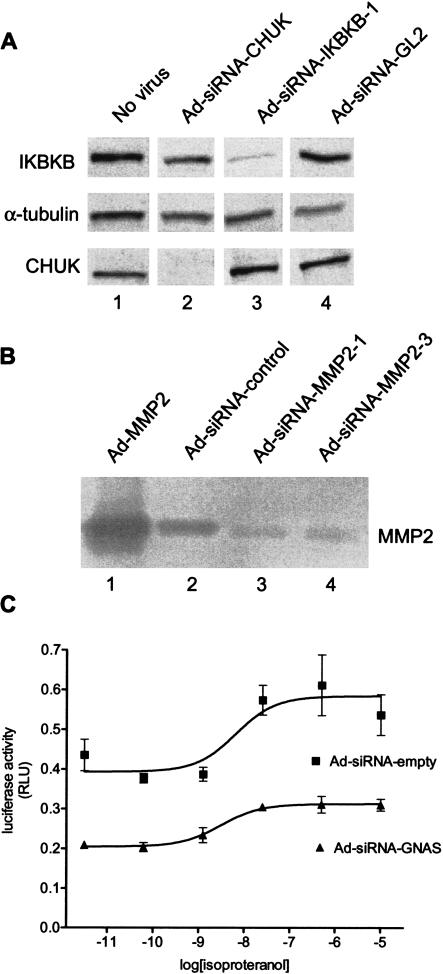
Adenoviral siRNA expression leads to reduction of the target protein. (A) Protein expression levels for CHUK (IKKα), IKBKB (IKKβ), and α-tubulin were detected by Western analysis of samples derived from U2OS cells 6 d after infection with Ad-siRNA-CHUK, Ad-siRNA-IKBKB-1, control virus Ad-siRNA-GL2, or from uninfected cells (no virus). The protein levels of CHUK and IKBKB were specifically reduced by the corresponding adenoviral knock-down construct. (B) The effect of adenoviral knock-down was determined at the level of protein activity. Gelatin-degrading activity of MMP2 was measured using 10% gelatin-zymogram gels. Supernatants of primary synoviocytes were analyzed 6 d after infection at m.o.i. 7500 with Ad-siRNA-MMP2-1 and Ad-siRNA-MMP2-3, and compared with Ad-siRNA-control, a virus containing a target sequence against M6PR. For reference, an adenoviral cDNA expression construct encoding the MMP2 protein (Ad-MMP2) was used and demonstrated the identity of the MMP2 band. The inverted image of the zymogram is presented. (C) Knock-down of GαS (encoded by GNAS) by Ad-siRNAGNAS results in reduction of β2-adrenergic receptor signaling. HEK293 cells were infected (m.o.i. 150) with Ad-siRNA-GNAS or control virus Ad-siRNA-empty for 3 d. Subsequently, the medium was refreshed and the cells were reinfected (m.o.i. 300) with a reporter adenovirus encoding a luciferase gene under control of the cAMP-responsive element (CRE)-dependent promoter and incubated for 2 extra days. The endogenously expressed β2-adrenergic receptor is stimulated with increasing concentrations of the agonist isoproteranol. Signaling via the active GαS subunit results in increased cAMP levels and subsequently activates the CRE-dependent promoter. The luciferase activity (indicated on the Y-axis as relative light units; RLU) was measured 6 h after stimulation with the agonist. The isoproteranol concentration (in moles per liter) is plotted as logarithmic values on the X-axis. pEC50 values remain largely unaffected (values between 8.2 and 8.5). Error bars indicate the standard deviation values based on 3 data points.

References

    1. Ashrafi, K., Chang, F.Y., Watts, J.L., Fraser, A.G., Kamath, R.S., Ahringer, J., and Ruvkun, G. 2003. Genome-wide RNAi analysis of Caenorhabditis elegans fat regulatory genes. Nature 421: 268-272. - PubMed
    1. Bernstein, E., Denli, A.M., and Hannon, G.J. 2001. The rest is silence. RNA 7: 1509-1521. - PMC - PubMed
    1. Brummelkamp, T.R., Bernards, R., and Agami, R. 2002a. A system for stable expression of short interfering RNAs in mammalian cells. Science 296: 550-553. - PubMed
    1. ____. 2002b. Stable suppression of tumorigenicity by virus-mediated RNA interference. Cancer Cell 2: 243-247. - PubMed
    1. Devroe, E. and Silver, P.A. 2002. Retrovirus-delivered siRNA. BMC Biotechnol. 2: 15. - PMC - PubMed

Publication types

MeSH terms