


Comment
doi: 10.1172/JCI19799.
Turnover of lymphocytes and conceptual paradigms in HIV infection
Affiliations
- PMID: 12975464
- PMCID: PMC193676
- DOI: 10.1172/JCI19799
Item in Clipboard
Comment
Turnover of lymphocytes and conceptual paradigms in HIV infection
J Clin Invest.
2003 Sep.
Abstract
Prevailing views concerning the pathogenic mechanisms of AIDS have shifted from models that focus primarily on direct HIV-mediated killing of CD4+ T cells to models that emphasize the pathogenic role of generalized immune system activation. The observation that increases in T cell turnover seen in HIV-infected individuals primarily reflect increased proliferation of effector-memory T cells supports the concept that chronic immune activation plays a prominent, if not predominant, role in the pathogenesis of AIDS.
Figures
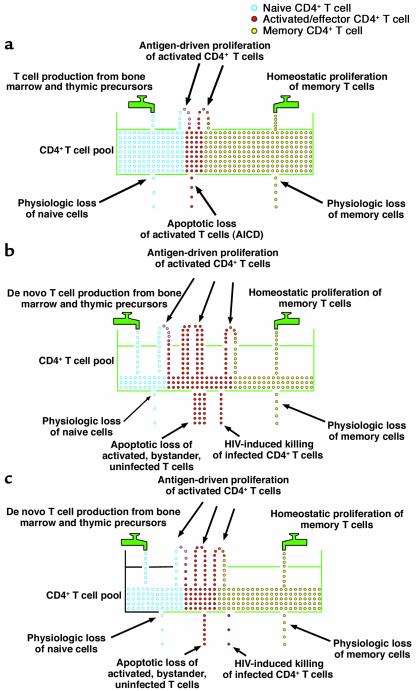
Turnover of specific CD4+ T cell subpopulations (naive versus central memory versus effector memory) during HIV infection. (a) Uninfected controls. (b) HIV-infected individuals. (c) HIV-infected HAART-treated individuals. We present this model, which integrates of the work of Hellerstein et al. (18) with concepts emerging from references cited in this Commentary, as well as research not cited because of space limitations.
Comment on
-
Subpopulations of long-lived and short-lived T cells in advanced HIV-1 infection.J Clin Invest. 2003 Sep;112(6):956-66. doi: 10.1172/JCI17533. J Clin Invest. 2003. PMID: 12975480 Free PMC article.
References
-
- Ho DD, et al. Rapid turnover of plasma virions and CD4 lymphocytes in HIV-1 infection. Nature. 1995;373:123–126. - PubMed
-
- Wei X, et al. Viral dynamics in human immunodeficiency virus type 1 infection. Nature. 1995;373:117–122. - PubMed
-
- Perelson AS, Neumann AU, Markowitz M, Leonard JM, Ho DD. HIV-1 dynamics in vivo: virion clearance rate, infected cell life-span, and viral generation time. Science. 1996;271:1582–1586. - PubMed
-
- Mellors JW, et al. Prognosis in HIV-1 infection predicted by the quantity of virus in plasma. Science. 1996;272:1167–1170. - PubMed
-
- Finkel TH, et al. Apoptosis occurs predominantly in bystander cells and not in productively infected cells of HIV- and SIV-infected lymph nodes. Nat. Med. 1995;1:129–134. - PubMed
Publication types
MeSH terms
LinkOut - more resources
Full Text Sources
Medical
Research Materials
