Plasma t-PA and PAl-1 antigen concentrations in non-insulin dependent diabetic patients: effects of treatment modality on fibrinolysis
- PMID: 1306076
- PMCID: PMC4532107
- DOI: 10.3904/kjim.1992.7.2.81
Plasma t-PA and PAl-1 antigen concentrations in non-insulin dependent diabetic patients: effects of treatment modality on fibrinolysis
Abstract
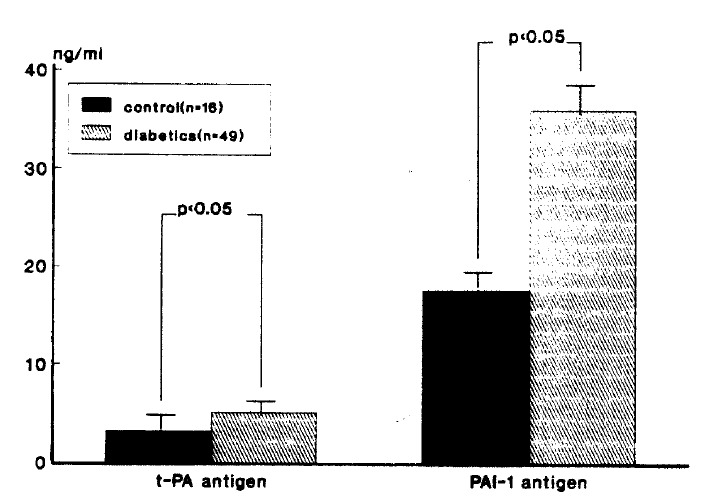
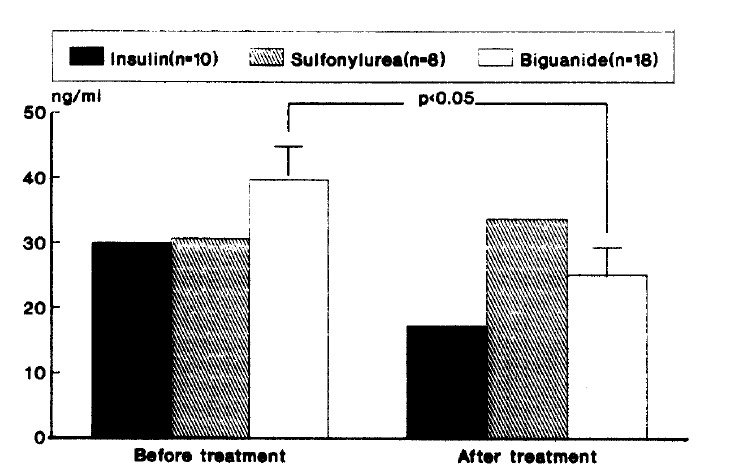
Basal plasma tissue type plasminogen activator (t-PA) and plasminogen activator inhibitor type 1 (PAl-1) antigen levels were studied in 49 non-insulin dependent diabetic patients (23 men, 26 women: ages 51.3 +/- 14.9 years) and 16 age matched non-diabetic subjects (9 men, 7 women: ages 49.8 +/- 12.2 years) as a control group. Compared to a control group, the diabetic patients had a significantly higher mean t-PA antigen (5.15 +/- 3.02 vs 3.20 +/- 2.30 ng/ml) and PAl-1 antigen (35.89 +/- 18.59 vs 17.60 +/- 15.36 ng/ml) levels (p < 0.05). Plasma t-PA antigen level was not influenced by each treatment modality. There was a significant decrease of plasma PAl-1 antigen level after Metformin administration compared to that of before Metformin administration (39.74 +/- 19.39 vs 25.14 +/- 16.18 ng/ml) (p < 0.05), and the insulin-treated group showed a tendency for a decrease of plasma PAl-1 antigen levels after insulin administration but this did not reach statistical significance (29.93 +/- 15.37 vs 17.32 +/- 10.60 ng/ml). Sulfonylurea did not change both plasma t-PA and PAl-1 antigen levels. In conclusion, diabetic patients have high t-PA and PAl-1 antigen levels. Biguanide reduced plasma PAl-1 antigen levels, which might play some helpful role in the improvement of chronic complications in NIDDM.
Figures
References
-
- Crofford OB. The long-range plan to combined diabetes. Vol. 1. US Department of Health, Education and Welfare, Public Health Service, National Institute of Health; 1976. Report of the National Commission on Diabetes. Publication NO. (NIH) 76-1018.
-
- Sprengers ED, Kluft C. Plasminogen activator inhibitors. Blood. 1987;69:381. - PubMed
-
- Almer LO. Fibrinolytic disorders in diabetes mellitus. Diabete & Metabolism. 1988;14:519.
-
- Auwerx J, Bouillon R, Collen D, Goboers J. Tissue-type plasminogen activator antigen and plasminogen activator inhibitor in diabetes mellitus. Arteriosclerosis. 1988;8:68. - PubMed
MeSH terms
Substances
LinkOut - more resources
Full Text Sources
Medical