. 2003 Sep 30;100(20):11759-64.
doi: 10.1073/pnas.1932318100. Epub 2003 Sep 16.

Calsequestrin determines the functional size and stability of cardiac intracellular calcium stores: Mechanism for hereditary arrhythmia

Affiliations

Calsequestrin determines the functional size and stability of cardiac intracellular calcium stores: Mechanism for hereditary arrhythmia

Dmitry Terentyev et al. Proc Natl Acad Sci U S A. .

Abstract

Calsequestrin is a high-capacity Ca-binding protein expressed inside the sarcoplasmic reticulum (SR), an intracellular Ca release and storage organelle in muscle. Mutations in the cardiac calsequestrin gene (CSQ2) have been linked to arrhythmias and sudden death. We have used Ca-imaging and patch-clamp methods in combination with adenoviral gene transfer strategies to explore the function of CSQ2 in adult rat heart cells. By increasing or decreasing CSQ2 levels, we showed that CSQ2 not only determines the Ca storage capacity of the SR but also positively controls the amount of Ca released from this organelle during excitation-contraction coupling. CSQ2 controls Ca release by prolonging the duration of Ca fluxes through the SR Ca-release sites. In addition, the dynamics of functional restitution of Ca-release sites after Ca discharge were prolonged when CSQ2 levels were elevated and accelerated in the presence of lowered CSQ2 protein levels. Furthermore, profound disturbances in rhythmic Ca transients in myocytes undergoing periodic electrical stimulation were observed when CSQ2 levels were reduced. We conclude that CSQ2 is a key determinant of the functional size and stability of SR Ca stores in cardiac muscle. CSQ2 appears to exert its effects by influencing the local luminal Ca concentration-dependent gating of the Ca-release channels and by acting as both a reservoir and a sink for Ca in SR. The abnormal restitution of Ca-release channels in the presence of reduced CSQ2 levels provides a plausible explanation for ventricular arrhythmia associated with mutations of CSQ2.


Figures
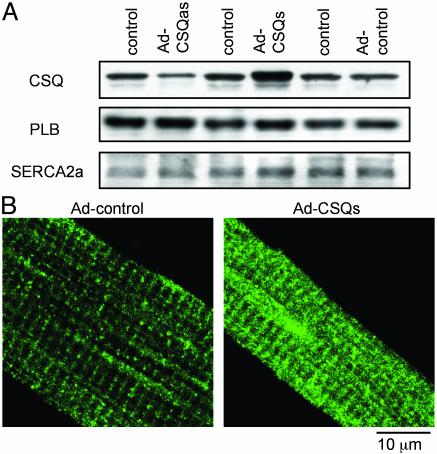
Fig. 1.
Fig. 1.
Expression and localization of CSQ2 in myocytes infected with control, CSQ2 sense (CSQs), and CSQ2 antisense (CSQas) adenoviral vectors. (A) Representative immunoblots detecting CSQ, phospholamban (PLB), and SERCA2a in myocytes infected with Ad-control, Ad-CSQs, and Ad-CSQas. (B) Immunofluorescence localization of CSQ2 in myocytes infected with Adcontrol and Ad-CSQs vectors. All measurements were performed 48–56 h after infection of myocytes with the adenoviral constructs.
Fig. 2.
Fig. 2.
Effects of increased and reduced CSQ2 levels on SR Ca content on caffeine- and ICa-induced Ca transients in rat ventricular myocytes. (A) Caffeine-induced intracellular Ca transients (upper traces) and INCX (lower traces) in myocytes infected with Ad-control, Ad-CSQs, and Ad-CSQas vectors. The average amplitudes (F/F0) of caffeine-induced Ca transients were 2.9 ± 0.3, 5.4 ± 0.6, 2.0 ± 0.3; integrals of INCX density were 0.54 ± 0.08, 1.22 ± 0.12, and 0.28 ± 0.05 pC/pF, for Ad-control, Ad-CSQs, and Ad-CSQas, respectively (n = 6–10). (B) Recordings of Ca transients (top traces) along with their first derivative (dF/dt, middle traces) and recordings of ICa (bottom traces) in cardiomyocytes infected with Ad-control, Ad-CSQs, and Ad-CSQas vectors. (C and D) Voltage dependence of Ca transients (C) and ICa (D) in myocytes infected with Ad-control, Ad-CSQs, and Ad-CSQas vectors (n for each point ranged from 6 to 10). The half-time decays of ICa at 0mV (t1/2) were 18 ± 4, 20 ± 6, and 17 ± 5 ms, n ≥ 6, for control, CSQs, and CSQas, respectively. All measurements were performed 48–56 h after infection of myocytes with the Ad constructs.
Fig. 3.
Fig. 3.
Effects of increased and reduced CSQ2 levels on properties of Ca sparks in permeabilized myocytes. (A) Representative line-scan images of Ca sparks acquired in myocytes infected with Ad-control, Ad-CSQs, and Ad-CSQas vectors. The average amplitudes (ΔF/F0) of sparks were 1.63 ± 0.01, 2.26 ± 0.03, and 1.32 ± 0.01 (n = 1,374–1,515); spatiotemporal frequencies were 4.79 ± 0.01, 4.76 ± 0.04, and 4.80 ± 0.02 events per second per 100 μm for control, CSQs, and CSQas cells, respectively. (B) Surface plots of averaged Ca sparks (3) in myocytes infected with Ad-control (42 events), Ad-CSQs (26 events), and Ad-CSQas (49 events) vectors. (C) Temporal profiles of averaged Ca sparks presented in A at the spatial peak. (Inset) Traces were scaled to the same peak amplitude. (D) The first derivative of the F/F0 traces shown in B.(E) Histograms of the rise times of individual Ca sparks in cells infected with Ad-control, Ad-CSQs, and Ad-CSQas vectors. The average rise times were 7.89 ± 0.01, 13.61 ± 0.02, and 6.32 ± 0.01 ms, for control, CSQs, and CSQas myocytes, respectively. All experiments were performed 48–56 h after infection of myocytes with the Ad constructs.
Fig. 4.
Fig. 4.
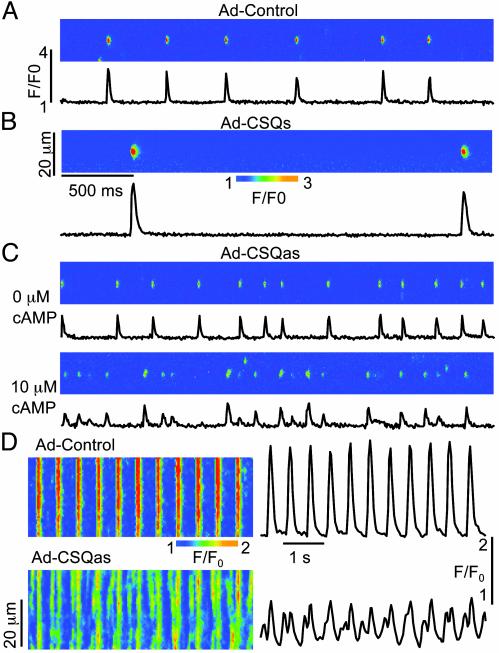
Effects of altered CSQ2 levels on rhythmic Ca transients and restitution behavior of Ca-release sites. (AC) Images of repetitive Ca sparks measured in the presence of 10 nM imperatoxin A in a control myocyte (A), a myocyte overexpressing CSQ2 (B), and a myocyte with reduced CSQ2 levels (C) in the absence (Upper) and in the presence (Lower) of 10 μM cAMP. All measurements were performed 48–56 h after infection with Ad-control, Ad-CSQs, and Ad-CSQas vectors. (D) Line-scan images along with averaged temporal profiles acquired in a control myocyte and in a myocyte with reduced CSQ2 levels stimulated at 2 Hz in the presence of 0.5 μM isoproterenol in the bathing solution.
Fig. 5.
Fig. 5.
Illustration of the effects of increased and reduced CSQ2 levels on functional properties of the SR Ca store. The functional size of the SR Ca stores is determined by the level of CSQ2. The SR Ca-release channel is positively controlled by the free luminal [Ca] through the luminal Ca sensor. Increasing CSQ2 levels augments the amount of Ca released from SR by delaying the luminal [Ca]-dependent closure of the RyR channels. Reducing CSQ2 produces an opposite effect. After its discharge, the SR Ca store is refilled by SERCA. The store is functionally recharged when luminal Ca is reassociated with the luminal Ca sensor. Increased CSQ2 levels prolong the time required for functional recharging of the store, whereas reduced CSQ2 levels shorten the recovery. In CSQ2-underexpressing cells the RyRs are prone to premature activation. Increasing SERCA activity by adrenergic stimulation further accelerates recharging of the Ca store, providing an explanation for the role of catecholamines in triggering episodes of CPVT. JSR, junctional SR.

References

    1. Fabiato, A. (1985) J. Gen. Physiol. 85, 247–289. - PMC - PubMed
    1. Bers, D. M. (2002) Nature 415, 198–205. - PubMed
    1. Terentyev, D., Viatchenko-Karpinski, S., Valdivia, H. H., Escobar, A. L. & Györke, S. (2002) Circ. Res. 91, 414–420. - PubMed
    1. Kass, R. S. & Tsien, R. W. (1982) Biophys. J. 38, 259–269. - PMC - PubMed
    1. Allen, D. G., Eisner, D. A. & Orchard, C. H. (1984) J. Physiol. 352, 113–128. - PMC - PubMed

Publication types